


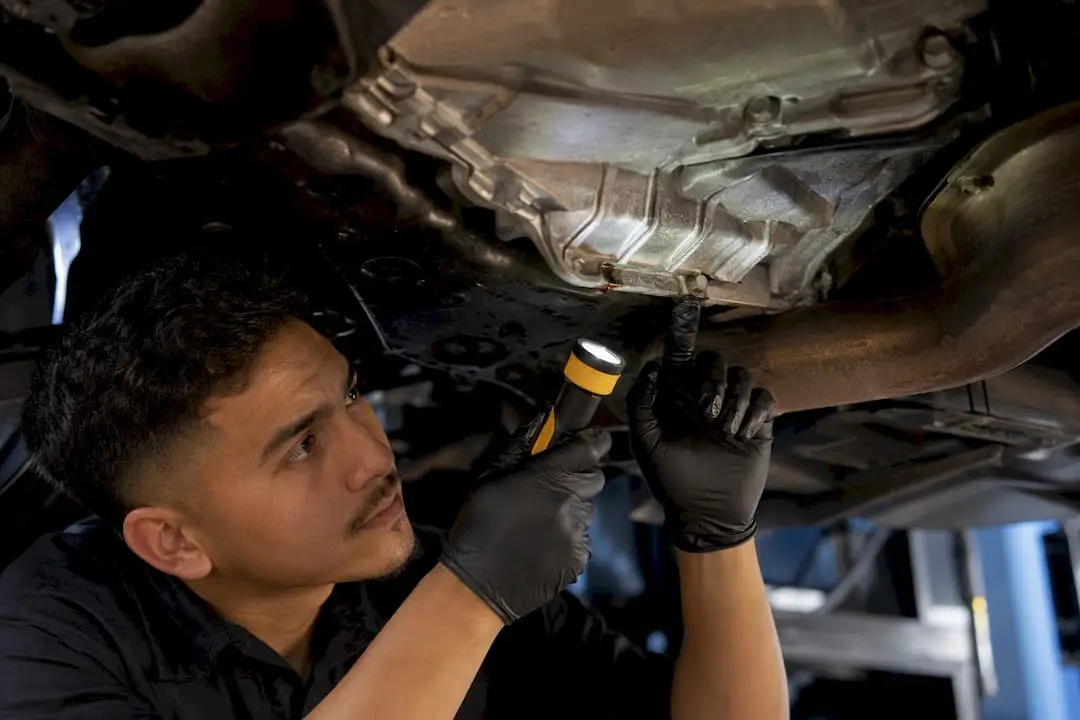
If you’ve found a reddish or brown puddle under your car, it’s likely a transmission fluid leak, and the right move depends on what you see: a small spot means you can drive carefully to a shop soon, but active dripping, a burning smell, or slipping gears means you should stop and call for a tow. Waiting too long turns a cheap gasket fix into an expensive rebuild.
TL;DR:
- Small transmission fluid leaks can often be monitored and repaired, but active dripping or slipping gears require immediate towing to prevent costly damage.
- Transmission fluid darkens with age, feels slicker than engine oil, and typically leaks from pan gaskets, cooler lines, or seals, with repair costs ranging from $75 to over $1,500 depending on severity.
- Checking for leaks involves simple card tests, fluid level inspection, and potential UV dye use, but internal leaks need professional pressure tests and pan inspections.
- Preventive measures include regular fluid checks, inspecting cooler lines after impacts, and following manufacturer guidelines to extend the transmission’s lifespan.
- Always seek professional diagnostics if the fluid appears milky, foamy, or if metal particles are found, as these signs indicate serious internal issues needing extensive repairs.
Table of Contents
- What Does a Transmission Fluid Leak Look Like?
- Where Do Transmission Fluid Leaks Usually Start?
- Can You Drive With a Transmission Fluid Leak?
- How Do You Diagnose a Transmission Fluid Leak Yourself?
- What Does It Cost to Fix a Transmission Fluid Leak?
- How Can You Prevent a Transmission Fluid Leak?
- When Should You Call a Professional for a Transmission Leak?
- How We Approach Transmission Fluid Leaks
- Book a Transmission Fluid Leak Diagnosis
- Sources
- FAQ
What Does a Transmission Fluid Leak Look Like?
Fresh transmission fluid runs bright red or pink, but as it ages it darkens toward brown, and either way it feels oily and slippery between your fingers, with a faint petroleum smell that’s sometimes described as slightly sweet. That’s a useful distinction, because transmission fluid darkens with age and behaves differently from other automotive fluids, which helps you rule out coolant (usually green, orange, or pink but watery and sweet smelling) or engine oil (dark brown to black, thicker, less slippery).
Here’s a quick way to confirm what you’re dealing with:
- Lay a clean sheet of cardboard or white paper under the car overnight and check the color and texture of any drips in the morning.
- Note where the puddle forms. Fluid centered near the middle of the vehicle usually points to the transmission pan or cooler lines, not the engine.
- Rub a small sample between two fingers. Transmission fluid feels notably slicker than engine oil.
- If your vehicle has a dipstick, pull it and check the fluid level and color against the specs in your owner’s manual.
Pro Tip: Many newer vehicles use sealed transmissions with no dipstick. If yours is one of them, check the fluid level at a shop with a lift, since checking from underneath is the only reliable method.
Where Do Transmission Fluid Leaks Usually Start?
Most leaks trace back to a handful of predictable spots, and where the fluid appears often tells you what failed before a technician even looks underneath. Leak points typically include the pan gasket, cooler lines, axle seals, torque converter seal, and cracked housings.
- Pan gasket or drain plug: The most common and cheapest leak to fix, usually showing as a slow drip directly below the transmission pan.
- Cooler lines: These metal or rubber lines run between the transmission and the radiator, and road debris or corrosion can puncture them. If you notice pinkish, milky, or foamy fluid mixed into your coolant, that mixing points to a failed radiator cooler and calls for an immediate stop.
- Axle or output seals: These sit where the axle exits the transmission housing and tend to leak after high mileage or worn CV joints.
- Front pump or torque converter seal: A leak here often shows up near the front of the transmission, close to the engine, and usually signals more involved labor.
- Cracked pan or housing: Impact damage from road debris or a curb strike can crack the housing itself, leading to a fast, obvious leak rather than a slow seep.
Can You Drive With a Transmission Fluid Leak?
Whether you can safely drive comes down to how the fluid is behaving, not just whether you see a spot on the driveway. A slow seep with normal shifting is usually fine for a short trip to the shop, but active dripping, slipping, or foaming fluid means the vehicle needs to be towed rather than driven.
Use this quick framework before you turn the key:
- Check the ground. A small, dry spot from yesterday with no fresh drip today usually means you can monitor it and schedule a visit soon.
- Check your shifting. If gears engage normally and there’s no burning smell, a short, careful drive to a nearby shop is typically acceptable.
- Check for red flags. A burning smell, visible smoke, fluid actively streaming, or the transmission slipping or refusing to engage means stop immediately and call for a tow.
| Signs Observed | Recommended Action |
|---|---|
| Small dry spot, normal shifting | Monitor, schedule service soon |
| Slow seep, no smell, shifts fine | Short drive to shop is acceptable |
| Burning smell, smoke, or streaming fluid | Stop driving, call for a tow |
| Slipping, delayed engagement, milky fluid | Stop driving, call for a tow |
The reason this matters so much mechanically is simple: transmissions rely on fluid for hydraulic pressure, not just lubrication. Once the level drops too low, the clutches inside can’t engage properly, and that slipping generates heat that damages components a fresh gasket can’t fix.
How Do You Diagnose a Transmission Fluid Leak Yourself?
A methodical check at home can often tell you what a shop will confirm later, and it costs you nothing but a clean rag and some patience. Locating drips with cardboard, checking fluid level, and rechecking after a short drive are standard first steps.
- Run the cardboard test. Park on level ground overnight with cardboard underneath, then check for color, location, and drip pattern in the morning.
- Check the fluid level and color against your owner’s manual specs, using the dipstick if your vehicle has one.
- Clean the suspected area with degreaser so you can see fresh fluid clearly rather than guessing at old residue.
- Drive a short distance, then park and recheck the same spot to confirm the leak is active and see how much fluid accumulates.
- Use a UV dye kit if the source still isn’t obvious. These kits typically run $15 to $30 and let you spot the exact leak point with a UV flashlight after a short drive.
Pro Tip: If you’re getting under the vehicle yourself, always use jack stands rather than relying on a jack alone, and never work under a car supported only by a floor jack.
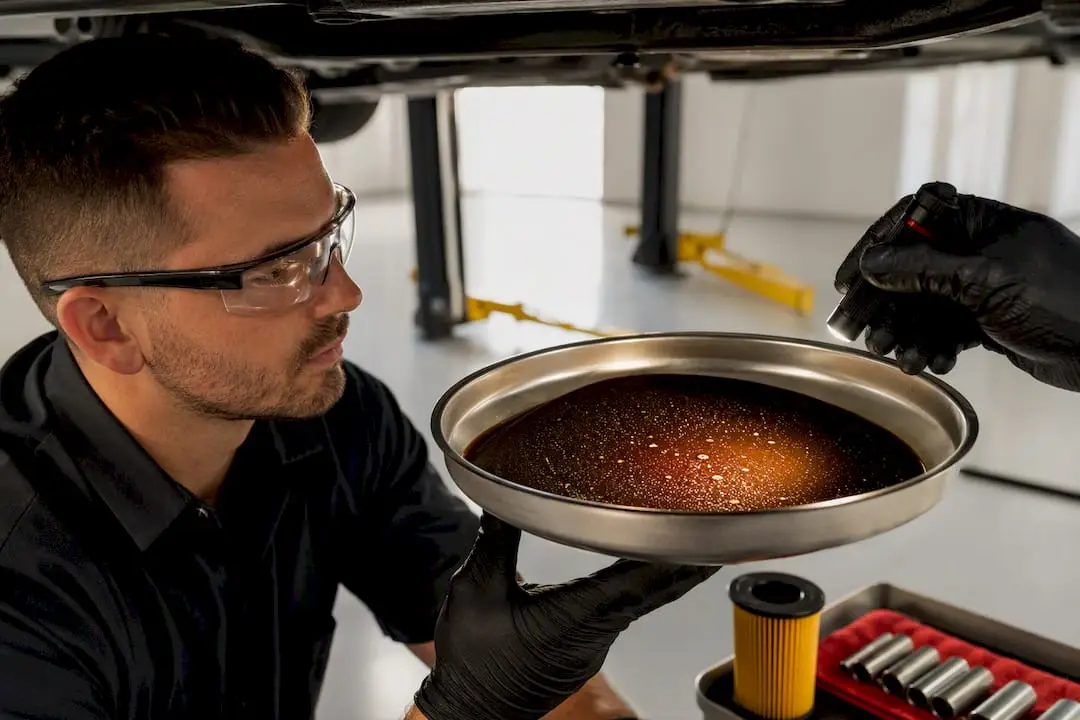
A professional shop goes further than you can in the driveway. Technicians typically run pressure tests to isolate slow leaks, drop the pan to inspect the gasket and filter directly, and check the drained fluid for metal shavings or a burnt smell. Finding metal particles in the fluid is a serious sign, since it usually shifts the conversation from a simple seal repair toward a full internal inspection or rebuild.
What Does It Cost to Fix a Transmission Fluid Leak?
Cost depends entirely on where the leak starts, and the range is wide because a gasket job and an internal rebuild are two completely different repairs wearing the same name. Typical repair costs run from around $75 for a simple pan gasket to well over $1,500 for internal seal or torque converter work.
- Pan gasket or drain plug: roughly $75 to $350, one of the most affordable and common fixes.
- Cooler line or hose replacement: roughly $100 to $300, depending on accessibility.
- Axle or output seal replacement: roughly $150 to $600, since it often involves removing the axle.
- Front pump, torque converter, or internal seal repair: $600 to $1,500 or more, because it usually requires partial or full transmission removal.
Certain warning signs push costs even higher. Milky or foamy fluid from coolant contamination often means the radiator’s transmission cooler has failed internally, which can require both a radiator replacement and a full fluid flush to clear out contaminated ATF. Metal flakes or a burnt smell in the fluid are similarly serious, since they suggest internal wear that a simple external seal won’t solve.
Labor rates, vehicle make, and how accessible the transmission is on your particular model all shift these estimates in either direction. The pattern that holds true across nearly every case: catching a leak at the gasket stage costs a fraction of what waiting until the fluid runs low enough to damage clutches will cost you.
How Can You Prevent a Transmission Fluid Leak?
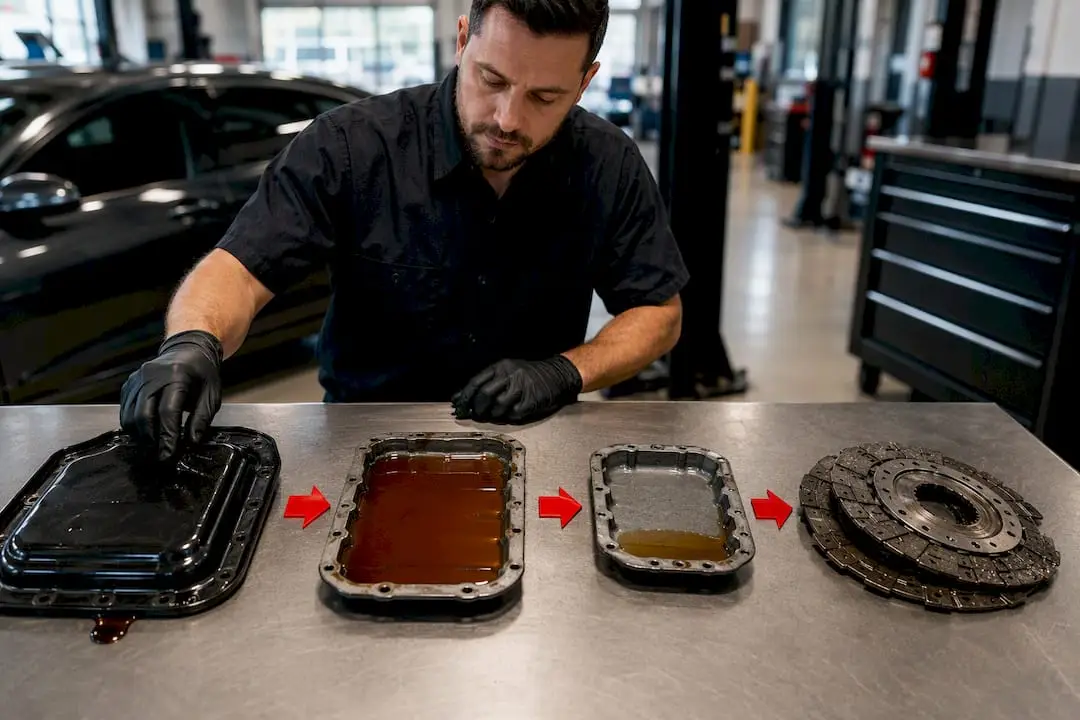
Most leaks are preventable with a handful of habits that take a few minutes at a time. Follow your manufacturer’s recommended fluid change interval, and shorten it if you tow frequently, drive in stop-and-go traffic often, or live somewhere with extreme heat.
- Check your fluid level and color every few oil changes, even if nothing seems wrong.
- Have cooler lines inspected after hitting a curb, pothole, or road debris, since impact damage doesn’t always show immediately.
- In hot Texas summers, extra heat stresses seals and gaskets, so watch fluid condition more closely during peak heat.
- Cold weather thickens fluid and can reveal marginal seals that were fine in warmer months, so a pre-winter transmission check catches issues before they worsen.
- Wipe down the transmission pan and cooler line fittings occasionally so a new leak is easy to spot early.
When Should You Call a Professional for a Transmission Leak?
Some signs are your cue to stop troubleshooting at home and get the vehicle to a shop. Milky or foamy fluid, visible metal shavings, a pattern of repeatedly topping off fluid, or any of the severe symptoms covered earlier all call for professional diagnostics rather than more guesswork.
When you’re picking a shop, a few questions tell you a lot fast:
- Can they show you the leak directly, ideally with photos or video from a digital inspection?
- Are the technicians ASE-certified?
- What warranty comes with the repair?
- Will they give you a written estimate before starting work?
Pro Tip: Ask specifically whether the estimate is based on a visual diagnostic or a full pan drop and fluid inspection. The two can lead to very different final numbers.
How We Approach Transmission Fluid Leaks
We diagnose leaks with ASE-certified technicians and back it up with a Digital Vehicle Inspection, so you see the actual leak point on your own transmission rather than taking our word for it. After-hours drop-off and a complimentary ride service keep the process from disrupting your day, and every repair carries our 2-year/24,000-mile warranty.
— Kwik Kar
Book a Transmission Fluid Leak Diagnosis
A leak that looks minor from your driveway can hide a bigger problem underneath, and that’s exactly where a proper inspection earns its cost. We start every visit with a written estimate, not a guess, so you know what you’re paying for before any work begins.

Our diagnostic process uses a Digital Vehicle Inspection to show you the exact leak point with photos, whether it’s a simple pan gasket or something further inside the transmission. From there, our ASE-certified technicians walk you through repair options and realistic costs before touching your vehicle, and every completed repair carries our 2-year/24,000-mile warranty. If you’re already noticing a spot under your car or a change in how your vehicle shifts, book a general auto repair appointment with us in Celina and get a clear answer instead of a guess.
Sources
- Transmission fluid leak (HowStuffWorks) — Diagnosing car problems
- Transmission Fluid Leak: How to Find & Fix All Common Leak Points (VehicleBar)
- Can I Drive With a Transmission Leak? Safety Guide (RideCheckPro)
- 8 causes your transmission fluid is leaking red puddle (The Motor Guy)
FAQ
Can You Still Drive a Car With a Transmission Leak?
Yes, briefly, but only if it’s a minor seep with normal shifting and no burning smell. Active dripping, slipping, or foamy fluid means you should stop driving and arrange a tow.
How Much Does It Cost to Fix a Transmission Fluid Leak?
Costs typically range from $75 to $350 for a pan gasket, $100 to $300 for cooler lines, $150 to $600 for axle seals, and $600 to $1,500 or more for internal seal or torque converter repairs.
Is a Transmission Fluid Leak Easy to Fix?
A pan gasket or drain plug leak is usually a straightforward, affordable fix, but leaks involving the torque converter, front pump, or internal seals require significantly more labor and often partial transmission removal.
How Do You Tell if Your Transmission Is Leaking Fluid?
Look for a reddish to brown, oily puddle centered near the middle of the vehicle, use a cardboard test overnight to confirm an active drip, and check your fluid level and color against your owner’s manual if your car has a dipstick.