


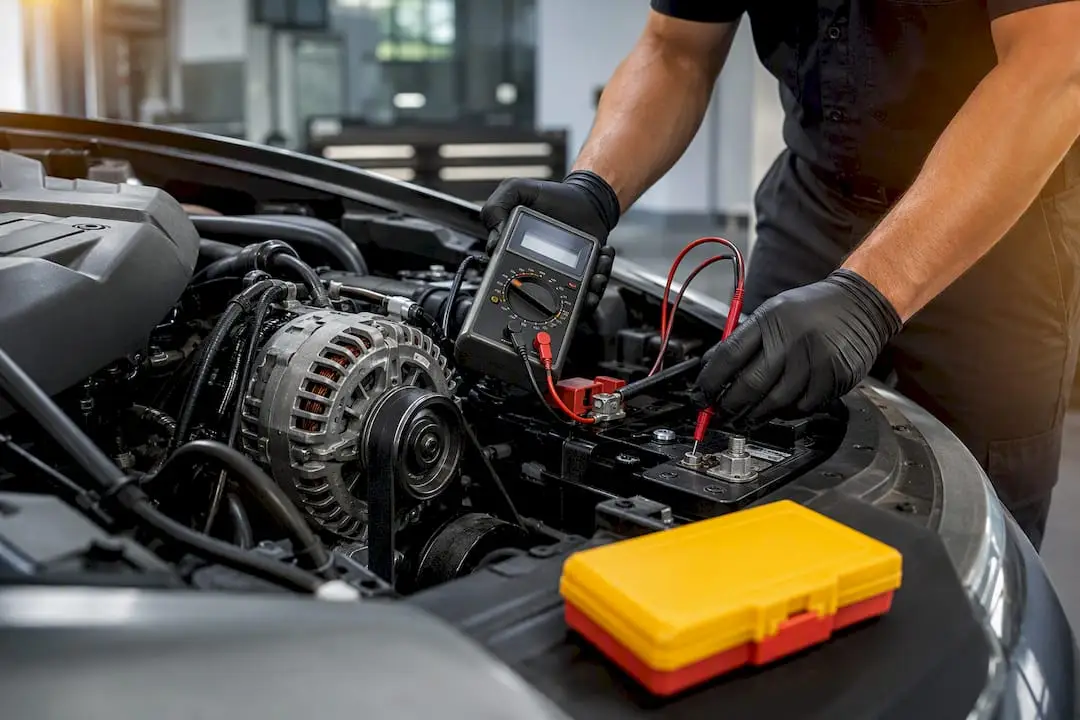
A battery warning light while driving generally means your charging system, usually the alternator or its wiring, is failing rather than the battery itself. Keep the engine running if you’re not already stopped, switch off nonessential electronics, and head to a safe destination. Depending on your electrical load, you likely have somewhere between 15 minutes and an hour before the car loses power.
TL;DR:
- The battery warning light mainly indicates a charging system failure, often caused by the alternator, regulator, or wiring issues, not the battery itself.
- A healthy charging system maintains voltage between 13.5 and 14.7 volts when the engine runs; outside this range signals potential alternator or regulator problems.
- Drivers can typically drive 15 to 90 minutes after the warning light appears, but should head to a safe location and turn off nonessential electronics immediately.
- Proper diagnosis requires voltage and load testing, inspection of belts and wiring, and documentation from a qualified technician to avoid unnecessary or incorrect repairs.
- Preventative measures include regular battery load tests, inspecting belts and terminals, and requesting comprehensive charging-system checks during routine maintenance.
Table of Contents
- What Does the Battery Warning Light Actually Monitor?
- What Causes the Battery Light to Come On?
- What Should You Do the Moment the Light Comes On?
- How Do You Check Voltage Without a Shop Visit?
- How Long Can You Keep Driving With the Light On?
- How Can You Prevent This From Happening Again?
- Why Does a Professional Charging-System Diagnosis Matter?
- What Do We See Wrong Most Often?
- Need Help Now? Get Your Charging System Checked at Kwik Kar of Celina
- Sources
- FAQ
What Does the Battery Warning Light Actually Monitor?
The battery light isn’t a battery gauge at all. It’s a charging-system monitor that lights up when voltage drifts outside the normal operating band, and that’s almost always an alternator, regulator, or wiring problem rather than a dead battery.
While the engine runs, a healthy charging system should hold voltage between about 13.5 and 14.7 volts. A resting battery, meaning the engine is off and the car has sat for a while, should read closer to 12.4 to 12.7 volts. That gap matters. Your battery can test perfectly fine at rest and still trigger the warning light, because the light isn’t checking the battery’s stored charge. It’s checking whether the alternator is replenishing that charge while you drive.
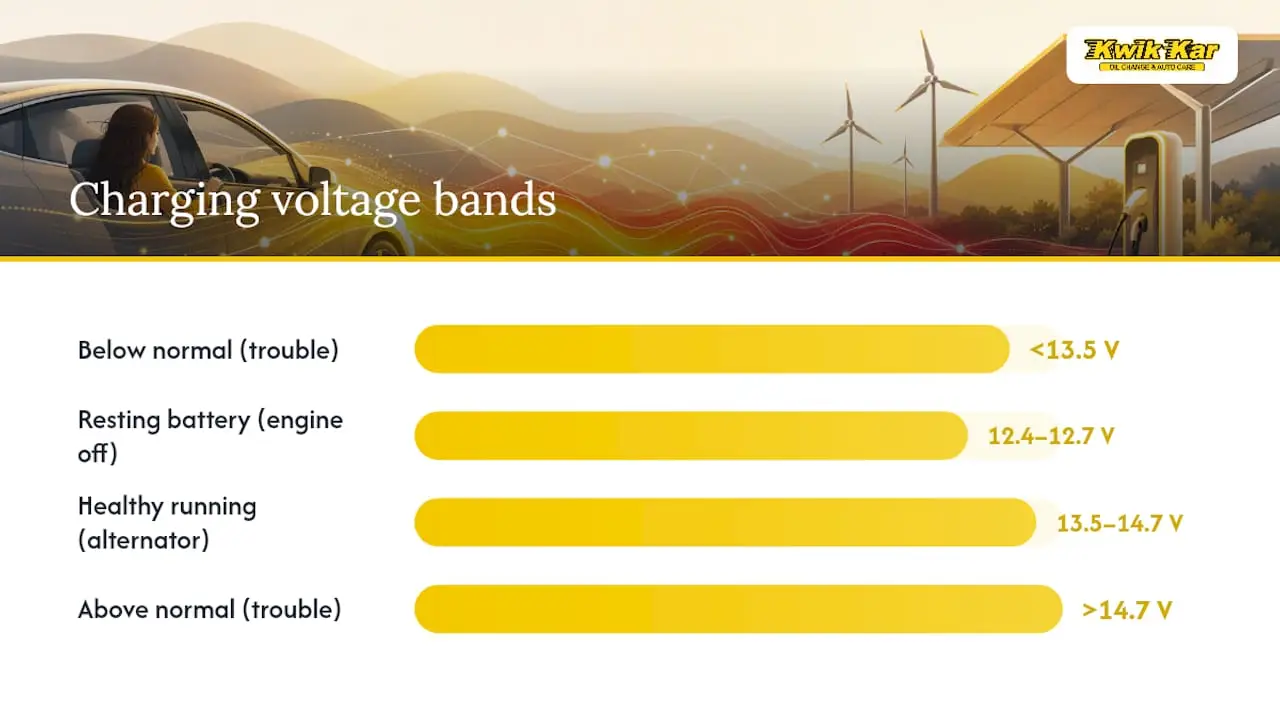
Quick fact: Running voltage above 14.7V or below 13.5V both point to charging-system trouble, either overcharging from a bad regulator or undercharging from a weak alternator or loose belt.
This is why so many drivers get surprised at the parts counter. They assume the light means “buy a battery,” when it’s frequently telling you something upstream of the battery has gone wrong.
What Causes the Battery Light to Come On?
Charging-system failures tend to follow a predictable pattern, and knowing the usual suspects helps you describe the problem accurately when you call a shop. Common causes include:
- A failing alternator or a worn-out internal voltage regulator, the most frequent culprit by far
- A slipping, cracked, or broken serpentine belt that can’t spin the alternator fast enough
- Loose or corroded battery terminals, or a weak ground strap that breaks the circuit
- A damaged wire, blown fusible link, or a corroded connector somewhere in the charging circuit
- A battery with a failing internal cell, or an electrical load (aftermarket lights, stereo, winch) that outpaces what the alternator can supply
An intermittent flicker often points to a slipping belt, worn alternator brushes, or a loose connection that shifts under vibration, which is different from a steady light that stays on from the moment you start the car.
What Should You Do the Moment the Light Comes On?
Your first job is to buy yourself time and distance safely, not to diagnose the problem from the driver’s seat. Here’s the order that matters:
- Keep the engine running unless you’re already somewhere safe to stop. Restarting a car with a weak charging system can be harder the second time.
- Turn off nonessential electronics right away. That means the air conditioning, radio, heated seats, and phone chargers. Every one of those pulls current your alternator may no longer be supplying.
- Head straight to the nearest safe destination, whether that’s home, a garage, or a well lit parking lot. Skip heavy traffic and steep grades if you have a choice, since both demand more from your electrical system.
- Pull over immediately and call for help if headlights start dimming badly, the engine misfires or stumbles, or other warning lights join the battery icon on your dash.
Pro Tip: Roll down a window instead of running the AC fan. It costs you almost nothing electrically and keeps you alert while you drive to safety.
How Do You Check Voltage Without a Shop Visit?
A basic multimeter answers the biggest question fast: is this a battery problem or an alternator problem? Test resting voltage first, ideally after the car has sat overnight, then start the engine and test again at idle and at roughly 2,000 RPM.

A healthy alternator holds running voltage in the 13.5 to 14.8 volt range at both idle and higher RPM. If the reading barely climbs above 12 volts or drops below 13 with the engine running, the alternator isn’t doing its job.
The comparison between the two readings tells the real story:
- Normal resting voltage plus low charging voltage usually points to the alternator, regulator, or belt
- Low resting voltage plus normal charging voltage suggests the battery itself is the weak link
- Voltage that swings up and down at idle, then stabilizes at higher RPM, often means a slipping belt or a marginal alternator that struggles under low speed load
A basic voltage check is a starting point, not a final answer. A proper load test on the battery combined with a full charging-system check catches marginal alternators that read fine on a static multimeter but fail once you add real electrical demand, which is exactly the kind of problem that leads to a repeat breakdown a week later.
How Long Can You Keep Driving With the Light On?
Most drivers get somewhere between 15 and 90 minutes of usable driving time once the charging system fails, and that window shrinks fast with heavier electrical load, older batteries, or a combination of headlights and air conditioning running at once.
Once system voltage drops toward roughly 11 volts, the engine can stall and may not restart. That’s your hard limit. Watch for headlights that dim noticeably, an engine that starts to misfire or hesitate, or additional warning lights joining the battery icon. Any of those means stop now, not at the next exit.
How Can You Prevent This From Happening Again?
Most charging-system failures give warning signs weeks before they leave you stranded, and a few habits catch them early:
- Have your battery load tested periodically, and plan on replacement around 4 to 5 years depending on how it tests, not just its calendar age
- Ask your shop to inspect the serpentine belt and tensioner for cracking, glazing, or slack during routine service
- Keep battery terminals and ground straps clean, tight, and free of corrosion buildup
- Request a full charging-system test as part of your regular maintenance visit, not just a battery check
Aftermarket electronics load down the system too. Adding high-draw lighting without a proper anti-flicker decoder or voltage-stabilizing capacitor can trigger the same warning light symptoms as a genuine alternator fault.
Why Does a Professional Charging-System Diagnosis Matter?
A thorough diagnostic goes well past glancing at the dash. It should include voltage and load testing, a wiring voltage-drop check, a physical inspection of the belt and connectors, and documented results you can actually read, not just a verbal “it’s fine.”
At Kwik Kar of Celina, our ASE-certified technicians back up every charging-system check with a printed Digital Vehicle Inspection, so you see the actual numbers instead of taking someone’s word for it. Ask any shop for those results, and ask whether the repair carries a warranty. Qualifying repairs come with a warranty, which matters because a documented diagnosis is what keeps you from paying for a new alternator when the real fix was a corroded ground strap.
What Do We See Wrong Most Often?
We see it constantly: a driver replaces the battery, the light comes back within days, and now they’re paying twice. Skipping the charging-system test doesn’t just risk a wrong diagnosis, it almost guarantees a repeat visit.
Insist on a full test before anyone swaps parts. And keep jumper cables in your trunk along with your shop’s phone number saved in your phone. Cheap insurance, real peace of mind.
— Kwik Kar
Need Help Now? Get Your Charging System Checked at Kwik Kar of Celina
We provide documented answers through voltage and load tests, along with a Digital Vehicle Inspection so you can see exactly what’s failing before you approve any repair.

That transparency is what separates a shop visit that fixes the actual problem from one that just replaces the easiest part. Qualifying repairs carry a warranty, and if your schedule is tight, there are options like after-hours drop-off and ride services so a dead alternator doesn’t derail your whole day. If your battery light came on today, book a diagnostics appointment or explore our general auto repair services to get the charging system tested properly, before you spend money on the wrong part.
Sources
For further reading on charging-system voltage ranges and testing methods, see AutoZone’s battery light guide, Midtronics on battery warning lights, and Steer’s diagnostic guide.
- Battery light on car – AutoZone
- Battery light on while driving: 7 causes & what to do — Car Care Total
FAQ
Can I Still Drive My Car if the Battery Light Is On?
You can typically keep driving for a short time, generally 15 to 90 minutes depending on your electrical load, but you should head straight to a safe destination and cut nonessential accessories immediately.
Does the Battery Light Mean a Bad Battery or a Bad Alternator?
It usually points to the charging system, most often the alternator or its wiring, rather than the battery itself, since the light monitors running voltage rather than stored charge.
How Long Can I Drive With the Battery Light On While Driving?
Most drivers get roughly 15 to 90 minutes before voltage drops enough to cause stalling, and once running voltage nears 11 volts, the engine may not restart.
How Do I Know if It’s the Battery or the Alternator?
Compare resting voltage (around 12.4 to 12.7V) with running voltage (13.5 to 14.8V): normal resting voltage with low charging voltage points to the alternator, while low resting voltage with normal charging voltage points to the battery.