


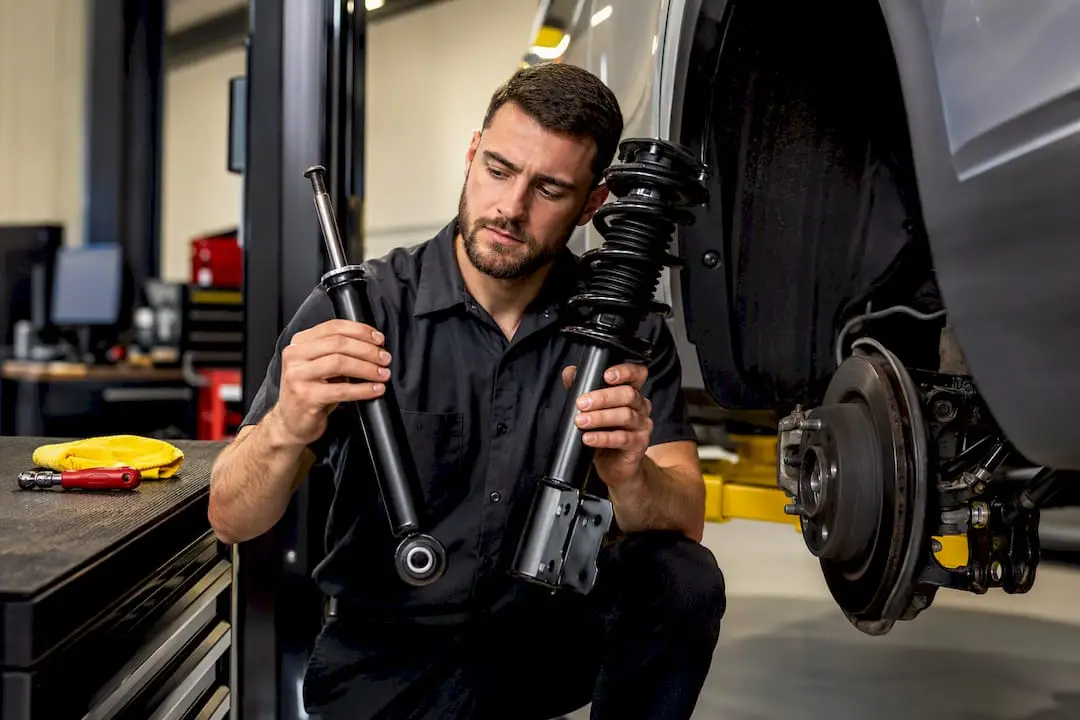
A shock absorber only dampens motion. A strut does that job plus carries part of your car’s weight and holds the wheel’s alignment angle in place, which is why Monroe’s own technical guidance treats them as different parts, not interchangeable terms. Replace a strut and you need a wheel alignment afterward. Replace a shock and you usually don’t. An ASE-certified technician checks for both during a standard suspension inspection.
TL;DR:
- Replacing a strut requires a wheel alignment due to its role in steering geometry, while a shock typically does not need this adjustment.
- Most front-wheel-drive vehicles with MacPherson struts may need an alignment after replacement, and many vehicles use shocks in the rear, so correct identification is essential.
- Signs of worn shocks include excessive bounce, nose-dive under braking, sway through turns, and tire cupping, with fluid leaks indicating failure.
- Strut replacement is more costly and labor-intensive than shocks because it involves coil spring compression and often includes an alignment, ideally performed in pairs on the same axle.
- DIY replacement is feasible for shocks but dangerous and complicated for struts due to spring tension; professional inspection and proper tools are recommended.
Table of Contents
- What Is the Difference Between Shocks and Struts?
- Does My Car Have Shocks or Struts?
- Worn Shock Symptoms: When Your Suspension Is Failing
- How Much Does Strut Replacement Cost?
- Should I Replace Struts Myself or Hire a Pro?
- What a Suspension Inspection Actually Checks
- When to Schedule a Suspension Check
- Where to Verify Suspension Recalls and Technical Details
- Sources
- FAQ
What Is the Difference Between Shocks and Struts?
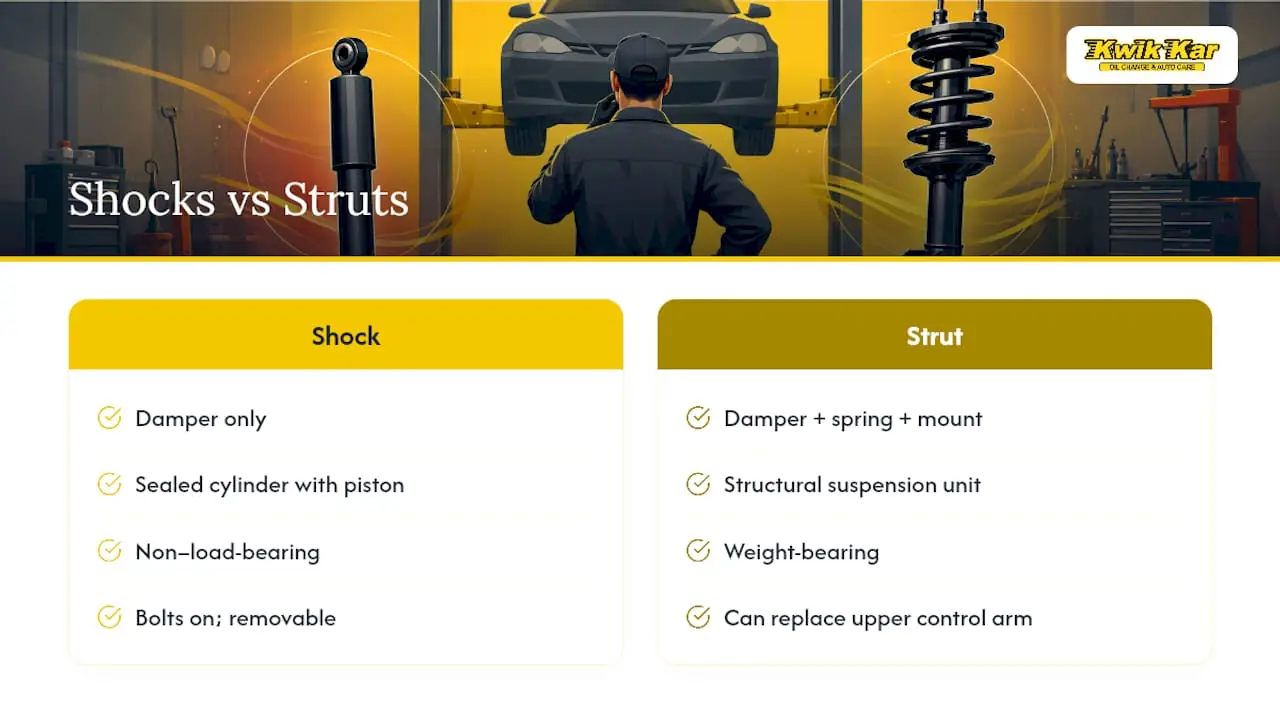
A shock absorber is a standalone damper. It’s a sealed cylinder with a piston moving through hydraulic fluid, and its only job is to slow down the spring’s bounce after your tire hits a pothole or dip. Take a shock off the car, and nothing else about the suspension geometry changes. It bolts on, controls motion, and that’s the whole assignment.
A strut is a bigger deal mechanically. It bundles the damper with a coil spring and a mounting point into one structural unit, and in many designs it replaces the upper control arm and ball joint outright. That means a strut is weight-bearing in a way a shock never is. It holds part of the car’s mass and sets the steering pivot point for that wheel.
This is exactly why the strut vs shock question matters for repair planning, not just trivia. The classic example is the MacPherson strut, found on the front suspension of most front-wheel-drive sedans, hatchbacks, and crossovers built since the 1980s. Because a strut is tied into steering geometry, removing one disturbs camber and caster angles, and O’Reilly Auto Parts notes that a follow-up wheel alignment is normally required. A shock swap carries no such requirement. Many vehicles actually run struts up front and shocks in the rear, a mixed setup that catches a lot of owners off guard when they assume their whole car uses one system or the other.
Does My Car Have Shocks or Struts?
You don’t need a lift or a diagnostic scanner to figure this out. A few minutes of looking will usually tell you.
- Check the owner’s manual or a parts diagram. Most manufacturers specify “front strut assembly” or “rear shock absorber” by name in the suspension section.
- Look at the wheel well. If you see a coil spring wrapped directly around the damper, forming one continuous unit from the top mount down to the lower control arm, that’s a strut. A shock sits separately from the spring, usually mounted at an angle beside or behind it.
- Go by vehicle type as a rough guide. Front-wheel-drive cars and crossovers commonly run MacPherson struts in front. Pickup trucks and rear-wheel-drive vehicles often use shocks at both axles, paired with a different spring type entirely.
- When in doubt, ask a shop to confirm during an inspection. Some vehicles use hybrid setups that don’t match the usual pattern, and a quick visual check from a technician settles it in minutes.
Worn Shock Symptoms: When Your Suspension Is Failing
Suspension wear rarely announces itself with a warning light. It shows up as a change in how the car behaves, and the changes tend to escalate in a fairly predictable order.
- Excessive bounce after a bump. A healthy shock or strut settles the car in one or two motions. A worn one keeps bouncing.
- Nose-dive under braking or squat under acceleration. Both signal the damper can no longer control weight transfer.
- Swaying or body roll through turns, along with vibration at highway speeds that wasn’t there before.
- Cupping on the tires. This scalloped wear pattern happens because the suspension can’t keep consistent tire contact with the road, and it eats tread unevenly.
- Visible fluid on the outside of the unit, or a clunking noise over bumps.
A typical damper lasts somewhere in the 50,000 to 100,000 mile range, though rough roads, towing, or a heavy daily load shorten that considerably. If you’re seeing fluid leakage or hearing clunks, that’s not a “watch it for a while” symptom. Fluid loss means the damper has lost its ability to control motion at all, and it belongs on this week’s to-do list, not next month’s.
How Much Does Strut Replacement Cost?
Strut replacement costs more than a shock swap for a straightforward reason: the parts and the labor are both bigger jobs. A shock is a bolt-on component. A strut assembly involves compressing a loaded coil spring, which either requires a spring compressor tool or buying a preloaded strut assembly that arrives already sprung and ready to install.
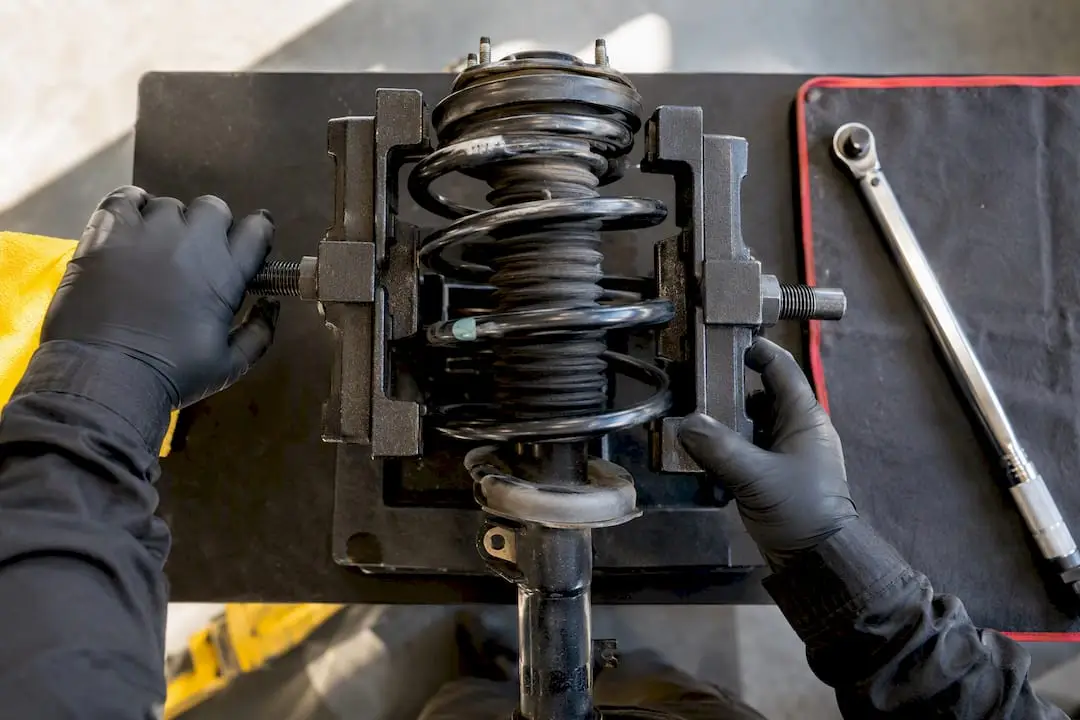
Then there’s alignment. Because struts set steering geometry, most shops build a wheel alignment into the total strut replacement cost, and skipping it is a mistake that shows up later as uneven, accelerated tire wear that can quietly erase whatever you saved.
Manufacturers including Monroe recommend replacing shocks and struts in pairs on the same axle, never one side alone. The logic holds up: if one side has worn out, the other side on that axle is almost certainly close behind it, and running one new damper against one tired one creates uneven damping that can unevenly load the new part and shorten its life.
A few budgeting habits help here:
- Treat axle-pair replacement as the practical minimum, not just the manufacturer’s suggestion.
- Replace all four when the front and rear are showing wear at roughly the same time, rather than paying for two separate labor visits months apart.
- Ask upfront whether the shop uses preloaded strut assemblies, since they cut labor time compared to compressing springs on the original unit.
Pro Tip: Always ask for the alignment to be quoted alongside the strut estimate, not as a separate line item you discover later. A strut job without an alignment isn’t really finished, and most reputable shops will tell you that upfront.
Should I Replace Struts Myself or Hire a Pro?
Some shock jobs are genuinely doable in a driveway with basic hand tools and a jack. A rear shock on many trucks is a straightforward two-bolt swap that doesn’t touch the spring at all.
Struts are a different story. Compressing a loaded coil spring without the right equipment is one of the more dangerous jobs in home auto repair. A spring under tension that slips free can cause serious injury, and this is exactly why preloaded strut assemblies exist as a safer middle path for confident DIYers.
- Skipping the post-replacement alignment isn’t a minor shortcut. It leads to fast, uneven tire wear that undoes the point of the repair.
- A digital vehicle inspection before you start any of this shows you exactly which bushings, mounts, or components are actually worn, so you’re not guessing.
- If spring compression, alignment specs, or torque values aren’t things you’re comfortable with, that’s the signal to book a shop instead of a parts store run.
What a Suspension Inspection Actually Checks
A proper inspection walks a set path: look for fluid leaks and worn mounts or bushings, check for tire cupping, then confirm the diagnosis with a test drive that reveals bounce, sway, or nose-dive. From there it’s diagnose, recommend axle-pair replacement, install, align, and test drive again before handoff. A written warranty and a digital vehicle inspection report give you something concrete to point to if a problem resurfaces, and having ASE-certified technicians on the job means the diagnosis isn’t a guess.
— Kwik Kar
When to Schedule a Suspension Check
Visible fluid on a shock or strut, a noticeable change in how the car handles corners, or tires wearing unevenly are all reasons to get looked at before the problem gets more expensive. Kwik Kar of Celina handles steering and suspension work, including wheel alignments, alongside the diagnostics needed to confirm what’s actually worn before any parts get replaced.

Many repair shops offer warranties on their repairs and provide various convenience options so a suspension inspection doesn’t have to disrupt your day. If you’ve noticed bounce, sway, or uneven tire wear, browse the full list of services and get an inspection scheduled before those symptoms turn into a bigger repair bill.
Where to Verify Suspension Recalls and Technical Details
- Check your vehicle’s recall history anytime through the NHTSA recalls database by VIN or model.
- Review manufacturer guidance on replacement best practices for deeper technical detail.
Sources
- Shocks vs. struts: What’s the Difference? — Monroe
- How to tell if your shocks or struts are worn out — KBB
- Symptoms of bad shocks and struts — AutoZone
- The difference between shocks and struts — O’Reilly Auto
FAQ
How Do I Know If I Have Bad Shocks or Struts?
Watch for excessive bouncing after bumps, nose-dive when braking, swaying in turns, or a clunking noise. Cupped tire wear and visible fluid on the unit are two of the clearest confirmed signs of worn shocks or struts.
Should I Replace the Struts or Just the Shock?
Replace whichever component your vehicle actually uses on that axle, but always do both sides together. Manufacturers recommend replacing in pairs because one worn side almost guarantees the other is close behind it.
How Much Does It Usually Cost to Replace Struts?
Pricing depends on the vehicle, parts choice, and whether preloaded assemblies are used, plus the required wheel alignment. Kwik Kar doesn’t publish a flat rate online, so current estimates are available by asking through the services page or during an inspection.
Can I Drive With a Bad Strut?
You can, but you shouldn’t for long. A failing strut lengthens braking distance, reduces steering control, and accelerates tire wear, and fluid leakage or a clunking noise means the part has likely lost its ability to control motion at all.