


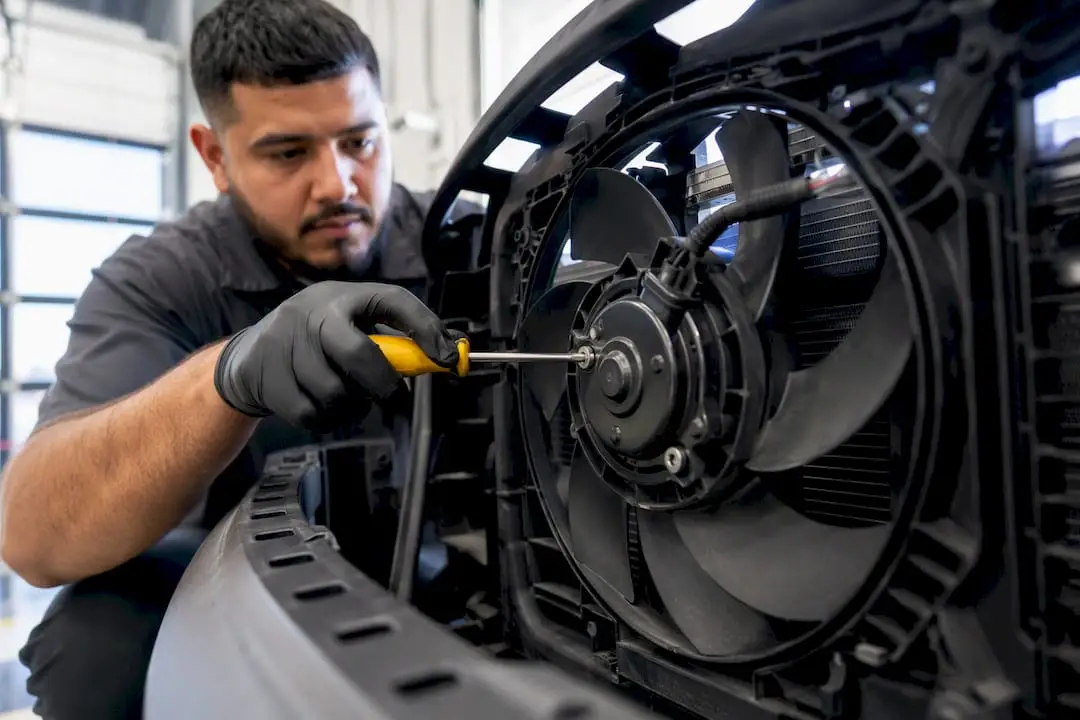
If your AC is cold on the highway but turns warm the moment you stop at a light, the most likely culprits are poor condenser airflow, a low refrigerant charge, or a compressor that loses steam at low RPM. Start by checking whether the condenser fan is actually spinning and comparing vent temperature at idle versus around 2,000 RPM. If engine temperature climbs while you sit there, that’s your cue to stop idling and get it looked at soon.
TL;DR:
- Weak or dead condenser fans are the most common cause of warm air at idle, especially if the fan isn’t spinning or runs inconsistently when the AC is on.
- A low refrigerant charge from leaks causes proper cooling at speed but warm air when idling, due to insufficient refrigerant flow at low compressor RPM.
- Clogged or bent condenser fins restrict airflow, reducing heat exchange and causing warm air at idle, which can often be fixed with gentle cleaning.
- RPM-dependent cooling issues often point to problems with the compressor clutch, belt slip, or control valves that perform poorly at low engine speeds.
- Proper diagnosis relies on comparing vent temperatures at idle and around 2,000 RPM, along with pressure tests and electrical checks, before attempting repairs.
Table of Contents
- Why Does AC Blow Warm at Idle but Cold While Driving?
- 60-Second Checks to Narrow Down the Problem
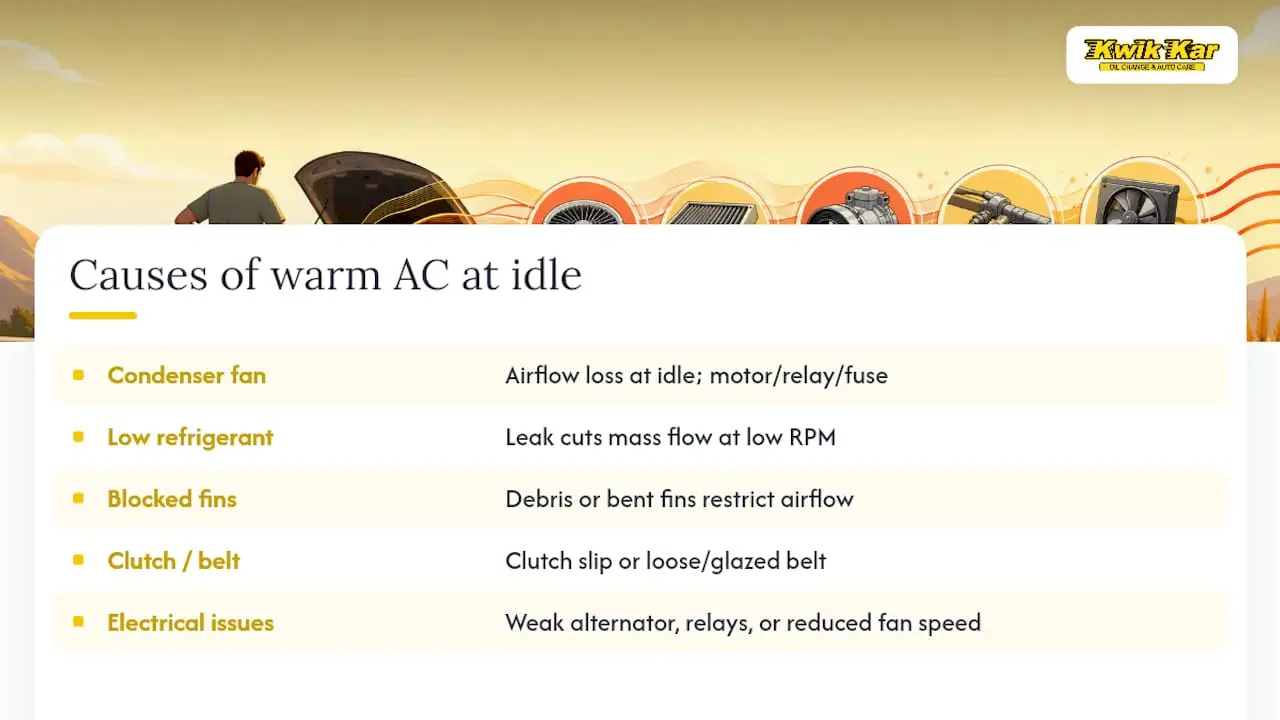
- Nine Common Causes Behind an AC That Runs Warm at Idle
- What a Shop Actually Tests When Diagnosing Warm-at-Idle AC
- When to Keep Driving and When to Pull Over
- Maintenance That Keeps Idle Cooling From Failing Again
- How Kwik Kar Diagnoses and Fixes Idle-Cooling Problems
- Why Most Warm-at-Idle Advice Misses the Point
- Sources
- FAQ
Why Does AC Blow Warm at Idle but Cold While Driving?
This pattern is common enough that shops have a name for it: airflow-dependent cooling loss. At highway speed, air rams through your condenser at 40, 50, 60 miles an hour, carrying heat away from the refrigerant efficiently. Drop to idle and that ram air disappears entirely. Your system now depends on the electric condenser fan alone to move air across those fins, and if that fan is weak, intermittent, or dead, cooling drops off fast.
The same speed sensitivity applies to your compressor. It’s belt driven off the engine, so idle RPM means the compressor turns slower, moves less refrigerant, and produces less cooling capacity. A system that’s borderline on refrigerant charge, or has a compressor that’s starting to slip, can mask its problems at speed and expose them completely the moment you’re sitting still. That’s the pattern behind ac cold then warm complaints, and it’s exactly why the fix usually isn’t “add more refrigerant and hope.”
60-Second Checks to Narrow Down the Problem
Before you call a shop, a few quick observations at home will tell you a lot about what’s failing. Run these checks with the engine warmed up in a driveway or open area, never near moving parts with your hands.
- Set the controls the same way every time. Max A/C, recirculation on, blower on high. This gives you a consistent baseline for comparison.
- Watch the condenser fan (or fans). At idle, with the AC on, you should see the fan (or fans, on many vehicles) spinning steadily. If it’s silent, cycling on and off rapidly, or spinning noticeably slower than expected, that’s a strong lead.
- Check compressor clutch engagement. Listen and look at the compressor pulley. If the clutch isn’t visibly locking in and turning with the pulley, the compressor may not be running at all.
- Feel the vents at idle, then rev to about 2,000 RPM. If vent temperature drops noticeably as RPM climbs, that points toward airflow or low charge rather than a dead component.
- Look at the condenser face (the front-most radiator-like unit, ahead of your engine radiator) for caked bugs, leaves, or road debris blocking airflow.
Stay clear of the fan blades and belt area the entire time. If anything looks blocked or the fan won’t spin, that alone often explains ac warm at idle without needing a shop visit to confirm.
Nine Common Causes Behind an AC That Runs Warm at Idle
Warm air at idle almost always traces back to one of a handful of failure points. Here’s how to read the clues.
1. Condenser or radiator fan not running, or running weak. If the fan stays silent or barely turns while the AC is on, airflow across the condenser collapses at idle. This is one of the most frequent causes of ac not cold at idle, and it’s also one of the cheaper fixes when caught early: fan motor, relay, wiring, or a blown fuse are the usual suspects.
2. Low refrigerant charge from a small leak. Gradual performance decline, rapid compressor cycling, or oily residue near fittings all point to a leak. A system that’s low on charge loses mass flow fast at low compressor speed, which is why it can still feel decent on the highway and turn ac cold then hot the second you idle. The fix is locating the leak, repairing it, then evacuating and recharging by weight, not just topping off a can.
3. Blocked or bent condenser fins. Road debris, leaves, and bent fins restrict airflow even with a healthy fan. Light cleaning with a soft brush and low-pressure water often restores performance; a crushed or corroded condenser needs replacement.
4. Compressor clutch slipping or belt issues. If cooling improves noticeably when you rev the engine but the clutch doesn’t fully engage at idle, you’re likely looking at clutch wear or a loose, glazed belt.
5. Variable displacement compressor control valve fault. Many newer compressors electronically control output. A failing control solenoid can starve output at idle while performing fine at higher RPM, a subtler version of the same airflow-and-speed story.
6. Engine overheating or a weak cooling system. Engine cooling problems and AC performance are more connected than most drivers realize. Under-hood heat soak overwhelms a marginal AC system, and a rising temperature gauge at idle is the giveaway.
7. Metering device restriction or icing. A partially blocked TXV or orifice tube, sometimes from trace moisture freezing inside the system, causes inconsistent pressures and sudden warm spells that don’t always correlate cleanly with RPM.
8. Overcharge, non-condensables, or contaminated refrigerant. Too much refrigerant, or air trapped in the system from a prior DIY top-off, raises head pressure and hurts cooling, especially at idle when the system has less margin to work with. Overcharge tends to show up after someone recently “recharged” the system without proper equipment.
9. Electrical or control issues at idle. Weak alternator output, corroded grounds, a failing relay, or an idle control strategy that reduces fan speed to save load can all mimic a mechanical failure. If a brief throttle blip revives the fans or cooling, suspect the electrical side first.
Pro Tip: Never top off refrigerant through the low-side port without a gauge set and a leak check first. Guessing at charge level is one of the fastest ways to turn a simple fix into an overcharge problem.
What a Shop Actually Tests When Diagnosing Warm-at-Idle AC
A technician isn’t guessing. The diagnostic sequence follows a specific logic built around comparison, not a single reading.
- Vent temperature at idle versus around 2,000 RPM. The relative change matters more than any single number; a system that improves sharply with RPM points toward airflow or marginal charge, while one that stays warm at both speeds suggests a deeper mechanical fault.
- High side and low side pressure checks. Comparing gauge readings against expected patterns tells the story: low pressure on both sides usually means undercharge, high head pressure with normal low side often means restriction or overcharge, and unusually high pressures across the board can mean non-condensables in the system.
- Fan command and electrical verification. This includes checking commanded voltage at the fan connector, relay function, and current draw, since a fan can appear to spin but still pull the wrong current under load.
- Compressor clutch and current draw testing, followed by bench or advanced compressor testing when a variable displacement valve is suspected.
- Leak detection with dye or an electronic sniffer when low charge shows up, followed by a full evacuation and recharge by weight rather than a partial top-off.
Refrigerant charge, compressor speed, and blower speed all interact to determine cooling capacity, which is precisely why a shop measures several points instead of relying on one temperature reading. The pattern across all these tests, not any single number, is what points to the actual repair.
When to Keep Driving and When to Pull Over
Warm air at idle by itself usually isn’t an emergency, but the details matter.
- Safe to keep driving: AC is warm only at idle, engine temperature gauge stays steady, and there’s no unusual noise or smell.
- Stop as soon as it’s safe: engine temperature is climbing, the condenser or engine fan isn’t running at all, you smell burning, or the compressor is making loud grinding or clicking noises.
- In the meantime: turn off the AC, crack the windows, and park in shade rather than idling to “wait it out.” Note when the symptom happens, how long it lasts, and what the temperature gauge does, since that log speeds up diagnosis considerably.
Maintenance That Keeps Idle Cooling From Failing Again
A little routine attention prevents most of the causes above from ever becoming a warm-idle complaint.
- Visually check the condenser face every few months, especially after driving on dusty roads or through pollen season, and gently clear debris before it packs in.
- Keep the front grille area clear; anything that restricts airflow into the engine bay affects the condenser too.
- Schedule an annual AC health check that includes a leak test, pressure readings, and refrigerant verified by weight rather than by feel.
- Replace the cabin air filter on schedule. A clogged filter doesn’t cause warm refrigerant, but it does starve airflow through the vents and makes marginal cooling feel worse than it is.
- Maintain your engine cooling and charging systems. Coolant condition, thermostat function, and alternator output all indirectly protect AC performance, since a compromised cooling system or weak electrical supply drags AC output down with it.
Pro Tip: Before a long summer trip, get the condenser cleaned and the system pressure checked. A pre-trip AC service catches marginal fans and slow leaks before they turn into a roadside surprise.
How Kwik Kar Diagnoses and Fixes Idle-Cooling Problems
Kwik Kar’s ASE-certified technicians run the exact comparison based tests described above, backed by a Digital Vehicle Inspection that shows you fan operation, pressure readings, and condenser condition in plain language, not just a repair order. Qualifying AC repairs come with a warranty, and after-hours drop-off plus complimentary ride service help customers avoid waiting around in the heat. Before your visit, jot down when the warm air happens, how long it lasts, and whether your temperature gauge moves. That short log often cuts diagnostic time significantly.
Why Most Warm-at-Idle Advice Misses the Point
Most articles on this topic treat warm-at-idle AC like a checklist problem: nine causes, pick one, fix it. In practice, the real skill is sequencing. Check airflow first, because a dead or weak condenser fan explains the overwhelming majority of “cold while driving, warm at idle” complaints, and it’s the cheapest thing to rule out. Only after you’ve confirmed the fan is actually moving air should you start worrying about refrigerant charge or a failing compressor control valve.
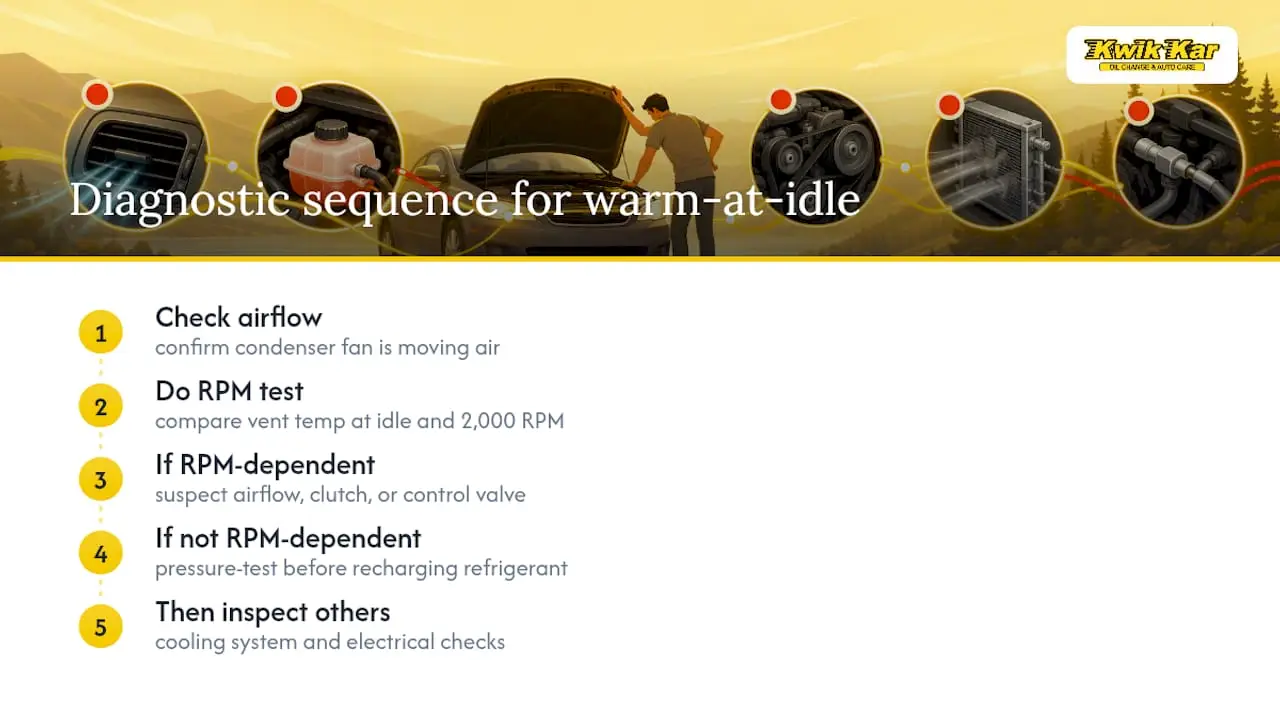
The conventional wisdom oversells DIY recharge kits. Adding refrigerant to a system you haven’t pressure tested is a coin flip, and an overcharged system can perform worse than an undercharged one. If your vent temperature improves meaningfully when you rev the engine, that’s not confirmation you need more refrigerant. It’s confirmation the problem is speed-dependent, which usually means airflow, clutch engagement, or a control valve, not charge level.
What readers should prioritize first isn’t a fix. It’s the comparison test: idle versus 2,000 RPM, vent temperature both times. That single habit turns a vague complaint into a diagnosis a technician can act on immediately.
— Kwik Kar
Sources
- Why Your Car’s AC Cools Better While Driving Than At Idle
- Steady state performance of an automotive air conditioning system (AACS) — Purdue IRACC
- Car AC Warm at Idle but Cold While Driving | Ascot Automotive
FAQ
Why does my AC get warm when I’m stopped but cold while driving?
Driving forces ram air through the condenser, cooling the refrigerant efficiently. At idle, that airflow disappears, so a weak fan, low refrigerant, or a compressor that loses output at low RPM becomes noticeable.
Why is my car AC blowing warm air when parked?
The most common reasons are a condenser fan that isn’t running properly, a low refrigerant charge from a small leak, or debris blocking the condenser fins. All three reduce heat rejection specifically when there’s no forward airflow to compensate.
What does it mean if your AC blows warm air?
It usually points to reduced heat exchange somewhere in the system, whether that’s poor airflow across the condenser, insufficient refrigerant to carry heat away, or a compressor and metering device not moving enough refrigerant at low speed.
Why does my vehicle get hot when idling with the AC on?
Running the AC compressor adds load to the engine, and if the condenser fan is weak or the engine’s own cooling system is already marginal, that extra heat can push the temperature gauge up while you sit still. If the gauge keeps climbing, pull over and turn the AC off rather than continuing to idle.