



If your car’s AC is not blowing cold, the most likely culprit is a refrigerant leak, a failing compressor, or poor airflow across the condenser. Run the short self-check below first. If you hear grinding, smell anything burning, or notice oily residue near the hoses, stop using the AC and get it looked at by a shop with EPA Section 609 certified technicians.
TL;DR:
- Most AC issues stem from refrigerant leaks, which are confirmed by low pressure readings and the presence of oily residue near hoses.
- A condenser fan that does not spin at idle but works at highway speeds indicates a fan or relay failure rather than a leak or compressor problem.
- Weak airflow despite cold air suggests a blower motor or clogged filter, not refrigerant, especially if the refrigerant levels are normal.
- Repair costs vary from simple recharges or filter swaps to compressor replacements, with average prices between $384 and $445, depending on the diagnosis.
- DIY refrigerant recharge is risky without proper gauges and leak detection equipment, and a licensed technician’s EPA Section 609 certification is essential for legal and safe servicing.
Table of Contents
- Why Is My Car AC Warm? Start With This Self-Check
- What’s Actually Causing the Warm Air?
- How Do Shops Diagnose an AC That Won’t Cool?
- How Much Does AC Repair Cost, and How Long Does It Take?
- Should You DIY It or Call a Shop?
- Why We Built Our AC Diagnostic Process Around Transparency
- Get Your AC Diagnosed the Right Way in Celina
- Where This Information Comes From
- Sources
- FAQ
Why Is My Car AC Warm? Start With This Self-Check
Before you spend money on a diagnostic visit, spend five minutes gathering information. Shops can often narrow down the problem faster when you arrive with specific details instead of just “the AC isn’t cold.”
Here’s a simple sequence to run in your driveway:
- Set the controls to max cool, recirculate, and the highest fan speed.
- Note whether the air is warm at idle but improves once you’re driving on the highway.
- Look through the front grille (engine off, parking brake on) to see if the condenser fan is spinning when the AC is on.
- Inspect the visible condenser for caked-on bugs, leaves, or bent fins blocking airflow.
- Check the hose fittings under the hood for a greasy or oily residue, which often marks a leak point.
- Check your cabin air filter’s location and condition, since a clogged filter can choke airflow and mimic a cooling problem.
- Confirm that air is actually coming out of the vents at a decent volume. Weak airflow points to a blower or filter issue rather than a refrigerant problem.
A few patterns are worth flagging in particular:
- Cold at highway speed, warm at a stoplight usually points to a condenser fan that isn’t running.
- Air blowing weakly from the vents, even if it feels cool, often means a blower motor or clogged filter, not refrigerant.
- A clicking or cycling sound from under the hood every few seconds can mean the compressor clutch is cycling due to low refrigerant.
Pro Tip: Write down exactly what you observed, including any smells, noises, or the speed at which the air improves. That single sentence can save your technician real diagnostic time and keep your bill lower.
What’s Actually Causing the Warm Air?
Refrigerant leaks account for the majority of “car AC not cold” complaints, according to AutoZone’s diagnostic library, but they’re far from the only cause. Here’s how the common culprits stack up and how a shop confirms each one.
- Refrigerant leak. The compressor clutch cycles on and off rapidly because the system doesn’t have enough refrigerant to maintain steady pressure. Since the AC system is sealed, low refrigerant almost always means a leak somewhere in the lines, not normal consumption. Technicians confirm this with manifold gauges showing low readings on both the high and low side, then locate the leak using UV dye or an electronic sniffer before recharging anything.
- Compressor failure. A grinding, clunking, or seized compressor won’t engage at all, or it engages and immediately shuts off. Electrical tests on the clutch coil combined with pressure readings confirm whether the compressor itself has failed internally.
- Condenser or condenser fan problems. If your air is cold at speed but warm at idle, the condenser fan is the prime suspect, since it’s the only thing moving air across the condenser when the car isn’t in motion. A technician checks the fan visually, then tests the fan motor, relay, and fuse if it isn’t spinning.
- Blend door or blower failures. Uneven temperatures from vent to vent, or airflow that’s weak everywhere, points toward a blend door actuator or blower motor problem rather than refrigerant. Shops verify the cabin filter first, then test the blower resistor and run scan tool commands to check whether the blend door actuator responds.
- Expansion valve or orifice tube contamination. Cooling that comes and goes, or a system that seems to “freeze up” and stop cooling after a few minutes, often traces back to moisture in the system freezing at the expansion valve. Fixing this typically means replacing the receiver-drier, which contains the desiccant that’s supposed to catch that moisture.
Short-cycling of the compressor clutch is worth calling out on its own. It’s often the earliest, cheapest signal that something’s wrong, and catching it before the compressor grinds itself apart can be the difference between a simple leak repair and a full compressor replacement.
How Do Shops Diagnose an AC That Won’t Cool?
A proper diagnosis follows a sequence, not a guess. Here’s what that process typically looks like when you bring your vehicle in.
- Symptom review. The technician asks about your self-check findings: warm at idle vs. highway, any noises, any smells.
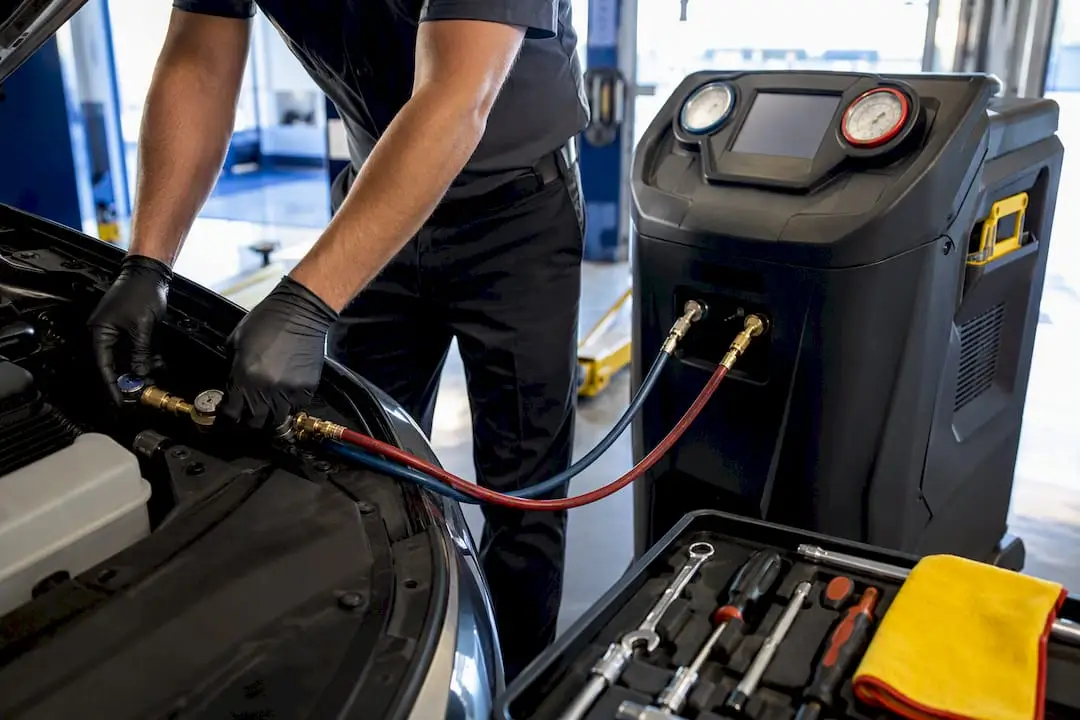
- Manifold gauge testing. Gauges attached to the high and low side service ports show system pressures, which point toward a leak, a failed compressor, or a blockage.
- Electrical checks. This covers the compressor clutch, pressure switches, and relays to rule out a wiring or fuse issue before assuming a mechanical failure.
- Leak detection. UV dye that fluoresces under a black light, or an electronic refrigerant sniffer, pinpoints exactly where refrigerant is escaping.
- Condenser and airflow inspection. A physical check confirms the fan runs and the condenser fins aren’t blocked or bent.
If the system needs to be opened for a repair, a few steps are non-negotiable for a lasting fix. The receiver-drier or accumulator gets replaced, since skipping it risks contaminating a brand-new compressor with the debris or moisture that caused the original failure. O-rings get replaced rather than reused. A contaminated system gets flushed. And the system gets fully evacuated before it’s recharged to the vehicle’s factory refrigerant spec, not just topped off.
Pro Tip: Ask your shop directly whether their technicians hold EPA Section 609 certification. It’s required for anyone legally servicing a vehicle’s AC system, and it means they’re using proper recovery and recycling equipment instead of just venting old refrigerant.
How Much Does AC Repair Cost, and How Long Does It Take?
Cost depends almost entirely on what’s actually broken, so a quote that seems high or low usually just reflects a different diagnosis than you expected.
- A simple recharge or cabin filter swap is typically the least expensive fix and can often be done quickly.
- A refrigerant leak repair plus a full recharge lands in the moderate range, since it involves locating and sealing the leak before refilling the system.
- A compressor replacement, especially one that requires a system flush and new receiver-drier, sits at the top of the range and may take more than a day if parts need to be ordered.
KBB’s service and repair data puts the average car AC repair cost between roughly $384 and $445, though major jobs like a full compressor replacement can run well beyond that. Vehicle type and refrigerant type both push the number around, since some newer systems use refrigerants that cost more per pound than older ones.
Should You DIY It or Call a Shop?
Some checks are perfectly safe to do yourself. Replacing a cabin air filter, visually confirming the condenser fan spins, and documenting your symptoms all take a few minutes and cost you nothing.
Where DIY gets risky is refrigerant. Without gauges or leak detection equipment, a store-bought recharge can leave you guessing at the actual pressure, and stop-leak products often mask a leak rather than fix it, which tends to create a bigger repair down the road.
- Skip DIY entirely if you hear a grinding or bearing noise from the compressor.
- Skip DIY if you spot oily residue anywhere in the AC lines.
- Get to a shop immediately if the compressor won’t engage even though refrigerant levels check out, or if the clutch is short-cycling repeatedly.
Pro Tip: If you’re not sure which category your symptom falls into, treat it like a professional job. A wrong guess on refrigerant work usually costs more to undo than it would have cost to diagnose correctly the first time.
Why We Built Our AC Diagnostic Process Around Transparency
Most AC complaints we see start the same way: a driver noticed warm air weeks ago, added a can of recharge from the auto parts store, and now the problem is back, worse. That’s not a knock on drivers. It’s a knock on how the industry has sold “quick fixes” for a sealed system that doesn’t respond well to guesswork.
Our technicians are ASE-certified, and every AC diagnosis comes with a Digital Vehicle Inspection so you can see exactly what we found, not just take our word for it. Repairs carry a 2-year/24,000-mile warranty, and if your schedule is tight, after-hours drop-off and complimentary ride service mean a warm-air AC doesn’t have to derail your week. Bring your car in with your symptom notes from the self-check, and expect a documented estimate before any work begins.

Get Your AC Diagnosed the Right Way in Celina
A quick top-off from a parts store might get you cold air for a week or two, but if there’s a leak, a weak compressor, or a fan that’s failing, that fix won’t hold. Kwik Kar’s AC repair service starts with the same diagnostic sequence outlined above: manifold gauge testing, UV dye or electronic leak detection, and full electrical checks on the compressor and pressure switches, all backed by a written estimate before anything gets repaired.

Every repair we perform is covered by our 2-year/24,000-mile warranty, and our Digital Vehicle Inspections give you photo documentation of exactly what we found under the hood. When you call or stop by, describe your symptom pattern, warm at idle versus warm all the time, any noise, any smell, so we can start diagnosing with a head start. Book your AC diagnostic appointment today, or explore our full lineup of auto repair services if something else on your vehicle needs attention while you’re in.
Where This Information Comes From
Refrigerant handling rules and technician certification requirements come from the EPA’s MVAC servicing regulations. Cost ranges and repair-time guidance draw on KBB’s repair cost data and mechanic-facing diagnostic resources from AutoZone.
Sources
- Regulatory requirements for MVAC system servicing | US EPA
- Car AC Repair Costs | KBB Service & Repair Guide
- Diagnosing car AC problems | AutoZone DIY
- Car AC Not Blowing Cold in 2026: The Symptom Pattern Names the Cause (Pulscar)
- AC accumulator/receiver drier: what they do and when to replace – RyCompressors
FAQ
Why Is My Car AC Blowing Cold Then Warm?
This pattern usually points to a refrigerant leak causing the compressor clutch to cycle on and off, or a condenser fan that only works intermittently at low speeds.
Why Is My AC Not Cooling at Idle but Fine on the Highway?
A condenser fan that isn’t spinning is the most common cause, since the fan is the only thing moving air across the condenser when your car isn’t creating its own airflow.
Can I Just Add Refrigerant Myself to Fix Warm Air?
You can, but since the AC system is sealed, low refrigerant almost always means there’s a leak, so adding refrigerant without finding and sealing that leak is usually a short-term fix at best.
How Much Does It Cost to Fix a Car AC That’s Not Blowing Cold?
Industry data puts the average repair between roughly $384 and $445, though a compressor replacement with a full system flush can cost significantly more.
How Do I Know if My Mechanic Is Qualified to Work on My AC?
Ask whether the technician holds EPA Section 609 certification, which is required to legally recover and recharge automotive refrigerant, and confirm they use manifold gauges and leak detection before any recharge.