



If your dashboard battery light comes on while driving, your headlights dim or flicker, or your car dies shortly after a jump-start, you’re likely looking at alternator trouble. The right move is to reduce your electrical load, pull over safely, and get a charging-system test rather than pushing on and risking a breakdown.
TL;DR:
- With the engine off, a healthy battery reads about 12.5 volts; running, charging voltage should be 13.5 to 14.5 volts, with outliers needing diagnosis.
- If the car dies soon after a jump start, suspect the charging system; if it keeps running, the battery is more likely at fault.
- A warning light or dimming headlights cannot identify the failed part: corroded cables, poor grounds, a damaged belt, or a regulator can mimic alternator trouble.
- Turn off nonessential electrical loads and pull over safely if symptoms worsen; if the vehicle dies after a jump, arrange a tow instead of retrying.
- A proper diagnosis checks the belt, battery, cables, and voltage regulator before condemning the alternator, preventing replacement of a part that is still working.
Table of Contents
- What your alternator does and why failure causes electrical symptoms
- Common alternator failure symptoms to watch for
- How to tell alternator symptoms apart from a bad battery or starter
- What to do right now if you notice these symptoms
- What a mechanic checks during a charging-system diagnosis
- How we diagnose charging-system issues at Kwik Kar
- Why early diagnosis saves you money
- Schedule a charging-system check with our team
- FAQ
- Sources
What your alternator does and why failure causes electrical symptoms
Your alternator converts the engine’s mechanical power into electricity, recharging your battery and running your lights, radio, and climate controls while the engine is on. When it starts to undercharge or overcharge the system, you’ll notice voltage-driven symptoms: lights that dim or flicker, accessories that respond sluggishly, or in some cases a battery that overheats and gives off an acid smell.
Modern alternators typically last around 7 to 10 years, though actual lifespan depends heavily on heat exposure, belt condition, and how much electrical load you place on the system day to day. A car that spends summers idling with the AC and infotainment running hard will usually see more wear than one driven in milder conditions, a pattern we see often with heat-related electrical strain in our own service bay.
Common alternator failure symptoms to watch for
Several warning signs point toward a failing alternator, though some overlap with battery or wiring issues, so we recommend treating this list as a starting point rather than a diagnosis.
- Battery or charging-system warning light on the dash: this light monitors voltage, not the battery itself, so it can illuminate even when the real culprit is a corroded cable.
- Dim, overly bright, flickering, or pulsing lights: voltage swings from an unstable alternator show up first in your headlights and interior lighting.
- A dead battery or repeated jump-starts, especially when the car starts then dies again: this is one of the clearest alternator patterns, since the battery isn’t being recharged as you drive.
- Slow or malfunctioning accessories: power windows, radios, or heated seats that lag or cut out while the engine runs suggest insufficient voltage supply.
- Trouble starting, stalling, or misfires: an alternator that can’t maintain steady voltage can starve the ignition system of the power it needs.
- Unusual noises like whining, growling, or squealing: these often trace back to worn bearings or a failing pulley inside the alternator assembly.
- A burning rubber or hot-wire smell: this points to overheating or overcharging and should never be ignored.
- Visible belt damage or loose, corroded connections: these can produce identical symptoms without the alternator itself being at fault.
Pro Tip: Keep a small notebook or phone note of when symptoms happen, like only at idle or only with the AC on. That pattern helps a technician narrow down the cause faster.
AAA’s consumer guidance notes that symptoms alone can’t always confirm which part has failed, since battery cables and loose connections often mimic true alternator failure.
How to tell alternator symptoms apart from a bad battery or starter
Jump-start behavior is one of the most useful clues you have. If your car dies again shortly after a jump-start, the charging system, meaning the alternator or voltage regulator, is likely the real problem. If it runs fine afterward, the battery itself was probably the main issue.
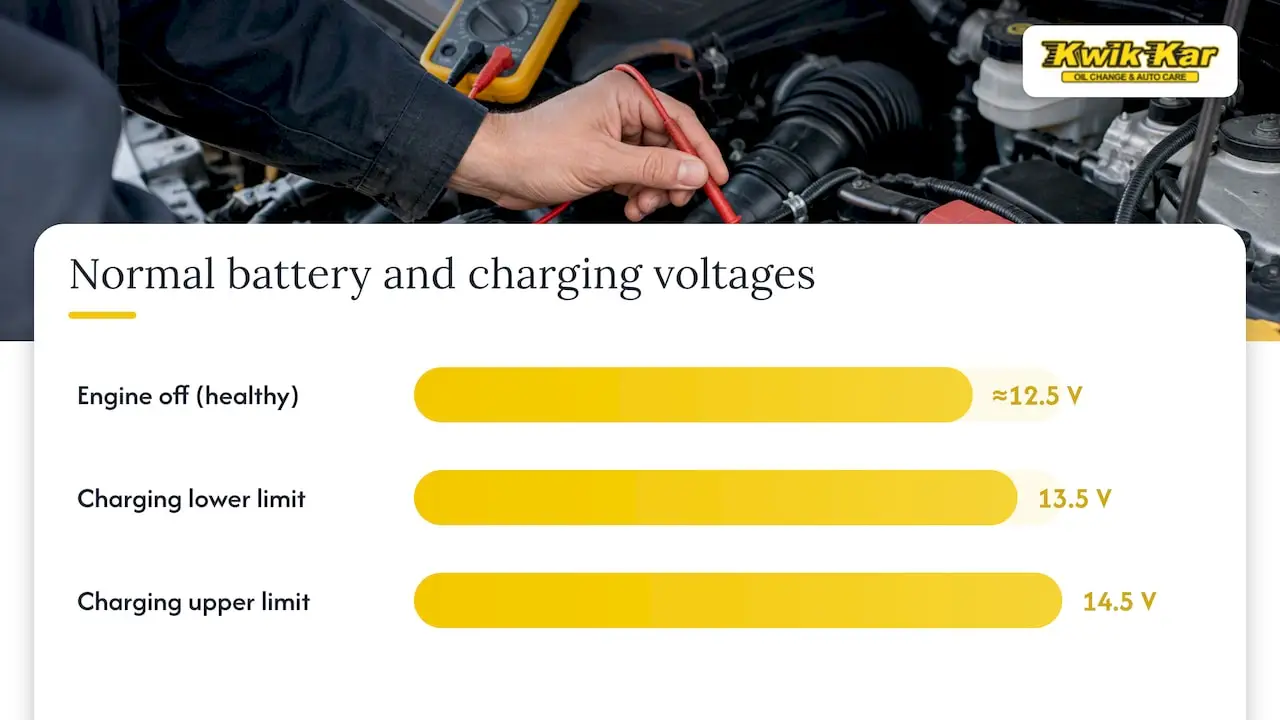
A simple multimeter check adds more certainty. With the engine off, a healthy battery reads around 12.5 volts, and with the engine running, the charging voltage should sit between roughly 13.5 and 14.5 volts. Readings outside that range are a strong signal to seek professional diagnosis rather than guess at a replacement part.
Several other issues can mimic alternator failure:
- Corroded or loose battery cables can restrict current flow and produce the same dimming or starting problems.
- A bad ground connection anywhere in the electrical system can cause erratic accessory behavior.
- A worn or broken drive belt prevents the alternator from spinning properly, even if the unit itself is fine.
- A faulty voltage regulator can cause overcharging or undercharging despite a healthy alternator.
- Parasitic drains, like a dome light left on, can drain a battery overnight and look like a charging failure the next morning.
A DIY multimeter check is reasonable with the engine off first, and you should never short the terminals or touch connections while the engine runs, since voltage spikes during testing can damage sensitive electronics.
What to do right now if you notice these symptoms
- Turn off nonessential electrical loads first, including the AC, stereo, and extra lights, which can buy you time to reach a safe location.
- If the battery light stays on or symptoms worsen, pull off the road safely rather than continuing to drive, since pushing forward risks draining the battery completely and leaving you stranded.
- A quick visual check for a broken belt or obviously damaged wiring is fine to do yourself, but never touch the alternator while the engine is running.
- If you jump-start the car and it dies again soon after, stop driving and arrange a tow or a charging-system diagnosis instead of repeating the jump.
Pro Tip: Keep your phone charged before a long trip when you suspect electrical trouble. A call for a tow beats being stuck with a dead phone on the shoulder.
What a mechanic checks during a charging-system diagnosis
A proper diagnosis goes well beyond swapping the alternator for a new one. Technicians typically work through a defined sequence to confirm the actual cause before recommending a repair.
- A visual inspection of the belt, tensioner, and alternator mounting, along with a check for overheating signs or corroded terminals.
- A battery state-of-charge test, followed by a charging test across the battery posts both with the engine off and running.
- Voltage drop tests on the positive and negative cables, along with diode and rectifier checks to rule out internal alternator faults.
- Testing with a shop-grade system tester, recording each value on a diagnostic worksheet so results can be compared against spec.
- Load testing and inspection of the voltage regulator and brushes, since wiring and connection issues are checked before the alternator is condemned.
How we diagnose charging-system issues at Kwik Kar
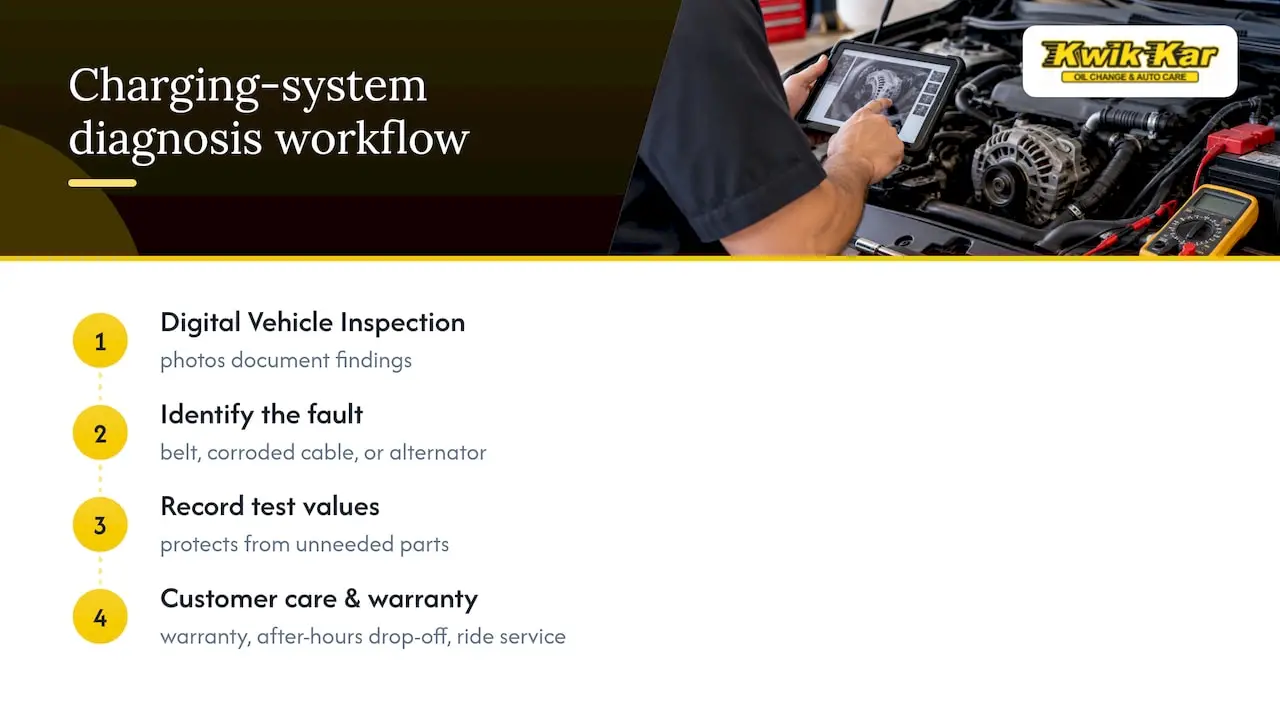
Our technicians walk through this same sequence on every vehicle that comes in with charging-system symptoms, starting with a Digital Vehicle Inspection that documents what we find with photos, not just a verbal estimate. That documentation means you can see exactly why we’re recommending a repair, whether it’s a belt, a corroded cable, or the alternator itself.
We provide warranty coverage on repairs, and offer after-hours drop-off and a ride service so a charging-system diagnosis doesn’t have to derail your day. Recorded test values also protect you from paying for a part you didn’t actually need.
Why early diagnosis saves you money
Catching alternator trouble early is almost always cheaper than waiting. A battery that’s been repeatedly undercharged can fail well before its time, and a roadside breakdown costs more in towing and lost time than a scheduled diagnostic visit ever would.
We’d rather confirm a real alternator failure with documented tests than replace a part on a guess. If you’re unsure what your symptoms mean, calling a shop you trust is a reasonable first step, not an overreaction.
— Kwik Kar
Schedule a charging-system check with our team
We offer dedicated Electrical & Starter service built around a thorough diagnostic process, with warranty coverage so you know the repair is done right the first time.

Getting started is simple:
- Schedule a charging-system diagnostic with our team.
- Receive a Digital Vehicle Inspection with photos and a clear written estimate before any work begins.
- Approve the repair only once you understand exactly what’s being fixed and why.
Visit our diagnostics page to book a visit and get a clear answer instead of a guess.
FAQ
How do you detect an alternator failure?
Watch for a battery or charging-system warning light, dimming or flickering lights, repeated dead batteries, or a car that dies shortly after a jump-start. A multimeter reading outside roughly 13.5 to 14.5 volts while the engine runs confirms the charging system needs professional attention.
What’s the difference between a bad alternator and a bad starter?
A bad alternator causes symptoms while the engine is running, like dimming lights or repeated dead batteries, since it fails to keep the battery charged. A bad starter instead prevents the engine from cranking at all when you turn the key, which is a separate system entirely.
Can a car run on a failing alternator?
A car can sometimes run for a short time on battery power alone once the alternator stops charging properly, but it will eventually stall as the battery depletes. Reducing electrical load and getting a diagnosis quickly is safer than relying on the battery to carry the car.
Is it safe to keep driving with the battery light on?
Driving with the battery light on is risky since it usually signals the alternator or charging system isn’t keeping the battery charged. We recommend reducing electrical load and heading to a shop for a diagnosis rather than continuing on a longer trip.
What voltage should a healthy charging system show?
A healthy system typically reads around 12.5 volts with the engine off and between 13.5 and 14.5 volts while the engine is running and charging. Readings consistently outside that range point to a charging-system problem worth professional testing.
Sources
- Signs Your Alternator May Need to Be Replaced | Via
- Warning Signs Of A Bad Alternator | AAA Club Alliance
- Signs of a bad alternator | O’Reilly Auto
- Checking the alternator | HELLA