


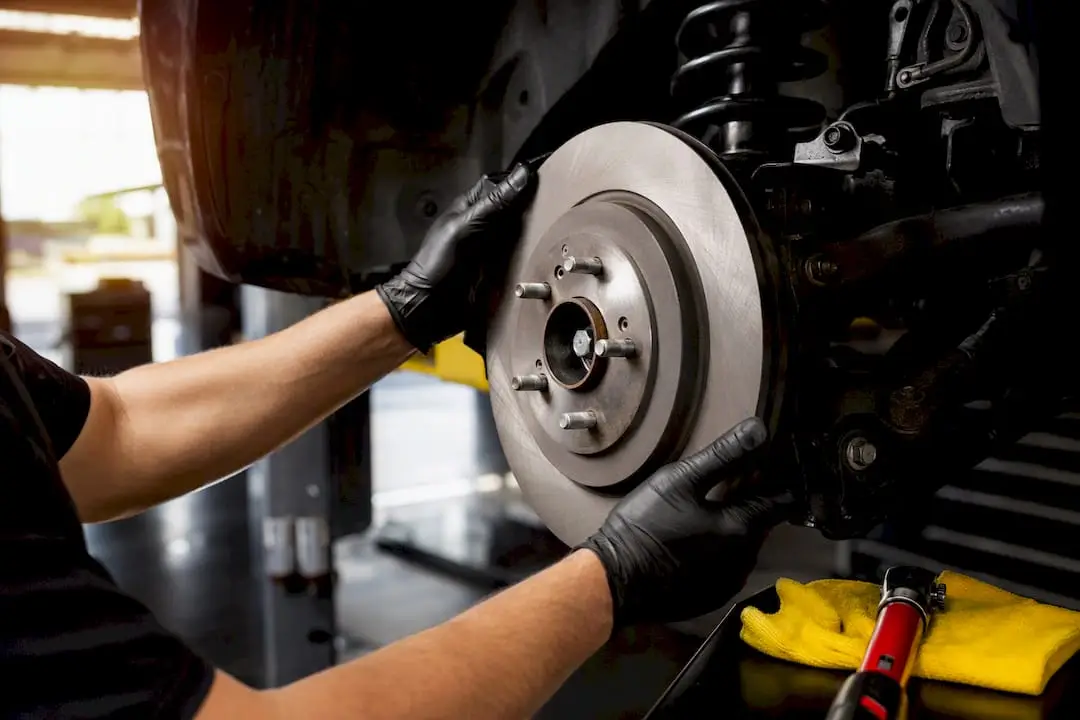
Most drivers pay $300 to $600 per axle for brake rotor replacement, and in 2026, replacing rotors almost always beats resurfacing them, based on current industry consensus. If your brakes grind, shake the steering wheel, or pull to one side, stop driving and get them checked right away. An intermediate DIYer with the right tools can usually handle the swap in an afternoon, but many drivers will save time and hassle by having a shop measure and document the job.
TL;DR:
- Replacing brake rotors typically costs between $300 and $600 per axle for most vehicles, with higher prices for trucks, EVs, and luxury models due to larger parts.
- Signs of bad rotors include pedal vibration, grinding noises, visible grooves, cracks, and blue discoloration, but a measurement of thickness is the most accurate diagnostic tool.
- In 2026, resurfacing rotors is almost always less safe and economical than replacement, especially for thin factory and performance rotors.
- A proper brake job involves measuring rotor thickness, torqueing hardware correctly, and completing a bed-in procedure to prevent future pulsation issues.
- Reputable shops should provide a detailed, written estimate with rotor thickness measurements and include a warranty and a clear record of parts and procedures.
Table of Contents
- What Does Brake Rotor Replacement Cost?
- What Are the Warning Signs of Bad Rotors?
- Can You Replace Brake Rotors Yourself?
- Should You Resurface or Replace Your Rotors?
- How Does the Replacement Process Actually Work?
- How Do You Get a Fair Quote and Avoid Overpaying?
- What Should You Ask Before You Drop Off Your Car?
- What Does a Quality Brake Job Look Like at Kwik Kar of Celina?
- Why Measurement Beats Guesswork on Rotors
- Book a Brake Inspection With Kwik Kar of Celina
- Sources
- FAQ
What Does Brake Rotor Replacement Cost?
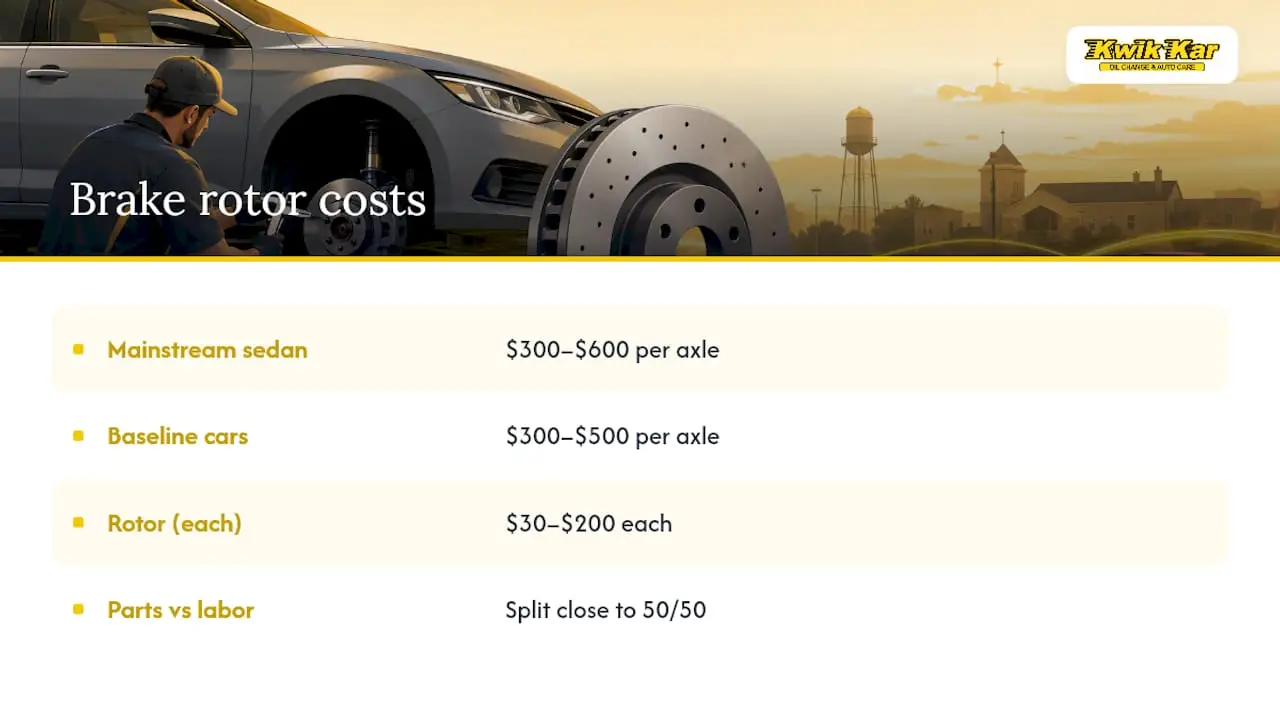
Rotor prices and labor rates swing the total more than most drivers expect. For a mainstream sedan or crossover, expect to pay around $300 to $600 per axle when pads are replaced at the same time, which is the standard recommendation. Trucks, SUVs, EVs, and luxury vehicles run higher, sometimes well past $600 per axle, because their rotors are larger and their brake systems carry more hardware.
Parts and labor typically split close to evenly. Rotors themselves range widely, often $30 to $200 each depending on whether they’re basic blank rotors or coated, drilled, or slotted performance versions. Labor commonly accounts for a substantial portion of the cost, since the job involves lifting the vehicle, pulling the caliper and bracket, and torquing everything back down correctly.
A few extras push quotes higher. Corroded hardware, rusted-on rotors that need extra time to free, ABS wheel speed sensors near the hub, and any request for premium coated rotors all add to the estimate. A baseline expectation of $300 to $500 per axle holds for most everyday cars, with region and vehicle class explaining most of the spread you’ll see between shop quotes.
What Are the Warning Signs of Bad Rotors?
Your brakes usually tell you something is wrong before a rotor fails outright. Watch for these signals:
- Vibration or pulsation felt through the brake pedal or steering wheel when braking
- Rhythmic squealing or grinding noises, especially at low speed
- Visible deep grooves, cracks, or scoring on the rotor’s face
- A blue or discolored tint on the rotor surface, a sign of overheating
A visual check only tells part of the story. The rotor might look fine but still measure thinner than it should, which is why a micrometer reading at the thinnest point of the rotor matters more than eyeballing it. If you feel grinding, violent shaking, or the car pulling hard to one side when you brake, that’s not a “get it checked next week” situation. Stop driving and arrange repair as soon as you can, even if that means a short, careful trip to the nearest shop. To understand what these symptoms mean before you get under the car, our guide on signs it’s time for new brake rotors breaks down each one in more depth.
Can You Replace Brake Rotors Yourself?
If you’ve already swapped brake pads and felt comfortable doing it, rotors are a reasonable next step. The job uses similar tools and adds only a few extra steps. Here’s what you’ll need and how to stay safe:
- Gather your tools: jack stands rated for your vehicle’s weight, a torque wrench, a C-clamp or brake piston tool, a micrometer, and brake cleaner.
- Lift the vehicle on a flat surface and set it on jack stands. Never work under a car supported only by a jack.
- Remove the wheel, then the caliper and bracket. Support the caliper so it doesn’t hang by its brake hose, which can damage the line.
- Pull the old rotor, install the new one, and torque the lug nuts to your manufacturer’s spec in the correct pattern.
- Test the pedal firmness and do a slow test drive in an empty lot before hitting the road.
Some jobs belong with a professional. If a rotor is rusted onto the hub and won’t budge, if your vehicle has an electronic parking brake or integrated ABS sensor near the rotor, or if you don’t own a torque wrench and micrometer, hand it to a shop rather than guessing.
Should You Resurface or Replace Your Rotors?
Resurfacing used to be the default move. In 2026, it rarely makes financial or safety sense. Modern rotors are manufactured thinner than older designs, and many arrive with only 1 to 2 millimeters of material above the discard specification, so machining off even a small amount of surface damage often pushes the rotor below its legal minimum.
That minimum is stamped directly on the rotor as “MIN TH,” usually on the outer edge or hub area. A shop, or you, should measure the rotor’s actual thickness with a micrometer and compare it against that stamp before deciding anything. If there’s a solid margin, resurfacing an older, heavier rotor can still be worth it. For thin factory rotors, replacement is usually the safer and cheaper path once you factor in machining labor against the cost of a new part.
How Does the Replacement Process Actually Work?
Whether you’re doing it yourself or watching a technician work, the sequence looks the same:
- Lift and secure the vehicle, then remove the wheel.
- Remove the caliper and mounting bracket, supporting the caliper so it doesn’t strain the brake hose.
- Remove the old rotor, using penetrating oil or controlled heat if it’s rusted onto the hub.
- Install the new rotor along with fresh pads, since replacing rotors in pairs on the same axle prevents uneven braking.
- Torque the caliper bolts and lug nuts to spec, then perform a bed-in procedure to ensure an even pad layer and prevent future pulsation complaints.
A straightforward axle takes most technicians 45 minutes to an hour and a half, as explained in detail on Auto Glass Kings about their repair process and customer expectations. Frozen rotors, integrated electronic parking brakes, or seized hardware add time and sometimes cost.
Pro Tip: After installation, drive gently for the first 15 to 20 stops, avoiding hard braking or holding the brake at a stop while the rotor is hot. This bed-in process seats the pad material evenly and prevents disc thickness variation, which causes far more pulsation complaints than an actual warped rotor.
Recheck lug torque after the first 50 to 100 miles, and take a short test drive to confirm the pedal feels firm and the car tracks straight under braking.
How Do You Get a Fair Quote and Avoid Overpaying?
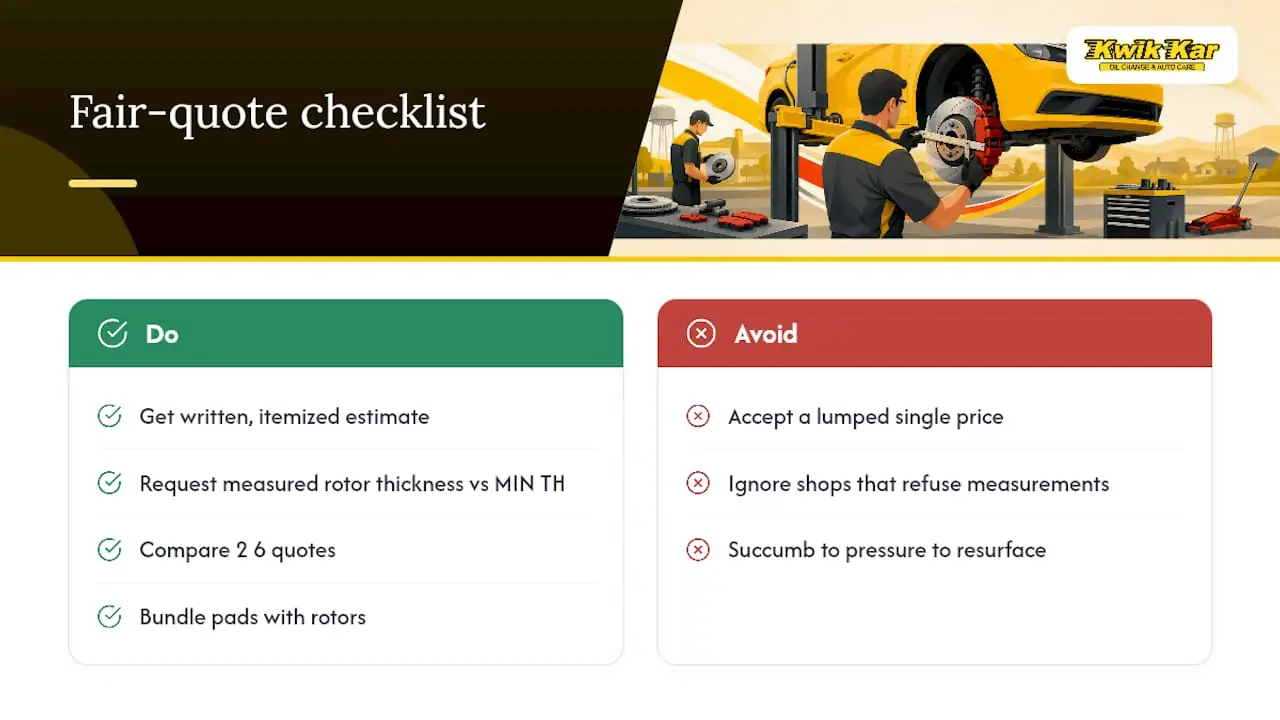
A written estimate should break down parts, labor, disposal fees, and any sensor or hardware charges separately, not lump them into one number. Ask the shop to state the measured rotor thickness against the MIN TH spec in that estimate. If they can’t or won’t give you a number, that’s worth questioning.
You can save money without cutting corners. Reputable aftermarket rotors often perform just as well as OEM parts at a lower price, and bundling pads with rotors usually costs less than paying for two separate labor charges later. If budget is tight, replacing one axle now and the other soon after is safer than delaying both. Getting quotes from two or three shops helps you spot outliers fast.
Be wary of vague diagnoses, a shop that refuses to share actual measurements, or heavy pressure to resurface rotors that are clearly near their minimum thickness. Those are signs to get a second opinion.
What Should You Ask Before You Drop Off Your Car?
A few questions upfront prevent surprises on pickup:
- Ask for the measured rotor thickness and how it compares to the MIN TH stamp.
- Confirm whether pads will be replaced along with the rotors.
- Ask what brand or grade of rotor they’re installing.
- Ask how lug nuts will be torqued, ideally with a torque wrench, not an impact gun alone.
- Ask whether a bed-in procedure is included before you drive off.
Get an itemized written estimate before work starts, and flag if your vehicle’s ABS or electronic parking brake needs extra service. After about a week of driving, check for returning pulsation or uneven pad wear, since that can signal an installation issue worth a follow-up visit.
What Does a Quality Brake Job Look Like at Kwik Kar of Celina?
A trustworthy brake job leaves a paper trail, not just a receipt. At Kwik Kar of Celina, ASE-certified technicians perform Digital Vehicle Inspections that document exactly what they find, including measured rotor thickness, so you’re not taking anyone’s word for it. Every repair carries a warranty, and after-hours drop-off plus a ride service offers convenience to your schedule.
The details that separate a solid repair from a rushed one are measured thickness against MIN TH, a documented torque method, a completed bed-in procedure, and a clear record of parts used. Ask for those specifics regardless of who does the work.
Why Measurement Beats Guesswork on Rotors
Rotors got thinner, aftermarket parts got cheaper, and resurfacing lost its economic edge. The fix isn’t complicated: insist on a measured MIN TH reading and a written record of the job, not a guess based on how a rotor looks.
— Kwik Kar
Book a Brake Inspection With Kwik Kar of Celina
If you’d rather have a documented, warrantied brake job than gamble on a DIY afternoon, Kwik Kar of Celina gives Celina drivers a straightforward alternative to guesswork repair shops: a written Digital Vehicle Inspection with actual rotor thickness readings verified by the shop, done by ASE-certified technicians, backed by a 2-year/24,000-mile warranty.
When you book, ask us to include your rotor thickness measurements against the MIN TH spec and confirm a bed-in procedure before you drive off the lot. Between after-hours drop-off and our complimentary ride service, getting your brakes done right shouldn’t cost you a whole day. Visit our general auto repair page to schedule your brake inspection and get a quote with the numbers spelled out, not hidden.
Sources
- What are signs of bad rotors? | PowerStop
- Signs of warped brake rotors | AutoZone DIY
- Brake rotor replacement cost (2026) | Pulscar
- Warped rotors: can you drive safely? | DirectBrakes
- Average cost rotors (2026) | CostInsider
FAQ
How much does it usually cost to replace rotors?
Most mainstream vehicles run $300 to $600 per axle with pads included, though trucks, EVs, and luxury vehicles often cost more due to larger rotors and pricier parts.
Can I replace my rotors by myself?
Yes, if you’ve handled brake pad jobs before and have jack stands, a torque wrench, and a micrometer; skip the DIY route if hardware is seized or your vehicle has an integrated electronic parking brake.
How do I know if my rotors need replacing?
Watch for pedal or steering wheel vibration, grinding or squealing noises, visible grooves or cracks, and blue discoloration, then confirm with a thickness measurement against the MIN TH stamp.
Can I still drive if my rotors are bad?
Light vibration might allow a short, cautious drive to a repair shop, but grinding, violent shaking, or pulling during braking means you should stop driving and get the vehicle inspected immediately.