


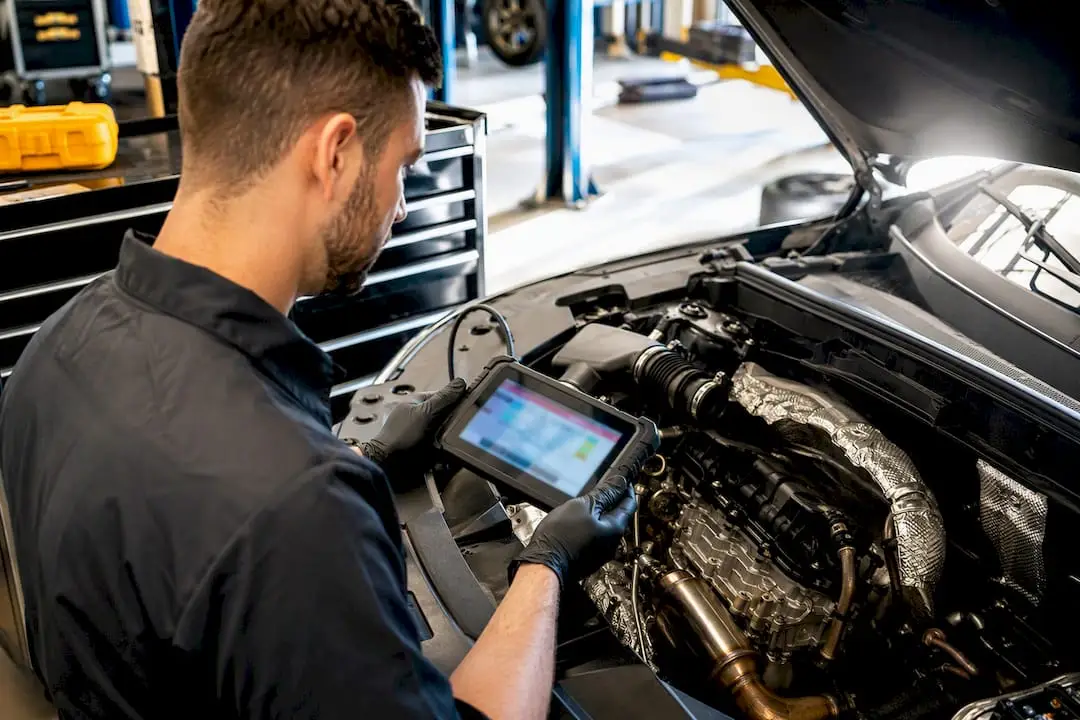
P0420 means the powertrain control module has detected that your catalytic converter’s efficiency on Bank 1 has dropped below the manufacturer’s threshold. That’s it. It’s a performance flag, not a death certificate for your converter. Before you spend a dime on parts, scan for related codes and pull live oxygen sensor data. Nine times out of ten, that’s where the real story is.
TL;DR:
- Most P0420 codes are caused by issues such as exhaust leaks, faulty oxygen sensors, or engine misfires, not just the catalytic converter itself.
- Diagnosing a P0420 requires reviewing fuel trim data, live oxygen sensor signals, and inspecting for leaks or sensor faults before replacing the converter.
- Repair costs vary from $100 to $400 for sensor and leak fixes, up to $2,500 for a new converter, emphasizing the importance of ruling out simpler causes first.
- A P0420 does not usually require urgent driving cessation unless accompanied by symptoms like rough performance or a sulfur smell, which indicate active damage.
- Proper diagnosis with full testing prevents unnecessary catalytic converter replacement and ensures the underlying problem is addressed to avoid repeated failures.
Table of Contents
- What Does the P0420 Code Mean for Your Catalytic Converter?
- What Symptoms Should You Watch for With P0420?
- What Causes a P0420 Code, from Most to Least Common?
- How Do Technicians Diagnose a P0420 Code?
- What Does It Cost to Fix a P0420 Code?
- Is a P0420 Code Serious, and Can You Keep Driving?
- How Does a Professional Repair Shop Approach a P0420 Diagnosis?
- Get Your P0420 Code Diagnosed Right the First Time
- Where to Find More on P0420 Diagnostics
- Sources
- FAQ
What Does the P0420 Code Mean for Your Catalytic Converter?
Your engine’s computer, the PCM, watches two oxygen sensors on Bank 1: one before the catalytic converter (upstream) and one after it (downstream). A healthy converter smooths out the oxygen signal. The upstream sensor should swing rapidly between rich and lean as the engine runs, while the downstream sensor should stay relatively flat and steady, showing that the converter is doing its job of storing and releasing oxygen efficiently.
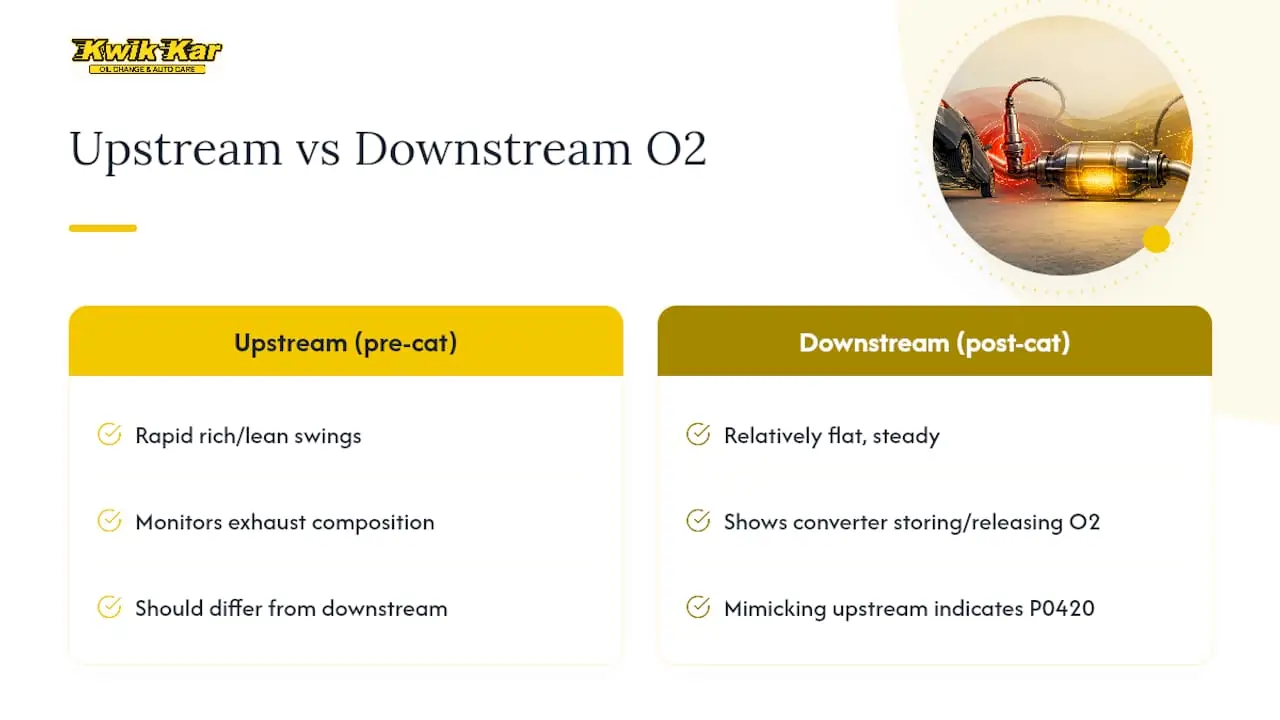
When the PCM sees the downstream sensor start mimicking the upstream sensor’s ups and downs, it assumes the converter has lost its ability to store oxygen properly, and that triggers P0420.
“Bank 1” simply refers to the side of the engine that contains cylinder number one. On a four-cylinder engine, there’s only one bank, so this distinction barely matters. On a V6 or V8, it tells your technician exactly which side of the engine and which converter to investigate, saving diagnostic time and labor cost.
What Symptoms Should You Watch for With P0420?
The most obvious sign is a check engine light, and the PCM logs freeze-frame data the moment it triggers, capturing engine speed, load, and temperature at that instant. That snapshot becomes valuable evidence for whoever diagnoses the problem later.
Beyond the dashboard light, drivers report a mix of symptoms depending on what’s actually causing the code:
- A rotten-egg or sulfur smell coming from the exhaust, usually a sign of a struggling or overheated converter
- Reduced engine power or noticeably sluggish acceleration, especially under load
- A rattling noise from underneath the car, which can mean the converter’s internal substrate has cracked or collapsed
- Worse fuel economy than usual, since a misfire or rich condition often causes P0420 in the first place
- A failed state emissions test, since P0420 is one of the most common reasons vehicles fail inspection
Some vehicles run fine with P0420 present and show none of these symptoms at first. That doesn’t mean the underlying cause has gone away. It usually means the damage is still in its early stages.
What Causes a P0420 Code, from Most to Least Common?
Most P0420 diagnoses start in the wrong place: the converter. In reality, the converter is often the victim, not the villain. Here’s the rough order of likelihood technicians work through:
- Catalytic converter contamination or damage. Oil or coolant burning through a failing engine seal coats the internal substrate and kills its efficiency. Sustained overheating from misfires can melt or collapse the honeycomb structure entirely.
- Weak or slow oxygen sensors. Sensors degrade with age and mileage, and a sluggish upstream or downstream sensor can produce a false efficiency reading even when the converter is fine.
- Exhaust leaks upstream of the downstream sensor. A leaking manifold gasket or cracked pipe lets outside air reach the sensor, skewing its reading and mimicking converter failure.
- Misfires, rich conditions, or bad fuel trims. Unburned fuel dumped into the exhaust overheats and chemically poisons the converter over time, which is the single fastest way to destroy a good one.
- PCM calibration issues or a poor-quality aftermarket converter. Some vehicles need a software update to properly interpret sensor data, and cheap universal converters frequently can’t meet the original efficiency threshold.
How Do Technicians Diagnose a P0420 Code?
A rushed diagnosis is how good converters end up in the trash and customers end up paying twice. Here’s the sequence a competent shop follows, and it’s worth knowing so you can tell whether a repair estimate skipped steps.
- Confirm the code and pull freeze-frame data. The technician checks for companion codes, particularly misfire codes (P0300 series) or fuel trim codes, since those point to a root cause well beyond the converter itself.
- Review fuel trims and misfire counters. Short-term and long-term fuel trims should generally sit within roughly ±10%. Numbers well outside that range mean the engine is running too rich or too lean, and that imbalance is likely cooking the converter.
- Graph live oxygen sensor data. The upstream sensor should switch quickly between rich and lean. The downstream sensor should stay comparatively flat. If the downstream trace starts mirroring the upstream one, that’s the classic signature of a converter that’s lost its oxygen storage capacity, though fuel and ignition health need to be confirmed healthy first.
- Inspect for exhaust leaks and check sensor wiring. A visual and smoke-test inspection rules out a leaking gasket or a chafed wire before anyone touches the converter.
- Physically inspect the converter. A technician will listen for rattling that suggests a collapsed substrate and check for heat discoloration or physical damage.
- Run an oxygen storage capacity test or 5-gas analysis if needed. Graphing rear oxygen sensor voltage under different driving conditions is a low-cost way to confirm whether the converter itself has failed, rather than guessing.
- Check for manufacturer TSBs or PCM calibration updates. Some automakers have issued software recalibrations that adjust how aggressively the PCM flags catalyst efficiency, which can resolve a P0420 with no hardware replacement at all.
Pro Tip: Don’t let anyone replace your catalytic converter until misfires, exhaust leaks, sensor faults, and contamination have all been ruled out. Ask your shop to save the freeze-frame and mode $06 data before and after the repair. That documentation protects you if the code comes back and proves the diagnosis was done right the first time.
What Does It Cost to Fix a P0420 Code?
Repair costs for P0420 swing wildly because the code has so many possible root causes, and a shop that jumps straight to converter replacement is usually skipping the cheaper options first. Work through fixes in this order:
- Exhaust leaks, oxygen sensor replacement, or wiring repair. These typically run somewhere in the $100 to $400 range for parts and labor combined, and they resolve the issue often enough that they’re always worth ruling out first.
- Misfire and fuel system repairs. Spark plugs, ignition coils, or fuel injectors vary widely in cost depending on the vehicle, but skipping this step means a new converter could fail again within months.
- Catalytic converter replacement. This is the most expensive path, generally landing between $400 and $2,500 depending on whether you use an OEM part, a direct-fit aftermarket unit, or a CARB-compliant converter required in certain states.
- PCM software recalibration. Some dealerships can resolve P0420 with a calibration update alone, which usually costs far less than a converter.
Unresolved root causes routinely cause a replacement converter to fail again, which is the single most expensive mistake in this whole process. A cheap universal converter that isn’t matched to your vehicle’s emissions requirements often re-triggers the code within weeks, turning a $400 repair into an $800 one. Choosing a direct-fit or CARB-compliant unit where required avoids that trap entirely.
Is a P0420 Code Serious, and Can You Keep Driving?
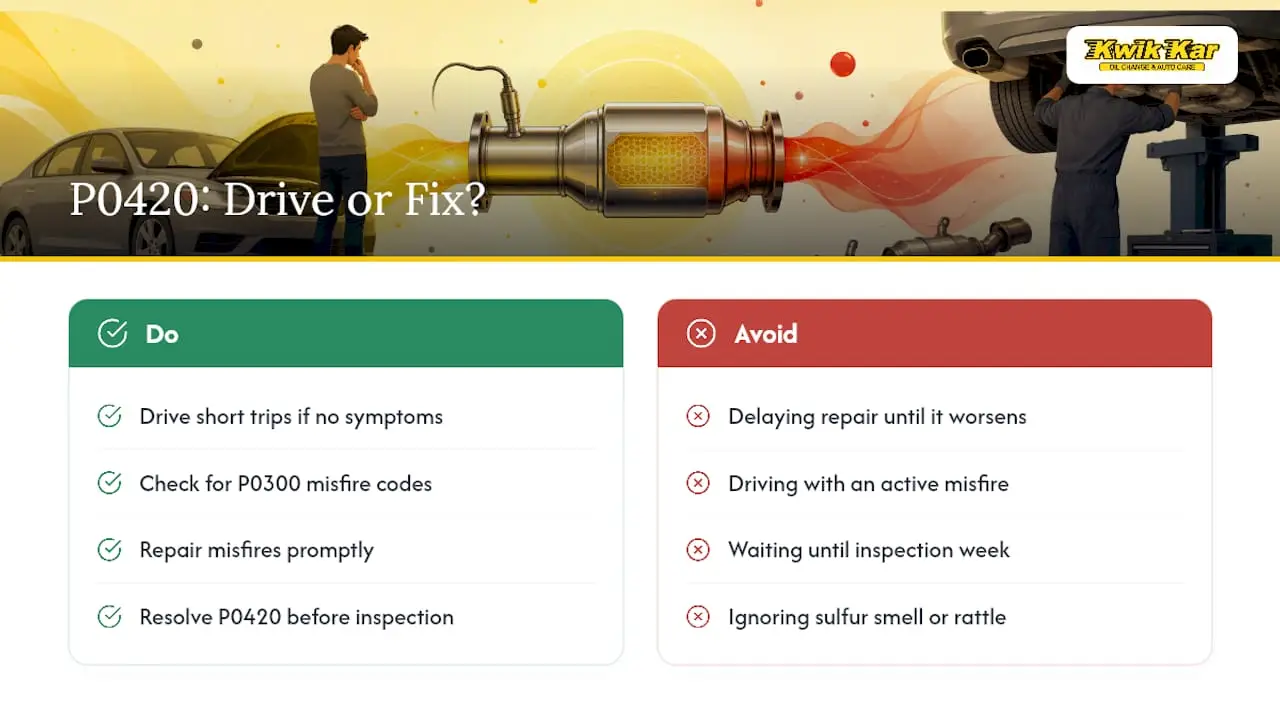
Short-term, most vehicles tolerate a P0420 code just fine. You can typically keep driving to work or run errands without the car stranding you. Long-term is a different story: an unresolved cause, especially a misfire, keeps dumping unburned fuel into the converter and accelerates its failure, turning a moderate repair into a full replacement.
Some situations deserve immediate attention rather than a “get to it eventually” approach. A P0420 paired with a misfire code in the P0300 series, a strong sulfur smell, a rattling noise, or a noticeable loss of power means the problem is active and worsening, not sitting still.
If you live somewhere with mandatory emissions testing, know that P0420 is one of the more common reasons vehicles fail their inspection. Waiting until inspection week to deal with it rarely ends well.
How Does a Professional Repair Shop Approach a P0420 Diagnosis?
The P0420 code is treated the same way every time: it is ruled out before anything is replaced. When a vehicle comes in with this code, freeze-frame and mode $06 data are pulled first, and live oxygen sensor traces are shown during a Digital Vehicle Inspection so customers can see exactly what the technician is seeing on the screen.
The shop checks for misfires, exhaust leaks, and contamination before a catalytic converter replacement ever makes it onto an estimate. Skipping that step can lead to unnecessary replacement costs. If a repair is warranted, eligible work is often backed by a warranty, and some shops offer after-hours drop-off and complimentary ride services to help customers manage their schedules.
Get Your P0420 Code Diagnosed Right the First Time
A P0420 code is one of the easiest ones to overdiagnose, and an unnecessary converter swap can cost you hundreds of dollars you didn’t need to spend. Kwik Kar of Celina’s ASE-certified technicians run the full diagnostic sequence, including live oxygen sensor analysis and freeze-frame review, before recommending any parts replacement, so you’re paying for the actual fix instead of a guess.

Our Digital Vehicle Inspection shows you the same data our technicians are reading, including exhaust leak checks, sensor readings, and misfire history, so you understand exactly what’s driving your check engine light. If a repair is needed, it’s backed by our 2-year/24,000-mile warranty, and if your car needs to stay overnight, our after-hours drop-off and complimentary ride service keep your schedule intact. Bring in any scan tool printouts or notes on when the light came on. Schedule your general auto repair appointment with Kwik Kar of Celina and get a straight answer on what’s actually wrong.
Where to Find More on P0420 Diagnostics
For deeper technical detail, Walker Exhaust Systems breaks down the full diagnostic workflow technicians use. Always check your vehicle manufacturer’s own service information and TSBs for model-specific repair steps, since PCM calibration and sensor placement vary by make.
Sources
- P0420 Code – Catalyst System Low Efficiency – 13.2% (KBB)
- P0420 Code: The Guide to Diagnosis and Fast Fixes (Identifix)
- How to Fix P0420 Emissions Code (Walker Exhaust Systems)
- P0420: Catalyst System Efficiency Below Threshold (Bank 1) (Edmunds)
FAQ
How Do I Fix a P0420 Code?
Start by scanning for related codes and checking live oxygen sensor data rather than replacing the converter first. Fix any exhaust leaks, misfires, or faulty sensors, since those cause most P0420 codes, and only replace the converter once those root causes are ruled out.
How Much Does It Cost to Fix a P0420 Code?
Costs range from about $100 to $400 for a sensor, wiring, or exhaust leak repair, up to $400 to $2,500 for a full catalytic converter replacement depending on the part type. The right number depends entirely on which root cause is actually behind your code.
Is a P0420 Code Serious?
It’s not usually an emergency by itself, but ignoring the underlying cause, especially a misfire, can accelerate converter damage and lead to a failed emissions test. Treat it as worth addressing soon rather than something to put off indefinitely.
Can I Still Drive My Car With a P0420 Code?
Most vehicles can be driven short-term with a P0420 code and no other symptoms. If you notice a rotten-egg smell, rattling, a loss of power, or a companion misfire code, get it inspected quickly, since those signs point to active damage rather than a minor sensor glitch.