



A radiator fan that will not turn on is usually a blown fuse, a failed relay, a wiring or connector fault, a bad fan motor, or a faulty temperature sensor. If your temperature gauge is climbing, you see steam, or a warning light is on, stop driving and let the engine cool. If the gauge is steady, you can safely work through the checklist below before deciding whether to call for a tow.
TL;DR:
- Checking the fan fuse, relay, and wiring is the first step, as these often cause simple electrical failures and are inexpensive to replace.
- A fan that runs when A/C is on but not otherwise indicates a sensor or control module issue, while a fan that never runs points to fuse, relay, wiring, or motor faults.
- If the temperature gauge climbs rapidly or warning lights activate, stopping immediately and calling for a tow prevents severe engine damage.
- Most diagnostic codes like P0480 or P0526 suggest wiring, fuse, relay, or sensor faults rather than a failed fan motor itself.
- Routine maintenance such as coolant level checks, radiator cleaning, and connector inspections can prevent fan failures before they occur.
Table of Contents
- Quick checks you can safely run right now
- Step-by-step diagnostic sequence a shop would follow
- When overheating means you should stop driving
- What the common fan codes actually mean
- Maintenance that prevents fan failures before they start
- What an ASE-certified shop checks that you can’t do at home
- Our take: diagnose the cheap parts first, but don’t stop there
- Get your cooling system checked at Kwik Kar of Celina
- FAQ
- Sources
Quick checks you can safely run right now
Before you reach for tools, rule out the easy stuff. Most no-start fan complaints trace back to one of five simple failure points, and you can check all of them in a few minutes with the engine off and cool.
- Look at your instrument cluster for a temperature spike or an illuminated warning light.
- Check the coolant reservoir level only when the engine is cold, and look for leaks, stains, or steam near the radiator.
- Inspect the fan blades and shroud for broken blades, debris, or anything jammed in the works.
- Find the fan fuse and relay in your owner’s manual, check them visually, and swap in a fuse of the same rating if one is blown.
- Turn on the A/C and see if the fan kicks on. If it does, the fault likely sits upstream in the control side rather than the motor itself.
That last check matters more than it seems. A fan that runs with the A/C on but not otherwise points toward a sensor or control module issue, while a fan that never runs under any condition points toward the fuse, relay, wiring, or motor.
Step-by-step diagnostic sequence a shop would follow
When the quick checks do not solve it, the next steps follow the same logic a trained technician uses: start safe, then narrow the fault from the simplest cause to the most expensive one. Consumer Reports recommends a diagnosis-first approach rather than swapping parts on a guess, since adding coolant or replacing a component won’t fix an electrical fault.
- Let the engine cool fully, wear eye protection, and disconnect the battery if your vehicle’s wiring diagram calls for it before touching fan connectors.
- Plug in an OBD-II scanner and pull stored and pending codes. Many scanners can also command the fan on directly, which tells you right away whether the control side or the motor is at fault.
- Pull the fan fuse and relay and test them properly, using a relay test socket or swapping in a known-good relay of the same type from another circuit.
- Inspect the connectors and ground points near the fan for corrosion or loose pins, and pull each pin to check the contact surface.
- Run a fused direct-power test to the fan motor following your vehicle’s wiring diagram. Keep hands and tools clear since the blades can start moving the moment power connects.
- Check voltage at the connector and, where you have the equipment, measure current draw. A motor pulling unusually high current is often seized or failing internally rather than simply disconnected.
- Based on what you find, repair the wiring, replace the relay or fuse, replace the fan motor, or schedule a shop visit for deeper testing.
Pro Tip: Always use a fused jumper wire for a direct-power test. An unfused direct connection can fry the wiring harness if something downstream is shorted.
Corroded connectors show up often enough after wet seasons that they deserve special attention, with some useful insights found in this key fob not detected: Fix it now or call a pro partner article. Moisture intrusion can affect common electrical problems in vehicles well beyond the cooling fan, so a thorough connector check is worth the extra few minutes.
When overheating means you should stop driving
Some symptoms mean pull over now, not when convenient. AAA advises stopping and arranging a tow the moment you see real overheating signs, since stop-and-go traffic and hot weather make a failing cooling system fail faster.
- Steam rising from under the hood or a sweet smell of coolant.
- A temperature gauge climbing rapidly or pegged near the red zone.
- An illuminated temperature or coolant warning light.
- Visible coolant puddles under the car or a hissing sound from the radiator area.
Continuing to drive on an overheating engine risks a blown head gasket, warped cylinder heads, or a seized engine, repairs that cost far more than a fan. Short trips in stop-and-go traffic or hot weather put extra strain on a struggling cooling system. If the gauge is steady and you just noticed the fan was quiet at idle, you can typically drive to a shop with the A/C off, since highway airflow often keeps temperatures in check.
What the common fan codes actually mean
A scan tool rarely gives you the exact broken part, but it narrows the search considerably. KBB’s OBD-II code library outlines what each cooling fan code typically points to.
- P0480, cooling fan 1 control circuit malfunction, often means a blown fuse, bad relay, damaged wiring, or a failed fan motor.
- P0481, the equivalent code for a second fan circuit on vehicles with dual fans, points to the same list of suspects on that circuit.
- P0483, fan speed or function malfunction, suggests the fan is not running at the speed the module commands, which can mean a sensor, module, or resistor issue.
- P0526, fan speed sensor circuit malfunction, typically means a wiring or sensor fault feeding incorrect speed data back to the control module.
- P0597, thermostat heating control circuit malfunction, often gets mistaken for a fan problem but usually traces back to the thermostat or its control circuit instead.
None of these codes replace a hands-on check. They tell you where to look, not which part to buy.
Maintenance that prevents fan failures before they start
A little routine attention goes a long way toward keeping your cooling fan reliable through hot Texas summers.
- Check coolant level and condition regularly, and flush it on the schedule your owner’s manual recommends.
- Clean debris from the radiator fins so airflow reaches the fan and core properly.
- Inspect wiring near the fan for chafing and check connectors for corrosion, especially after wet weather.
- Have belts, hoses, and the fan shroud inspected for wear, and have the relay tested during routine service visits.
Staying ahead of these small items can make a world of difference when temperatures spike in July.
What an ASE-certified shop checks that you can’t do at home
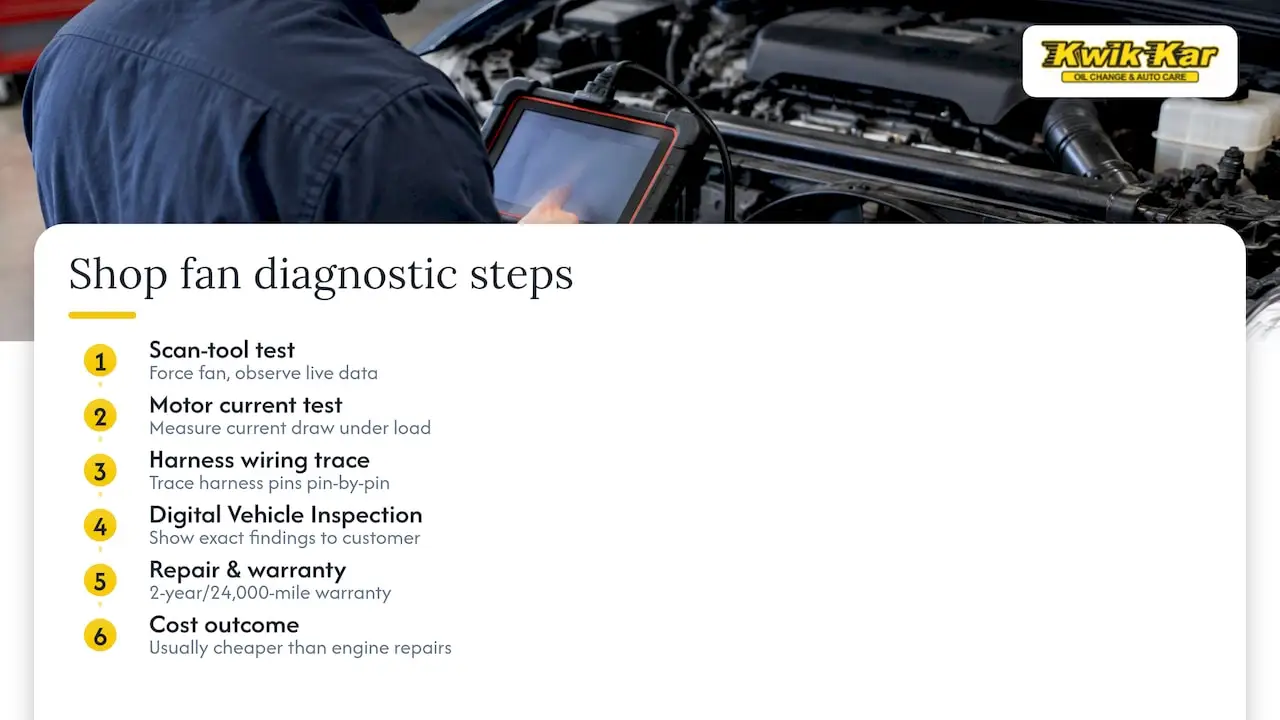
Once you’ve exhausted the basics, a shop brings tools and training that go further. Technicians run scan-tool commands that force the fan on and off while watching live data, measure motor current draw under load, and trace wiring harnesses pin by pin when a connector check isn’t enough. Every diagnostic includes a Digital Vehicle Inspection so you see exactly what we found, and any repair we complete carries our 2-year/24,000-mile warranty. A fan diagnosis and repair is usually less costly than engine work caused by overheating.
Our take: diagnose the cheap parts first, but don’t stop there
The advice that circulates most online stops at “check the fuse and relay,” and that’s genuinely where you should start since those parts fail often and cost little to replace. Where that advice falls short is assuming the fan is an isolated part. It is not. A fan that runs intermittently or draws high current is frequently a symptom of a cooling system under broader strain, a sensor sending bad data, a module losing its own power feed, or coolant flow restricted somewhere else entirely. Treating the fan as a stand-alone fix is how people replace a $40 motor twice before finding the real fault.
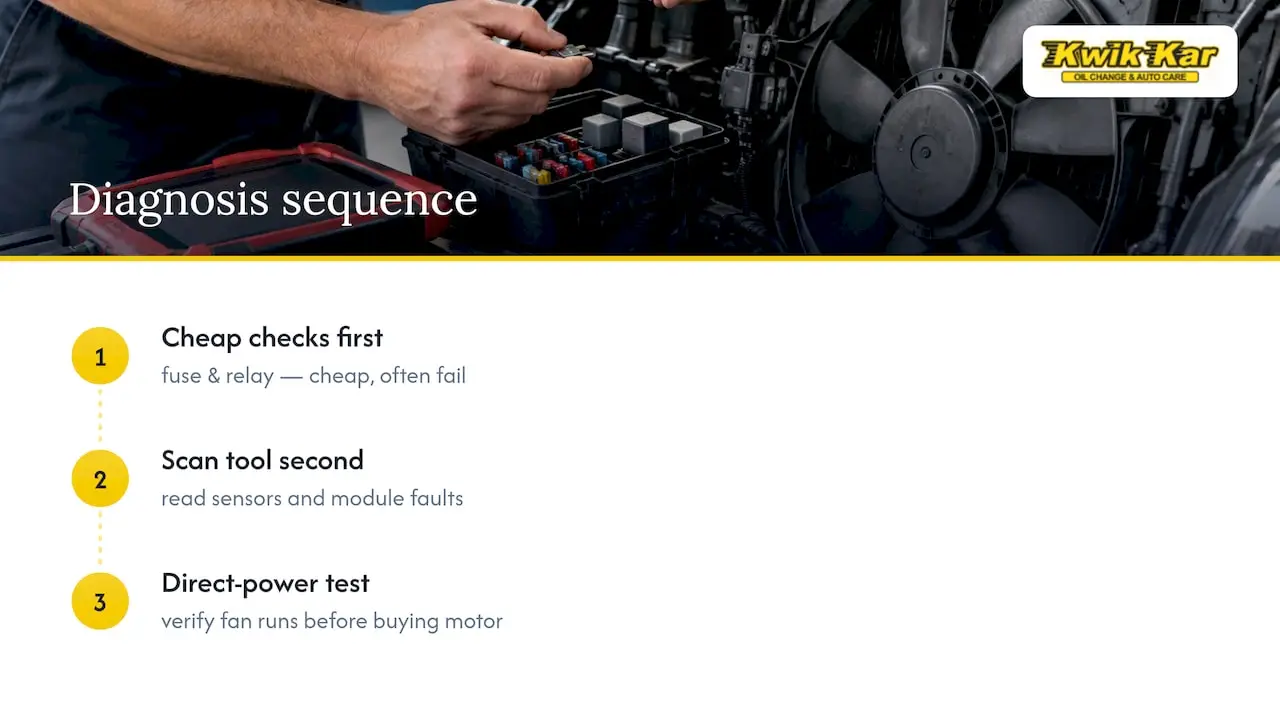
If you take one thing from this, let it be sequencing: cheap checks first, scan tool second, and a direct-power test before you ever buy a new motor. Skipping straight to parts replacement is the single most common way DIY fan repairs turn into repeat visits.
— Kwik Kar
Get your cooling system checked at Kwik Kar of Celina
Cooling-system diagnostics and electrical repairs come with a Digital Vehicle Inspection for clarity and a warranty backing every job, providing a documented answer instead of a guess. An after-hours drop-off option helps you fit fan checks into a busy schedule.

| If you need | We offer |
|---|---|
| A full diagnostic scan and inspection | Diagnostics |
| Cooling system repair or fan replacement | Cooling System |
| Wiring, relay, or connector repair | Electrical & Starter |
Schedule a cooling system inspection today and drive with confidence through the next heat wave.
FAQ
Can I drive a car if the radiator fan is not working?
You can drive short distances at highway speed if the temperature gauge stays steady, since airflow at speed can substitute for the fan. If the gauge climbs, a warning light comes on, or you see steam, pull over and arrange a tow rather than risk engine damage.
How do I tell if my radiator fan is bad?
A bad fan typically fails to turn on when the engine gets hot or when the A/C is running, even though the fuse, relay, and wiring test fine. A fused direct-power test to the motor confirms it: if power reaches the motor and it still does not spin, the motor itself has failed.
Can a bad thermostat cause the radiator fan not to work?
A failing thermostat can prevent the engine from reaching the temperature that normally triggers the fan, or it can trip a related code like P0597 that gets mistaken for a fan fault. Testing the thermostat and coolant temperature sensor separately from the fan circuit helps rule this in or out.
How expensive is it to fix a radiator fan?
Cost depends entirely on what failed: a fuse or relay is inexpensive, while a fan motor or control module costs more in parts and labor. A professional diagnostic at a shop like ours pinpoints the exact failed component before you pay for parts, which is available on request through our Cooling System service.
Sources
- P0480: Cooling Fan 1 Control Circuit Malfunction | KBB OBD-II Codes
- P0526: Cooling Fan Control Circuit Malfunction | KBB OBD-II Codes
- Car overheating: 8 causes and solutions | AAA Automotive
- What to do if your car overheats | Consumer Reports