



Torque converter shudder is a low-frequency vibration that happens when the torque converter’s lock-up clutch loses its grip and slips instead of holding a firm connection, it usually shows up under steady throttle at moderate highway speeds, and the fastest first step is checking your automatic transmission fluid (ATF) and having a shop reproduce the shudder on a road test. Short trips at low speed are generally safe, but this symptom rarely fixes itself, so getting it diagnosed soon protects your transmission from further wear.
TL;DR:
- Most torque converter shudder is caused by fluid degradation, incorrect ATF, or worn clutch surfaces, rather than mechanical failure of the entire transmission.
- Diagnosing shudder requires road testing, scan-tool checks, and fluid inspection before considering costly repair options like rebuilding or replacing the torque converter.
- Proper maintenance, including following manufacturer ATF intervals and managing heat, can prevent reoccurrence of shudder symptoms.
- Fluid service and friction modifiers often resolve shudder without needing full converter replacement, but unresolved issues may demand electrical fixes or hardware repairs.
- Ignoring shudder risks accelerating transmission wear and increasing repair costs, especially if symptoms are paired with slipping gears or unusual odors.
Table of Contents
- What Torque Converter Shudder Feels Like Behind the Wheel
- What Causes Torque Converter Shudder
- How a Shop Diagnoses Torque Converter Shudder
- What an ASE-Certified Shop Checks and Why It Matters
- Fixing Torque Converter Shudder: From Fluid Service to Full Replacement
- How Much It Costs and How Urgent It Is
- Preventing Torque Converter Shudder From Coming Back
- Why We Start Conservative on Every Transmission Diagnosis
- Get Your Transmission Checked at Kwik Kar
- Sources
- FAQ
What Torque Converter Shudder Feels Like Behind the Wheel
Drivers usually describe it as a light, rhythmic buzz or shake that comes through the seat, floor, or gear shifter, almost like driving over a rumble strip at a steady cruise. It’s not a jolt or a bang. It’s a subtle, repeating vibration that shows up and disappears in a pattern tied to speed and throttle position, often developing within a moderate speed range.
You’ll typically notice transmission shudder in a specific window rather than across your whole speed range. Community reports and shop experience indicate shudder commonly appears during light, steady acceleration or cruise at moderate highway speeds, right when the torque converter clutch tries to lock up fully. Punch the gas hard and the shudder often disappears, only to return once you settle back into a steady speed.
Because vibration can come from several places in a vehicle, it helps to rule out the obvious suspects before you assume it’s your torque converter:
- Tires and wheels: an unbalanced tire or a bent wheel usually vibrates in relation to vehicle speed, not throttle position, and it doesn’t go away when you shift into neutral.
- Engine misfire: a rough idle or a check engine light pointing to a misfire code suggests the issue is upstream of the transmission.
- Suspension or driveline: worn CV joints or motor mounts tend to produce clunks or vibration tied to turning or acceleration, not steady-speed cruising.
- Transmission shudder or whining noise when accelerating: a true torque converter issue combines the vibration with the specific speed and throttle pattern described above, sometimes alongside a faint transmission whine or gearbox whining noise during the shift itself.
Before your appointment, write down the exact speed range, whether it happens under light or heavy throttle, whether the RPM needle flutters, any dashboard warning lights, and whether you notice a burnt smell near the fluid dipstick. That detail turns a vague complaint into something a technician can reproduce and diagnose in one road test instead of three.
What Causes Torque Converter Shudder
Torque converter shudder almost always traces back to instability inside the lock-up clutch itself, the mechanism that locks the converter’s input and output so your engine and transmission spin as one unit instead of through fluid coupling alone. SAE research on slip-controlled torque converter clutches found that shudder develops when the friction coefficient between the clutch surfaces doesn’t rise smoothly as sliding speed increases. When that relationship goes flat or drops, the clutch grabs and releases in rapid succession instead of locking smoothly, and that’s the vibration you feel. The SAE’s modeling on ATF friction stability also notes that engine torque output, ATF pressure, and the transmission’s control response time all influence how stable that lock-up feels, so the fluid alone isn’t always the whole story.
The most common triggers mechanics see include:
- Degraded or incorrect ATF: fluid that’s broken down from heat, oxidation, or age loses the friction modifiers it needs, and using the wrong ATF specification for your vehicle can create the same instability from day one.
- Worn or glazed clutch plate surfaces: SAE testing on anti-shudder additives found that surface roughness on the clutch plates correlates directly with how often shudder occurs, meaning a smooth, glazed surface grips less predictably than a properly textured one.
- Contamination: metal particulate or varnish buildup in the fluid changes how the clutch surfaces interact, even when the fluid level looks fine.
- Transmission control or pressure issues: a failing solenoid or a transmission control module (TCM) that’s mistiming the lock-up apply pressure can produce a shudder that looks identical to a fluid problem but requires an electrical fix instead.
That last category is less common than a fluid issue, but it’s exactly why a scan tool and a proper stall test matter before anyone starts swapping parts.
How a Shop Diagnoses Torque Converter Shudder
A reliable diagnosis follows a set order, and you should expect a shop to walk through most of these steps rather than jumping straight to a repair estimate.
- Road-test replication. A technician drives the vehicle at the speeds and throttle positions you described, since a shudder that isn’t reproduced under controlled conditions is much harder to isolate.
- Scan-tool check. Pulling transmission codes and freeze-frame data through a diagnostic scanner shows whether the TCM logged a fault at the moment the shudder happened, which can point straight to a solenoid or pressure issue.
- ATF inspection. This means checking fluid level, color, smell, and looking for metal particulate, since burnt or dark fluid is one of the clearest, quickest signs of a fluid-related cause.
- Pressure and stall-speed testing. If the road test and fluid check don’t explain the symptom, a stall test measures how the torque converter behaves under load, helping confirm whether the clutch itself is slipping abnormally.
- Ruling out other systems. A thorough technician checks engine performance, motor mounts, and driveline components before ever pinning the cause on the torque converter, since vibration from those areas can easily mimic transmission shudder.
Pro Tip: Ask whether your quote includes a documented Digital Vehicle Inspection with photos or notes on fluid condition. That record gives you something concrete to compare against if the shudder returns after a repair, and it keeps the diagnosis honest.
What an ASE-Certified Shop Checks and Why It Matters
At Kwik Kar, our transmission diagnostics follow the same stepwise logic outlined above, run by ASE-certified technicians who document every stage through a Digital Vehicle Inspection. That means you see the actual fluid condition, the scan-tool results, and the technician’s notes rather than a one-line estimate that asks you to take a guess on faith.
We start conservative on purpose. Most shudder complaints begin with a fluid service because ATF condition is the single most common and least invasive cause, and there’s no reason to recommend a torque converter replacement before ruling out something a flush can fix. If the shudder persists after a proper fluid service, we move into pressure and stall testing, and only escalate toward solenoid work or internal transmission repair once the data supports it.
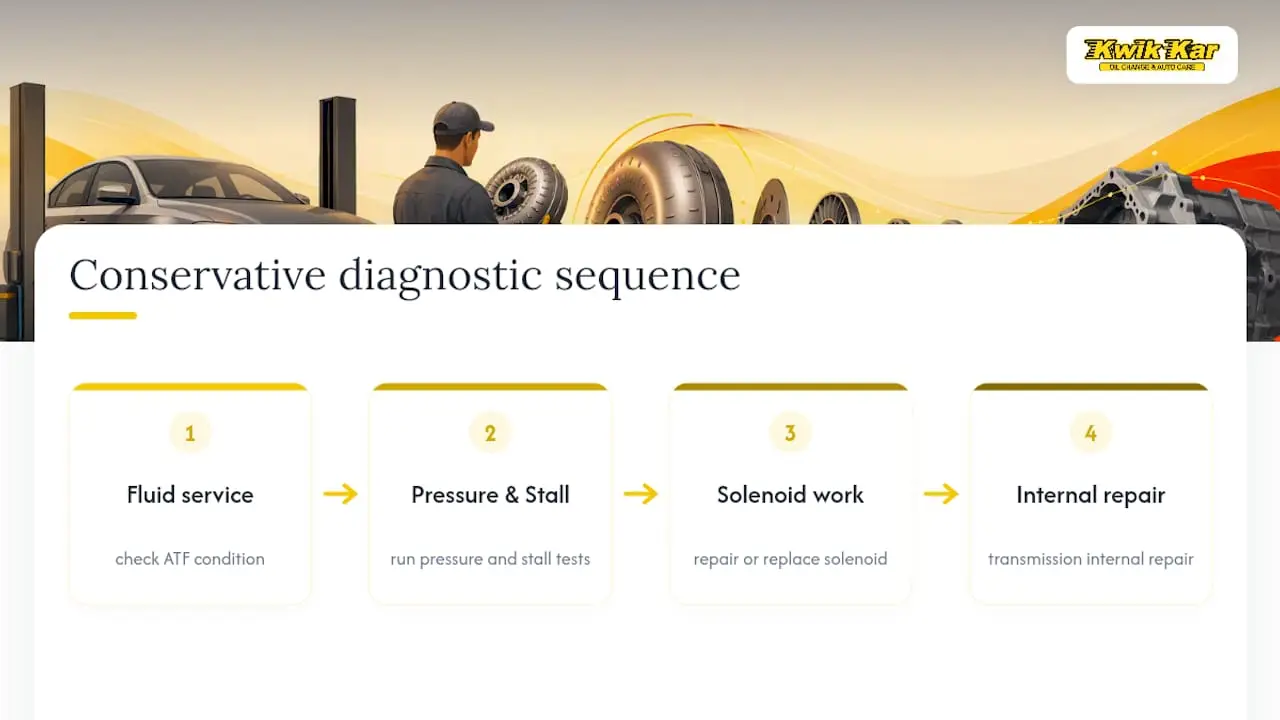
That sequencing protects you from paying for parts you don’t need, with many shops offering warranties on qualifying repairs to ensure confidence in the fix. Convenient options like after-hours drop-off and complimentary ride services can help customers manage their time during diagnostic and repair appointments.
Honest recommendations also mean telling you plainly when a symptom needs more than a quick top-off. If your fluid is burnt, or your scan tool shows a solenoid fault, we’ll say so directly, along with what it costs to fix it and why that’s the right next step for your vehicle.
Fixing Torque Converter Shudder: From Fluid Service to Full Replacement
Repairs generally move from least invasive to most invasive, and a good shop should walk you through this order rather than pitching the most expensive option first.
- ATF check and fluid service. Draining and replacing the fluid with the correct OEM-specified ATF, along with a filter change when it’s due, resolves a large share of shudder cases because it addresses degraded friction modifiers directly.
- Anti-shudder additives. SAE testing on lock-up clutch friction found that additives like over-based calcium sulfonate and specific friction modifiers can improve anti-shudder durability at the clutch surface. These additives help when the existing fluid and plate surfaces are in reasonably good shape, but they’re not a permanent fix if the clutch material itself is already worn.
- Transmission control or solenoid repair. When scan-tool data points to a pressure or timing fault rather than a fluid issue, replacing the affected solenoid or updating the TCM’s calibration can resolve a shudder that a fluid service alone won’t touch.
- Torque converter clutch rebuild or replacement. If the clutch material is physically worn or glazed beyond what fluid or additives can correct, rebuilding or replacing the torque converter becomes the reliable fix, since the friction-instability problem lives in the hardware itself at that point.
Pro Tip: Always ask for a short test drive after any transmission repair, at the same speed and throttle conditions where the shudder originally showed up. A shop confident in its repair should welcome that verification step, not brush it off.
Expect a technician to retest at the specific speeds where you originally felt the vibration. A fluid service that fixes the symptom at 30 mph but leaves a faint shudder at 45 mph tells you there may be a second contributing cause worth investigating further, rather than assuming the job is finished because the most obvious complaint went away.
How Much It Costs and How Urgent It Is
Repair costs scale directly with how far the problem has progressed, and Consumer Reports advises getting vehicle-specific quotes because procedures and part costs vary significantly by make, model, and transmission type.
- Fluid service: the lowest-cost option and the right starting point for most shudder complaints.
- Solenoid or pressure-related repairs: a moderate cost tier, since it involves targeted electrical or hydraulic component work rather than fluid alone.
- Torque converter rebuild or replacement: the highest cost tier, often involving significant labor since the transmission typically has to come out of the vehicle.
Ignoring shudder doesn’t make it go away. A slipping lock-up clutch generates extra heat and wear every time it engages incorrectly, and that accelerated wear raises your risk of a full transmission failure the longer it continues unaddressed. Abrupt or unusual shifting behavior alongside the vibration is a signal worth taking seriously, since odd gear shifts often point to broader gearbox problems that compound over time.
Short-term, monitored driving to get to a shop is usually reasonable if the shudder is mild and infrequent. If it’s paired with slipping, delayed engagement, burning smells, or warning lights, treat that as a sign to get it looked at immediately rather than waiting.
Preventing Torque Converter Shudder From Coming Back
Most prevention comes down to fluid discipline and heat management, and neither takes much effort once it’s part of your routine.
- Follow your manufacturer’s ATF service interval and use the exact ATF type specified for your vehicle, since the wrong fluid can trigger the same friction instability that causes shudder in the first place.
- Keep your cooling system in good shape. Transmission fluid that runs too hot breaks down faster, so a healthy radiator and transmission cooler protect your fluid’s friction properties over time.
- Respect towing and load ratings. Pulling heavier loads than your vehicle is rated for puts extra heat and stress directly on the torque converter and clutch.
- Get early ATF checks at the first sign of vibration. Catching degraded fluid before it causes surface wear on the clutch plates is far cheaper than waiting until a rebuild is the only option.
Our seasonal transmission maintenance guidance covers how Texas heat specifically accelerates fluid breakdown, which makes routine checks even more worthwhile if you’re driving through a Celina summer with the AC and transmission both working overtime.
Why We Start Conservative on Every Transmission Diagnosis
Our approach to shudder complaints comes down to one principle: fix the cheapest real cause first, and only escalate when the data says so. A fluid service costs a fraction of a torque converter replacement, and it resolves a meaningful share of shudder complaints on its own. There’s no reason to sell a customer on major transmission work before ruling that out.
That’s why every diagnostic starts with a documented inspection, not a guess. You see the fluid condition, the scan results, and our recommendation in writing, and if the fix does need to go further, you’ll know exactly why before you approve anything. Our 2-year/24,000-mile warranty backs the repair either way, so the goal isn’t the fastest invoice. It’s the right one.
If your vehicle has started shuddering at moderate highway speeds, bring it in and let us document it properly instead of guessing from a description alone.
— Kwik Kar
Get Your Transmission Checked at Kwik Kar
A shudder that starts small rarely stays small, and waiting on a diagnosis usually means paying more later instead of less. Kwik Kar of Celina runs the same stepwise process outlined throughout this guide, starting with a documented ATF check and road test rather than jumping straight to a parts quote, backed by a 2-year/24,000-mile warranty on qualifying repairs.
Our ASE-certified technicians handle everything from routine fluid service to full transmission repairs, and every visit includes a Digital Vehicle Inspection so you see exactly what we found and why we’re recommending it. After-hours drop-off and complimentary ride service mean you don’t have to rearrange your whole day around a diagnostic appointment. If you’re noticing vibration, whining, or hesitation under acceleration, visit our services page to see the full range of diagnostic and repair work we offer, and schedule a road test so we can reproduce the symptom and give you a clear, honest quote before any work begins.
Sources
- ATF Effects on Friction Stability in Slip-Controlled Torque Converter Clutches
- Maintain your car’s transmission and avoid costly repairs
FAQ
How Serious Is a Torque Converter Shudder?
It’s a symptom worth taking seriously, not an emergency in most cases, since a mild, occasional shudder usually allows for a monitored drive to a shop. If it’s paired with slipping gears, delayed engagement, or a burning smell, treat it as urgent, since odd shifting behavior often signals a broader gearbox problem that gets worse the longer it’s ignored.
How Much Does It Cost to Repair a Torque Converter Shudder?
Costs vary widely depending on the actual cause, ranging from a low-cost fluid service up to a much higher bill for a full torque converter replacement. Consumer Reports recommends getting a vehicle-specific quote since procedures and parts differ by make and model. Kwik Kar’s current diagnostic and repair pricing is available through our services page.
How Long Will a Transmission Last After It Starts Shuddering?
There’s no fixed timeline, since it depends on how long the shudder has been present and what’s causing it. A slipping lock-up clutch generates extra heat and wear every time it engages incorrectly, so the longer it goes undiagnosed, the higher the risk of accelerated damage or full transmission failure.
What Are the First Signs of Torque Converter Failure?
The earliest sign is usually a light vibration or shudder between 25 and 50 mph during steady acceleration or cruise, sometimes with a faint transmission whine as the lock-up clutch struggles to hold. Watch for that vibration alongside delayed gear engagement, rough shifting, or a burnt smell from the fluid, since those combined symptoms typically mean the issue has moved past a simple fluid problem.