



Yes, your transmission fluid needs attention when your owner’s manual calls for it, or sooner if the fluid looks or smells degraded or you notice shifting problems. Intervals vary widely by vehicle, generally falling somewhere between 30,000 and 100,000-plus miles. If you’re already seeing grinding, slipping, or warning lights, a fluid change alone may not fix the underlying issue, and a diagnosis comes first.
TL;DR:
- Transmission fluid should be checked regularly for color and smell, especially if you notice shifting problems or fluid appears dark or burnt.
- Use only OEM-specified fluid and proper tools when draining and refilling to avoid damaging your transmission or causing long-term issues.
- Following vehicle-specific service intervals, typically between 30,000 and 100,000 miles, depends on driving conditions like towing or hot climates.
- Symptoms like delayed shifting, slipping, or noises often indicate fluid degradation, but mechanical repair may be needed if fluid changes do not resolve issues.
- Professional service may cost a few hundred dollars and take 30 to 90 minutes, while DIY is feasible only on vehicles with accessible dipsticks and drain plugs.
Table of Contents
- How to drain and refill transmission fluid safely
- How often to change transmission fluid and what affects the schedule
- Signs your transmission fluid is bad
- Cost and time: DIY, quick-lube, and shop service
- Should you DIY it or bring it to a professional?
- Our approach to transmission fluid service and inspections
- What matters more than the mileage number on your calendar
- Ready to have your transmission checked?
- FAQ
- Sources
How to drain and refill transmission fluid safely
Before you touch a single bolt, confirm the exact fluid type and capacity in your owner’s manual. Transmissions are not forgiving of substitutions, and the wrong fluid can cause shifting problems or long-term damage, which is why AAA stresses using the OEM-specified fluid rather than a generic alternative.
Gather your gear before you start: safety glasses and gloves, a jack and jack stands (or ramps), a drain pan rated for several quarts, a torque wrench, a funnel, and a replacement filter and gasket if your transmission uses them. Working under a vehicle without proper support is one of the most common sources of home garage injuries, so skip the lift substitute and use rated stands.
Here’s the general sequence professionals and detailed guides recommend:
- Warm up the transmission by driving a few minutes, since fluid drains more completely and evenly when it’s not cold.
- Secure the car on level ground with the engine off and wheels chocked.
- Locate and remove the drain plug or pan, letting the old fluid flow completely into your pan.
- Inspect the drained fluid and filter for metal flakes, a burnt smell, or dark coloring, which can signal deeper problems.
- Reinstall the pan with a new gasket, or replace the filter if your transmission is equipped with one, torquing bolts to the manufacturer’s spec.
- Refill using the OEM-specified fluid and method, often checking the level with a dipstick at operating temperature or through a fill plug.
- Road test the vehicle, then recheck the fluid level and look for leaks around the pan.
Step-by-step guidance from Fleetio estimates a proper drain-and-refill or flush typically takes 45 to 90 minutes with the right tools and a clear procedure, though sealed systems can complicate things for a home mechanic.
It helps to understand the difference between a basic drain-and-fill, a drop-pan service that also replaces the filter, and a full machine flush. A flush cycles fluid through the torque converter and cooler lines, removing more old fluid overall, but Consumer Reports and other sources caution that power-flushing older or high-mileage transmissions can dislodge sludge and particles that were otherwise doing no harm, sometimes causing new clogs. When in doubt, a simple drain-and-fill is the safer starting point for a transmission with unknown service history.
Overfilling is a quieter risk than running low. Too much fluid can aerate and overheat, so always fill to the method your manufacturer specifies rather than guessing. When you’re finished, never pour old fluid down a drain or into the trash. Most auto parts stores and recycling centers accept used transmission fluid for proper disposal.
Pro Tip: Keep the drained fluid in a sealed, labeled container until you can compare its color and smell to fresh fluid, since that comparison alone often tells you whether something deeper is going on.
How often to change transmission fluid and what affects the schedule
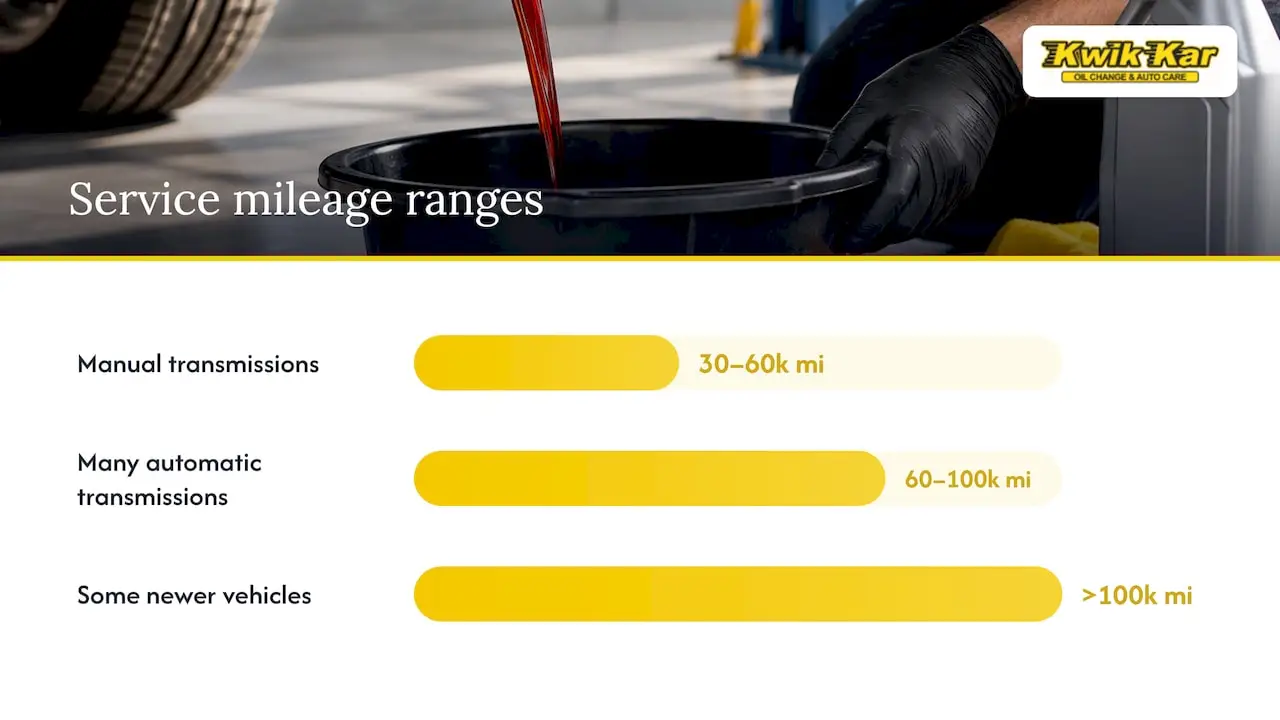
Service intervals depend heavily on your transmission type and how you drive. Manual transmissions often call for service around every 30,000 to 60,000 miles, while many automatics stretch to 60,000 to 100,000 miles or more. Consumer Reports notes that some newer vehicles may go past 100,000 miles between services, with CVTs and dual-clutch units carrying their own manufacturer-specific guidance.
Some automakers market “lifetime” fluid, implying no scheduled change is needed. In practice, that label describes the expected life of the vehicle under ideal conditions, and older or high-mileage cars still benefit from an inspection to catch problems early.
A few conditions move up the timeline:
- Frequent towing or hauling heavy loads
- Stop-and-go city driving with lots of short trips
- Extended time in hot climates, including Texas summers
- Off-road or performance driving
If any of these describe your routine, following the severe-service schedule in your manual rather than the standard one is the safer call.
Signs your transmission fluid is bad
A quick visual and smell check tells you a lot. Healthy automatic transmission fluid is red or pink; AAA and other sources describe dark, brown, black, or burnt-smelling fluid as signs it needs attention, while a milky appearance usually points to coolant contamination.
Watch for these driving symptoms too:
- Delayed or harsh shifts between gears
- Slipping, where the engine revs without matching acceleration
- Grinding or whining noises during shifts
- Overheating or a transmission warning light on the dash
- Visible fluid leaks under the vehicle
Metal flakes in the fluid or slipping that persists even after a fluid change are red flags that call for a diagnostic scan rather than another fluid service, since experts note that already-symptomatic transmissions often need repair, not just fresh fluid.
Cost and time: DIY, quick-lube, and shop service
Parts for a DIY drain-and-fill typically run on the lower end, with fluid and filter costs varying by type and vehicle. For labor, Kelley Blue Book’s cost estimates show that a shop-performed service commonly lands in the low hundreds of dollars, with the final number depending on your vehicle and whether you choose a basic drain-and-fill or a full flush.
A shop transmission fluid service commonly costs a few hundred dollars, according to Kelley Blue Book’s estimates, which means it’s worth asking upfront which service type you’re quoted for.
Time varies by approach:
- DIY drain-and-fill: roughly 1 to 2 hours with the right tools on hand
- Quick-lube or shop drain-and-fill: often 30 to 90 minutes
- Full flush service: typically longer, given the added equipment and fluid volume
Should you DIY it or bring it to a professional?
A short checklist helps you decide with confidence:
- Does your transmission have a dipstick, or is it a sealed system, since many newer vehicles lack a dipstick and require specialized access?
- Do you have safe vehicle access, whether ramps, stands, or a lift, along with the right tools?
- Can you confirm the correct OEM fluid and fill method for your specific make and model?
- Are you already seeing symptoms like slipping or grinding, which point toward diagnosis over DIY?
- Do you want documented service history or warranty coverage behind the work?
DIY mistakes tend to cluster around three things: using the wrong fluid, over or underfilling, and introducing contamination through dirty tools or containers. A professional shop brings diagnostic equipment, OEM-correct fill procedures, and often a service warranty, along with ASE-certified technicians trained to catch problems a visual check might miss.
Pro Tip: When you call a shop, ask specifically whether they’ll note the OEM fluid specification on your invoice and whether filter or gasket replacement is included, since those two details reveal a lot about how thorough the service will be.
Our approach to transmission fluid service and inspections
When you bring your vehicle to us, our ASE-certified technicians start with a Digital Vehicle Inspection that documents fluid condition, checks for leaks, and runs a diagnostic scan if you’re experiencing symptoms. That documentation means you see exactly what we found, not just what we did.
We select fluid based on your vehicle’s OEM specification rather than a one-size-fits-all approach, and every transmission service we complete is backed by a warranty. If your schedule is tight, convenient options like after-hours drop-off and ride services help you avoid rearranging your whole day around a fluid change.
What matters more than the mileage number on your calendar
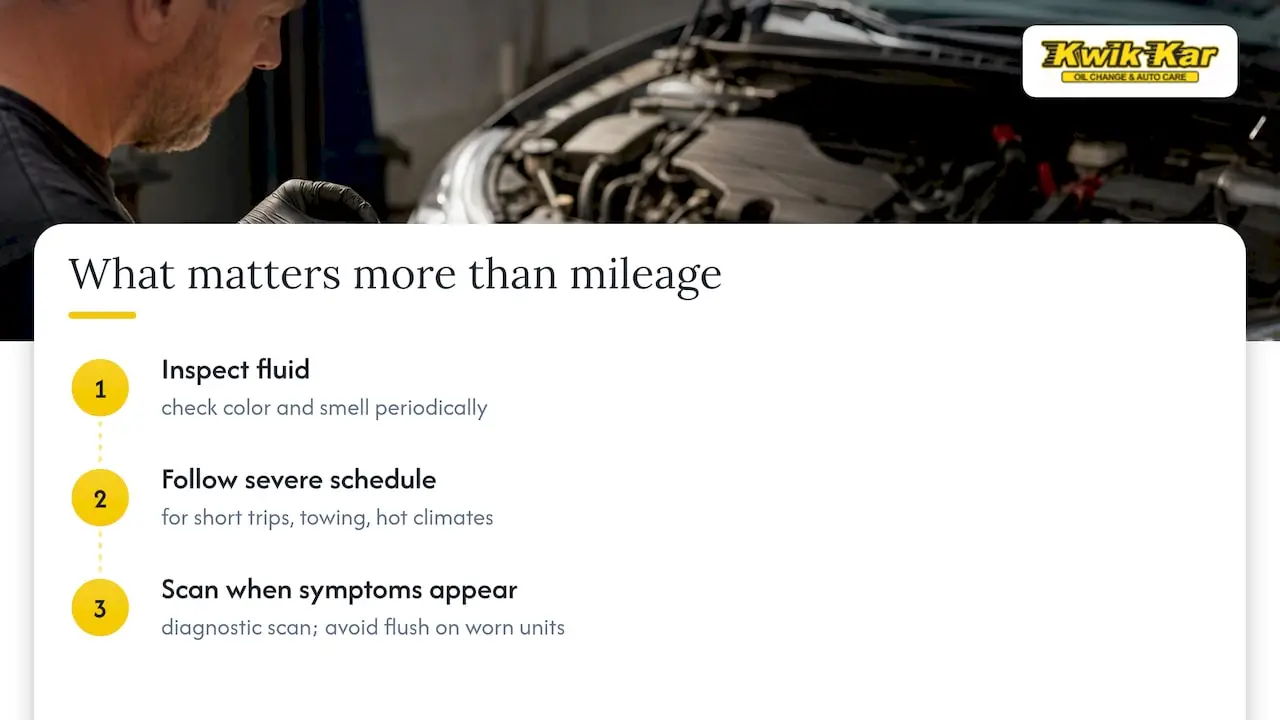
The conventional advice to “change your transmission fluid every X miles” misses the more useful question: what does the fluid actually look like right now? A manual’s interval is a reasonable starting point, but it was written for average conditions, and most of us don’t drive average conditions. Short trips, towing, and Texas summers all accelerate fluid breakdown in ways a fixed schedule can’t account for.
The bigger mistake we see is treating a fluid change as a cure-all once symptoms appear. If your transmission is already slipping or grinding, fresh fluid won’t undo mechanical wear, and in some cases a flush on an older, higher-mileage unit can stir up debris that was otherwise harmless. The smarter sequence is simple: check the fluid’s color and smell periodically, follow the severe-service schedule if your driving fits that profile, and get a diagnostic scan the moment you notice a shift that doesn’t feel right. Catching a problem early is almost always cheaper than chasing one after it’s spread.
— Kwik Kar
Ready to have your transmission checked?
A transmission fluid service includes a documented inspection, OEM-specified fluid, and the paperwork to prove it, all backed by a warranty. Whether you’re due for routine service or just noticed a shift that feels off, we’ll check it properly before recommending any work.

Visit our services page to see our full range of transmission and maintenance work, or reach out to schedule a visit that fits your week.
FAQ
How often should transmission fluid be changed?
Intervals depend on your vehicle and transmission type, with manuals commonly suggesting about 30,000 to 60,000 miles and automatics ranging from 60,000 to 100,000-plus miles, per Consumer Reports. Your owner’s manual is the most reliable source for your specific vehicle, and severe driving conditions can shorten that window.
Do I actually need to change transmission fluid?
Yes, even vehicles marketed with “lifetime” fluid benefit from periodic inspection, since that label reflects ideal conditions rather than a guarantee. Checking fluid color and smell, especially on higher-mileage vehicles, helps catch degradation before it leads to shifting problems.
What are signs you need a transmission flush?
Dark, brown, or burnt-smelling fluid is a common signal, along with delayed or harsh shifts, slipping, or grinding noises, as described by AAA. That said, a flush isn’t always the right call on older units, so a shop inspection can help determine whether a drain-and-fill is the safer option.
Can I replace transmission fluid myself?
It’s possible on many vehicles with a dipstick and accessible drain plug, using the correct OEM fluid and following a careful procedure like the one outlined by Fleetio. Many newer vehicles use sealed transmissions without a dipstick, which makes professional service a more practical choice for those models.
Sources
- Maintain your car’s transmission and avoid costly repairs – Consumer Reports
- Shift smoothly with quality automatic transmission fluid – AAA
- How to flush and replace transmission fluid: A step-by-step guide – Fleetio
- Transmission fluid change prices & cost estimates – Kelley Blue Book