


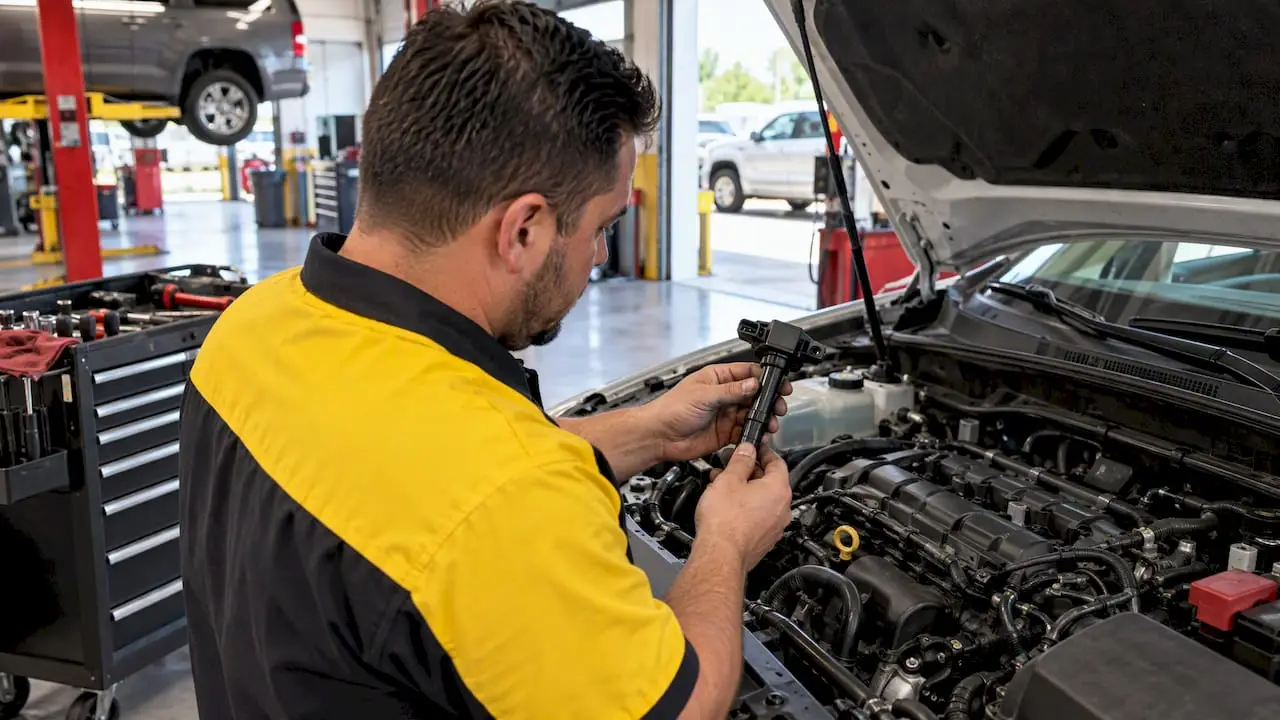
Failing ignition coils most often produce misfires, rough idle, hard starts, a check engine light, and reduced power. Before you replace anything, we recommend reading the OBD-II codes or getting a professional diagnostic to confirm the coil is actually the root cause rather than a symptom of something else.
TL;DR:
- A flashing check engine light signals a severe misfire that can damage the catalytic converter, so stop driving and arrange a tow.
- Misfire and coil circuit codes do not prove the coil has failed; technicians can compare freeze frame data, swap coils, and test resistance and voltage.
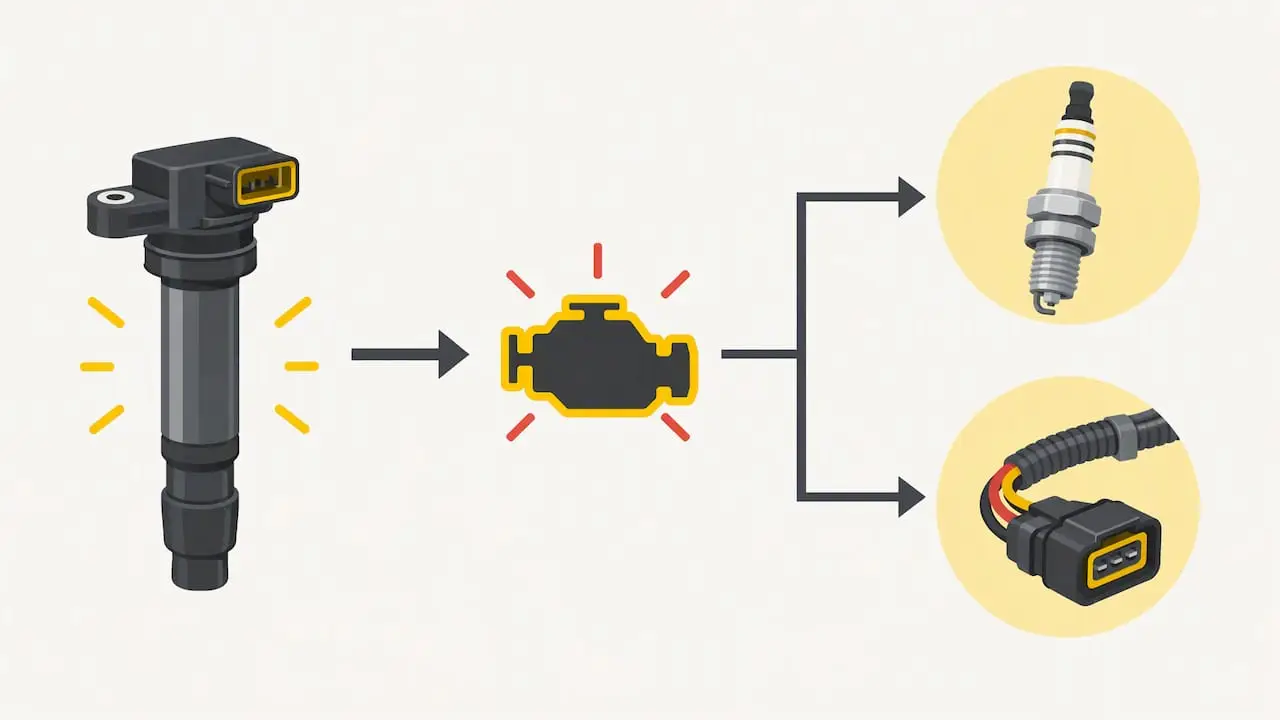
- Worn spark plugs, damaged wiring, contamination, or weak voltage can cause or mimic coil failure, so check these before replacing a recently installed coil.
- Repair costs depend on the number of coils, labor, and parts; worn plugs or damaged wiring may also need attention, and many repairs finish the same day.
Table of Contents
- What Are the Most Common Signs of a Bad Ignition Coil?
- What Causes an Ignition Coil to Fail?
- How Do Technicians Confirm a Bad Ignition Coil?
- When Should You Repair, and What Does It Typically Cost?
- How We Approach Ignition Coil Diagnosis at Our Shop
- Get a Clear Answer Before You Pay for Parts
- FAQ
- Sources
What Are the Most Common Signs of a Bad Ignition Coil?
Ignition coil trouble tends to announce itself in a handful of recognizable ways, and most drivers notice more than one symptom at once. Here’s what to watch for, roughly in the order drivers tend to notice them:
- Check engine light, steady or flashing. A steady light usually points to an emissions-related misfire that needs attention soon, while a flashing light signals a misfire severe enough to damage your catalytic converter and calls for immediate action.
- Hard starting or no-start, which can differ between cold and hot conditions depending on whether the coil is marginal or fully failed.
- Engine misfire, either isolated to one cylinder or bouncing randomly across several, often worse under load or acceleration.
- Rough idle and noticeable vibration, especially once the engine settles into idle speed where a weak coil has less help from momentum.
- Loss of power, sluggish acceleration, and dropping fuel economy, as the engine compensates for incomplete combustion.
- Backfiring, sputtering, or jerking at highway speeds, which points to a coil struggling to keep up with load.
A flashing check engine light specifically indicates a misfire rate severe enough to overheat and damage the catalytic converter, while a steady light signals a sustained emissions threshold breach that still deserves prompt diagnosis.
What Causes an Ignition Coil to Fail?
Coils rarely fail without a reason, and understanding the cause helps you and your technician decide whether replacing the coil alone will solve the problem. Common culprits include:
- Internal shorted windings or insulation breakdown, often from years of heat cycling.
- Oil or coolant contamination, carbon tracking, or physical cracking in the coil housing.
- Corroded or chafed wiring and connectors feeding the coil.
- Voltage-supply issues such as a weak battery, a failing relay or fuse, or a PCM driver fault.
- Fouled or over-gapped spark plugs, which force the coil to work harder and shortens its life.
Denso’s technical overview groups coil failure into four categories: internal short circuits, mechanical damage, contact failure, and voltage supply faults, with contamination and worn plugs adding stress over time.
Pro Tip: If you’ve replaced a coil recently and the symptoms return, check the spark plugs and wiring harness before assuming the new coil is also bad.
How Do Technicians Confirm a Bad Ignition Coil?
Swapping parts based on a guess wastes money, which is why a proper diagnostic sequence matters more than instinct. A thorough check typically follows these steps:
- Pull the OBD-II codes. Codes in the P0350 to P0362 range point to specific coil circuit faults, P0300 to P0308 indicate random or cylinder-specific misfires, and P2300 to P2311 may also reference coil-related faults.
- Review freeze-frame data and misfire counters. Freeze-frame data captures engine load, RPM, coolant temperature, and fuel trims at the exact moment of the misfire, helping separate a cold-start fouled-plug issue from a high-load ignition problem.
- Run a swap-test when the design allows it. Moving a coil to a different cylinder and watching whether the misfire follows it is a reliable way to confirm the fault, though coil-on-plug layouts sometimes limit how easily this can be done.
- Check resistance and voltage drop. Primary and secondary winding resistance should fall within a known range, and voltage-drop testing at the battery and ground under actual cranking load catches weak supply issues that a static voltage check misses.
- Use an oscilloscope when the pattern is unclear. Secondary waveform analysis shows firing voltage, burn time, and coil oscillations, and missing oscillations point to an internally shorted winding while a high firing spike with short burn time suggests excessive resistance.
Misfire monitors judge combustion by measuring crankshaft deceleration between firing events, so mechanical and fuel issues can trigger the same code as an actual ignition failure.
OpenExamPrep ASE study guide
That’s exactly why we treat a misfire code as a starting point, not a verdict, before recommending any part replacement.
When Should You Repair, and What Does It Typically Cost?
Some coil symptoms call for immediate action, while others can wait a few days for a scheduled visit. A flashing check engine light, a heavy, engine-shaking misfire, or a sudden loss of power are signs to stop driving and arrange a tow rather than continue on. A steady light with mild roughness can usually wait for an appointment, though we don’t recommend putting it off for long.
Repairs commonly involve replacing one or more coils, swapping worn plugs and boots at the same time, repairing damaged wiring, or, less often, investigating a PCM driver circuit. What you pay depends on:
- How many coils need replacement, since some engines fail one at a time while others fail in clusters.
- Labor time and access, which varies a lot by engine layout and whether the intake has to come off.
- Whether you choose OEM or quality aftermarket parts.
A diagnostic usually takes less than a day, and many coil repairs are completed same-day when parts are on hand. Having the work backed by a documented digital vehicle inspection and a written warranty gives you a clear record of exactly what was found and fixed.
How We Approach Ignition Coil Diagnosis at Our Shop
Our process starts with pulling codes and capturing freeze-frame data, then moving to a swap-test or scope check when the pattern needs more clarity. We walk you through every finding with a digital vehicle inspection, so you see exactly what we saw. If you’re seeing any of the symptoms above, we recommend getting a diagnostic before anything gets replaced.
— Kwik Kar
Get a Clear Answer Before You Pay for Parts
A misfire code only tells you which cylinder is struggling, not which part caused it, and that’s where a proper diagnostic earns its cost many times over. We run an OBD-II diagnostic test that reads the codes, checks freeze-frame data, and confirms the actual cause before we recommend a repair, so you’re never paying to guess.

- A documented digital vehicle inspection shows you exactly what we found, with photos and plain explanations.
- We aim to make the visit as convenient as possible, offering services that help minimize disruption to your day.
Browse our full list of auto repair services or head straight to the diagnostics page to get your coil symptoms checked properly.
FAQ
How can you tell if an ignition coil is bad?
The clearest signs are a check engine light, engine misfires, rough idle, hard starting, and a noticeable drop in power or fuel economy. A scan tool reading coil-specific OBD-II codes alongside a swap-test or resistance check is the most reliable way to confirm the coil itself, rather than a plug or wiring issue, is at fault.
How expensive is it to fix an ignition coil?
Cost depends on how many coils need replacing, labor time for your specific engine, and whether you choose OEM or aftermarket parts, so there’s no single figure that applies to every vehicle. A diagnostic first narrows down exactly what needs replacing, which avoids paying for parts that were never the problem.
Will a car run with a bad coil?
A car can often still run with one failing coil, especially on multi-cylinder engines, but it will usually misfire, idle roughly, and lose power. Continuing to drive with a flashing check engine light risks damaging the catalytic converter, so that symptom calls for prompt attention rather than continued driving.
How to tell if a coil needs replacing?
A coil needing replacement typically shows a confirmed misfire code tied to that cylinder, failed resistance readings, or a misfire that follows the coil during a swap-test. Reading freeze-frame data alongside these checks helps confirm the coil, rather than a spark plug or wiring fault, is the actual cause.
Sources
- Causes of ignition coil failure – DENSO
- Freeze-frame data / OBD2 scanner guidance — ANCEL blog
- Ignition waveforms (oscilloscope analysis) — technical note