


Most Texas drivers no longer need a yearly safety inspection. Emissions testing and commercial inspections are still required. As of January 1, 2025, noncommercial vehicles no longer need a safety inspection before registration, according to the Texas Department of Public Safety. Qualifying vehicles in Collin County, where Kwik Kar of Celina is located, still need emissions testing. Commercial vehicles follow different rules from noncommercial ones.
Below is a checklist built around that reality. It covers what the state requires, what you should still check yourself, and when a shop visit makes sense.
TL;DR
- Noncommercial vehicles in Texas no longer need an annual safety inspection to register, as of January 1, 2025.
- Gasoline vehicles aged 2 to 24 years registered in an emissions county, including Collin County, still need an emissions test.
- Commercial vehicles must still pass a safety inspection, and their rules differ from noncommercial rules.
- A trouble code from a scan is a starting point for diagnosis, never proof that a specific part has failed.
- Safety items like lights, tires, wipers, and brakes are still your responsibility, inspection or not.
Table of Contents
- Does my vehicle need an inspection in Texas right now?
- What happened to the Texas safety inspection sticker?
- Which Texas counties require emissions testing?
- What does a Texas emissions test check?
- What if my check engine light is on?
- What should I do if my vehicle fails the emissions test?
- What should I still check on my own vehicle?
- How do commercial vehicle inspections differ?
- What we recommend as a shop in Celina, TX
- Need a hand with inspections or repairs?
- A simple schedule you can follow
- FAQ
- Sources
Does my vehicle need an inspection in Texas right now?
It depends on how the vehicle is registered and where.
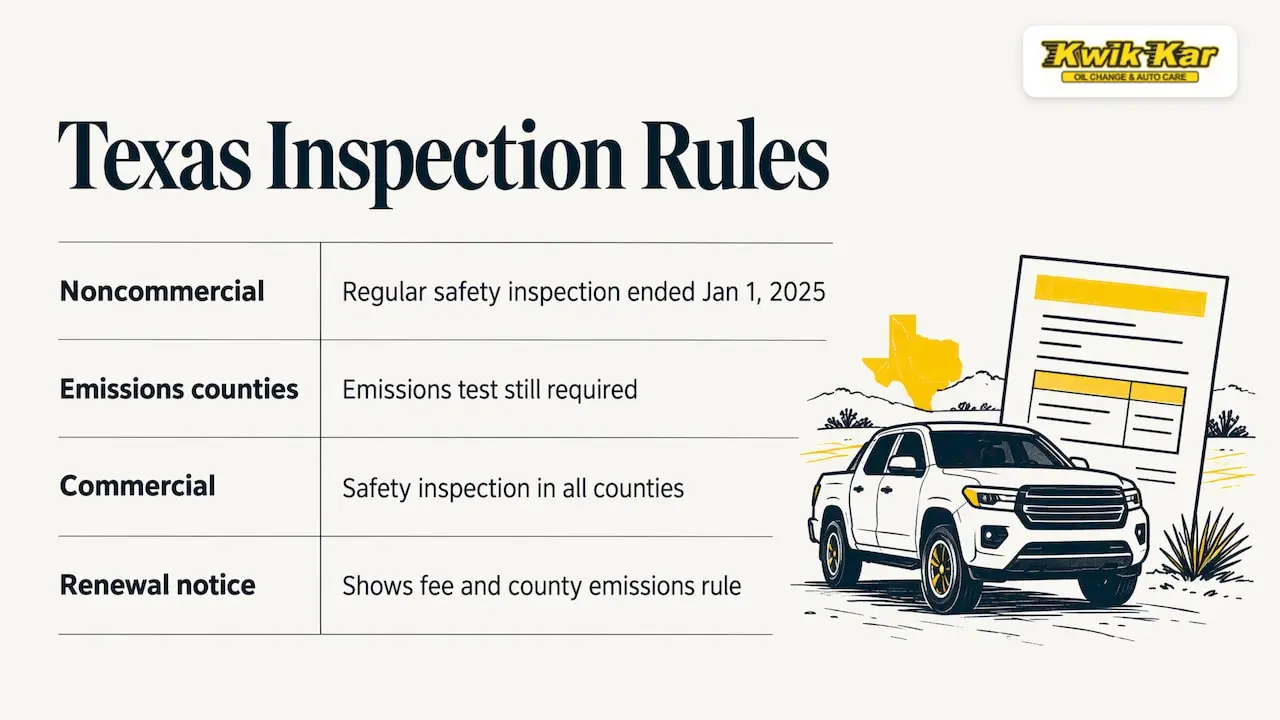
Noncommercial vehicles (most cars, SUVs, and pickups used personally): House Bill 3297, passed by the 88th Legislature in 2023, eliminated the regular mandatory safety inspection. The change took effect January 1, 2025, per the DPS announcement.
Vehicles in emissions counties: An emissions test is still required for noncommercial vehicles registered there. More on that below.
Commercial vehicles: These still need a passing safety inspection. DPS says this applies in all counties, and these vehicles are exempt from the inspection program replacement fee because they still pay for the inspection itself.
One practical note: TxDMV updated its systems so registration renewal notices flag the new inspection replacement fee and show whether your county requires emissions testing, according to the TxDMV release notes. Your renewal notice is the quickest way to see which rules apply to your vehicle.
What happened to the Texas safety inspection sticker?
For personal vehicles, the safety inspection step before registration is gone. Registration renewal still requires proof of current liability insurance when you renew by mail or in person, according to TxDMV.
A few things did not change:
- Your vehicle still has to be safe and legal to drive.
- Emissions testing continues in the listed counties.
- Commercial vehicles still need inspections.
If you are used to the annual routine, you may be tempted to skip a check-up altogether. We would not. The inspection used to catch burned-out bulbs, worn tires, and weak brakes once a year. Now that catch is up to you.
Which Texas counties require emissions testing?
According to DPS emission inspection criteria, 17 counties currently require annual emissions inspections:
| County | County | County |
|---|---|---|
| Brazoria | Collin | Dallas |
| Denton | Ellis | El Paso |
| Fort Bend | Galveston | Harris |
| Johnson | Kaufman | Montgomery |
| Parker | Rockwall | Tarrant |
| Travis | Williamson |
DPS also lists Bexar County as beginning emissions testing on November 1, 2026.
Collin County is on the list, so qualifying vehicles registered there still need testing. If you moved to the area from a county without emissions testing, this may be new to you. Denton County is on the list as well, which matters in a growing area where county lines run close to home. Check the county on your registration, not just the city you live in.
Which vehicles are tested?
Gasoline-powered vehicles between 2 and 24 years old registered in these counties must undergo an On-Board Diagnostics (OBDII) test, according to the DPS inspector study guide. The same guide says electric-only vehicles remain exempt.
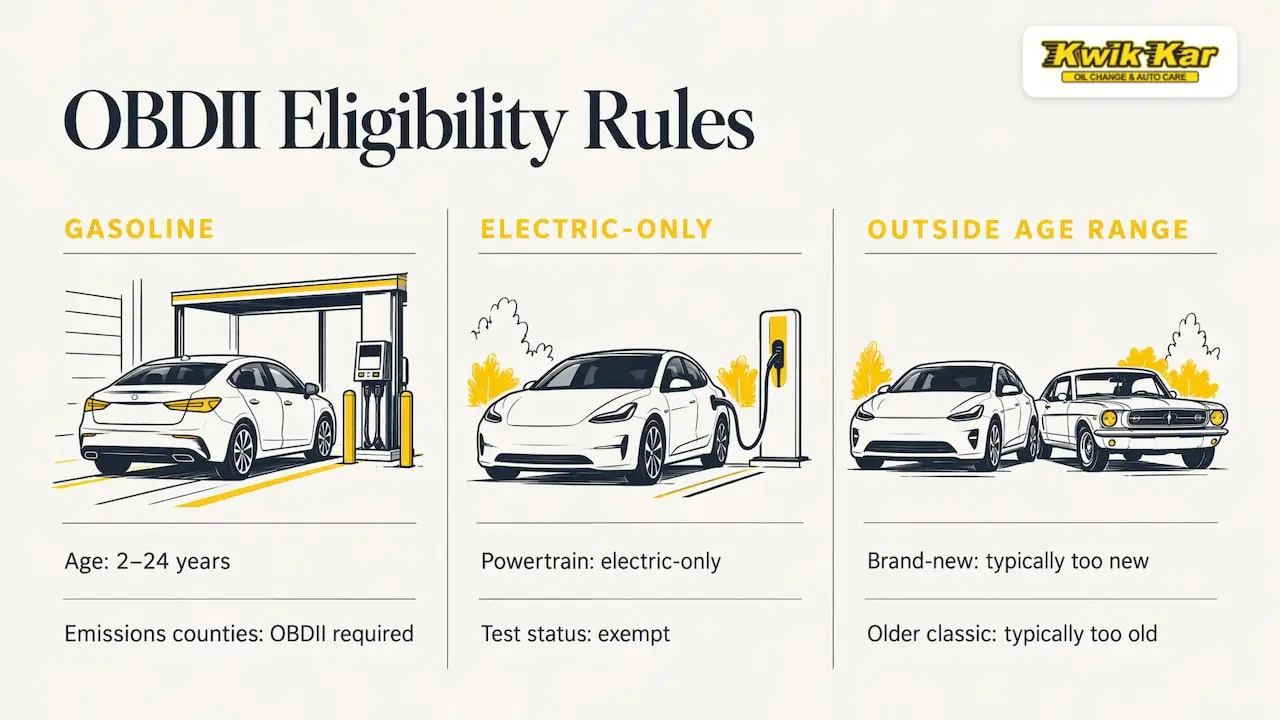
In plain terms: a brand-new car is typically too new to be tested, and an older classic is typically too old. Most daily drivers in between are covered.
What does a Texas emissions test check?
DPS lists these items as part of an emissions inspection:
- Catalytic converter system
- Evaporative emissions control system
- Exhaust system
- Gas cap
- PCV (Positive Crankcase Ventilation) system
The test works through your vehicle’s onboard computer. DPS explains that OBDII monitoring is designed to detect emission-related malfunctions, often before a driver notices anything, and that its goal is to keep vehicles emitting the minimum level of pollutants throughout their useful life (DPS study guide).
Simple pre-test checks you can do at home
These will not guarantee a pass, but they cover the easy causes:
- Look at the dashboard. A lit check engine light is the first thing to deal with before you go for a test.
- Tighten the gas cap. A loose or damaged cap is one of the listed inspection items. If the seal looks cracked, replace it.
- Listen for exhaust noise. A rumble, hiss, or rattle can point to a leak or a loose component. Our exhaust system service page explains what we look at.
- Notice how it runs. Rough idle, hesitation, or worse fuel economy can be early signs of an emissions-related problem.
What if my check engine light is on?
A warning light means the computer stored a code. It does not tell you which part to buy.
A diagnostic trouble code points to a system or circuit where something is outside its expected range. The cause might be a failing part, but it might also be a wiring issue, a vacuum leak, or a sensor reacting to a different problem. Replacing the part named in a code without testing can cost you money and leave the real problem in place.
That is why we start with testing and live data. Our article on OBD-II diagnostic testing explains how that process works. For one common example, see our guide to oxygen sensor failure and live data checks. Our diagnostics service covers check engine light concerns in general.
What should I do if my vehicle fails the emissions test?
DPS guidance says to repair the failed items and return to the original inspection station within 15 days for a free re-test (DPS emissions FAQ).
A sensible order of steps:
- Read the inspection report. It lists what failed.
- Get a diagnosis before repairs. Confirm the cause rather than guessing from the report or a code.
- Repair and keep your paperwork. Invoices matter if you later need a waiver.
- Re-test within the window. Do not let the 15 days slip.
If repairs do not solve the problem, DPS says eligible owners can apply for emissions waivers or time extensions (DPS waivers and extensions). That page also notes that Recognized Emissions Repair Facilities of Texas let owners count the full cost of diagnosis, parts, and labor toward waiver requirements, while independent facilities count parts only. Read that page before you pick where to repair, because it affects how your repair spending counts.
What should I still check on my own vehicle?
DPS recommends regular service to keep headlights, taillights, horn, mirrors, windshield wipers, tires, and other critical functions working, and notes that driving without many of these properly working is against the law (DPS). Here is a checklist to use every few months, and before any long trip.
Lights and visibility
- Headlights: low beams and high beams.
- Brake lights: have someone watch while you press the pedal, or back up to a reflective surface.
- Turn signals and hazards: front and rear, both sides.
- Taillights: both working and lenses not cracked.
- Mirrors: secure, not cracked, and properly adjusted.
- Windshield wipers: no streaking, skipping, or split rubber. Top off washer fluid.
- Windshield: look for cracks in your line of sight.
If you use a license plate cover, make sure your plate stays clearly readable from a distance. A plate cover readability test is one way to check.
Tires and wheels
- Check tire pressure when the tires are cold, using the number on the driver’s door jamb label rather than the number molded on the tire.
- Look for uneven wear, bulges, cracks, or nails.
- Pull on a wheel at the top and bottom. Play or clunking deserves a look.
- If the car pulls to one side, ask about a wheel alignment.
Brakes, steering, and suspension
These are on the commercial inspection list, and they matter just as much on a family SUV. Signs to act on:
- Squealing, grinding, or a soft pedal. See brake repair and our guide to signs you need new brake rotors.
- Steering that wanders, feels loose, or vibrates.
- Bouncing, nose-diving when braking, or clunks over bumps. Our suspension maintenance article covers common warning signs.
Under the hood and fluids
- Engine oil level and color.
- Coolant level in the reservoir (only when the engine is cool).
- Brake fluid level.
- Belts and hoses: cracks, fraying, or soft spots.
- Battery terminals: clean, tight, and free of buildup.
Texas heat is hard on batteries, belts, and cooling systems. Our seasonal guides on fall car maintenance and winterizing your car help you plan for each change in weather.
Paperwork
- Current registration.
- Proof of liability insurance. You need it to renew.
- Your renewal notice, which shows the fee and emissions requirement for your county.
How do commercial vehicle inspections differ?
They are separate from the noncommercial rules. DPS says commercial vehicles must still get a passing safety inspection in all counties. The DPS commercial motor vehicle chapter lists items such as:
- Steering mechanism
- Brake system
- Suspension
- Tires
- Lighting equipment (headlamps, stop lamps, tail lamps)
- Seat belts
- Windshield wipers
If you manage a fleet, confirm how each vehicle is classified before assuming a rule applies or does not. Our fleet maintenance checklist is a practical way to organize recurring checks between formal inspections.
What we recommend as a shop in Celina, TX
We see the same pattern since the change in 2025. Drivers hear that the inspection is gone and assume the car no longer needs a look. The inspection was never what kept the car safe. The brakes, tires, lights, and cooling system did that, and they still wear out on their own schedule.
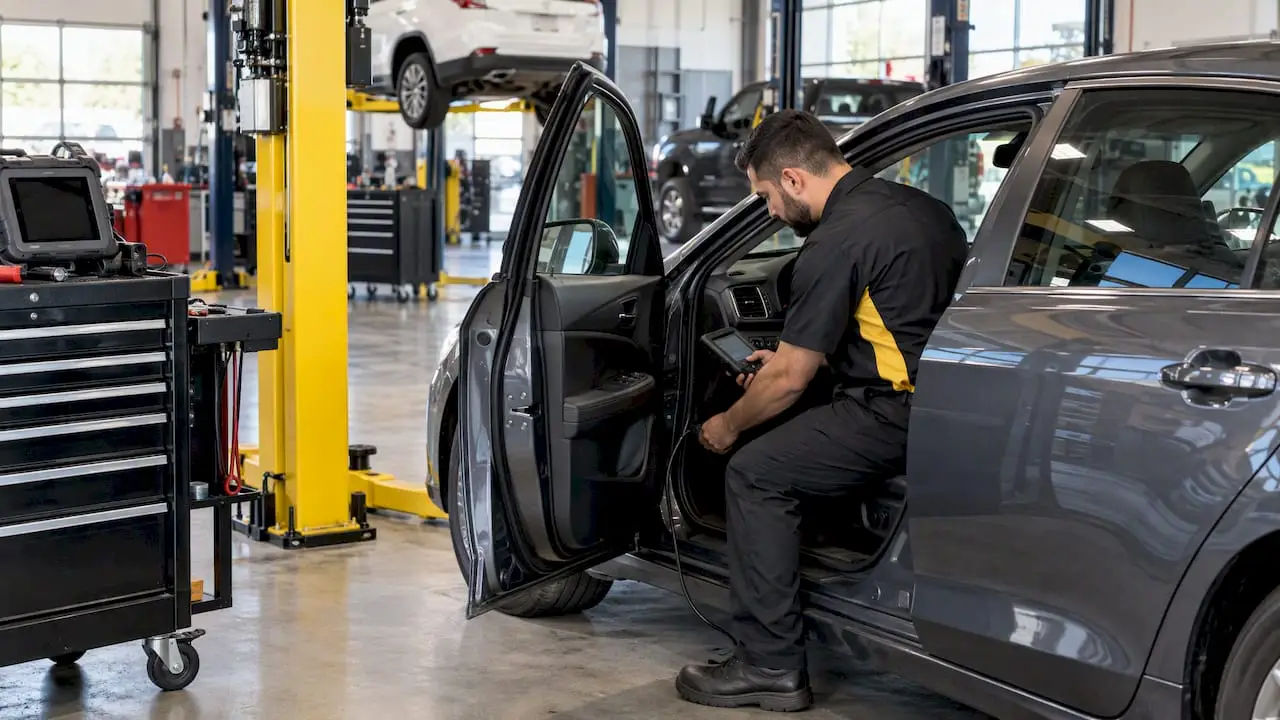
At Kwik Kar of Celina, we use Digital Vehicle Inspections so you can see what our ASE-certified technicians see, with clear notes, instead of taking our word for it. We aim to recommend what the vehicle needs and explain why. A checklist like the one above is the best starting point, and a technician’s eyes on the lift fills in what you cannot see from the driveway.
If you want to know how a report works, we explain it in our guide to digital vehicle inspections.
Kwik Kar
Need a hand with inspections or repairs?
Kwik Kar of Celina offers TX state inspections along with repair and maintenance for a wide range of vehicles. If you are unsure which rules apply to your car, truck, or work vehicle, call us and we will help you sort it out. We also offer after-hours drop-off and a complimentary ride service for busy schedules, and our repairs come with a 2-year/24,000-mile warranty.
You can browse everything we handle on our services page. If your check engine light is on before an emissions test, a diagnostic visit is a sensible first step.
A simple schedule you can follow
You do not need to check everything every week. This rhythm works for most drivers:
| When | What to check |
|---|---|
| Monthly | Tire pressure, all exterior lights, wipers, fluid levels |
| Before a road trip | Tires, brakes, coolant, battery, oil |
| Before registration renewal | Dashboard warning lights, gas cap, insurance card, county emissions requirement |
| Twice a year | Professional inspection of brakes, suspension, belts, hoses, and cooling system |
| Per your owner’s manual | Scheduled maintenance for your specific vehicle |
For that last row, follow your manufacturer’s schedule for your exact model. Intervals differ by make, engine, and driving conditions. If you drive a European model, our European repair page explains how we handle those vehicles, and our factory scheduled maintenance page covers service done to the maker’s schedule.
FAQ
Does my vehicle need an inspection in Texas?
Most noncommercial vehicles do not need a safety inspection to register since January 1, 2025. If your vehicle is registered in an emissions county, such as Collin County, and is a gasoline vehicle between 2 and 24 years old, it still needs an emissions test. Commercial vehicles still require a passing safety inspection.
Does Kwik Kar of Celina do inspections?
Yes. Kwik Kar of Celina lists TX state inspections among its services. Because the rules depend on whether a vehicle is commercial or noncommercial and which county it is registered in, call us before you come in so we can confirm what applies to your vehicle.
Can a check engine code tell me which part to replace?
No. A code tells you which system or circuit reported a problem, not which part has failed. Testing is needed to find the cause, which can save you from replacing parts you did not need.
What do I do if I fail the emissions test?
Have the cause diagnosed and repaired, then go back to the original inspection station within 15 days for a free re-test, according to DPS guidance. Keep your repair paperwork. If repairs do not resolve the failure, ask DPS whether you qualify for a waiver or time extension.
Sources
- Vehicle Safety Inspection Program Changes Now in Effect, Texas DPS
- Inspection Criteria for Emission Inspection, Texas DPS
- Emissions Inspector Study Guide: On-Board Diagnostics, Texas DPS
- Emission Inspections FAQ, Texas DPS
- Waivers and Time Extensions, Texas DPS
- Commercial Motor Vehicles, Texas DPS Safety Manual, Chapter 6
- Register Your Vehicle, TxDMV
- TxDMV Release Notes 24.3.1