



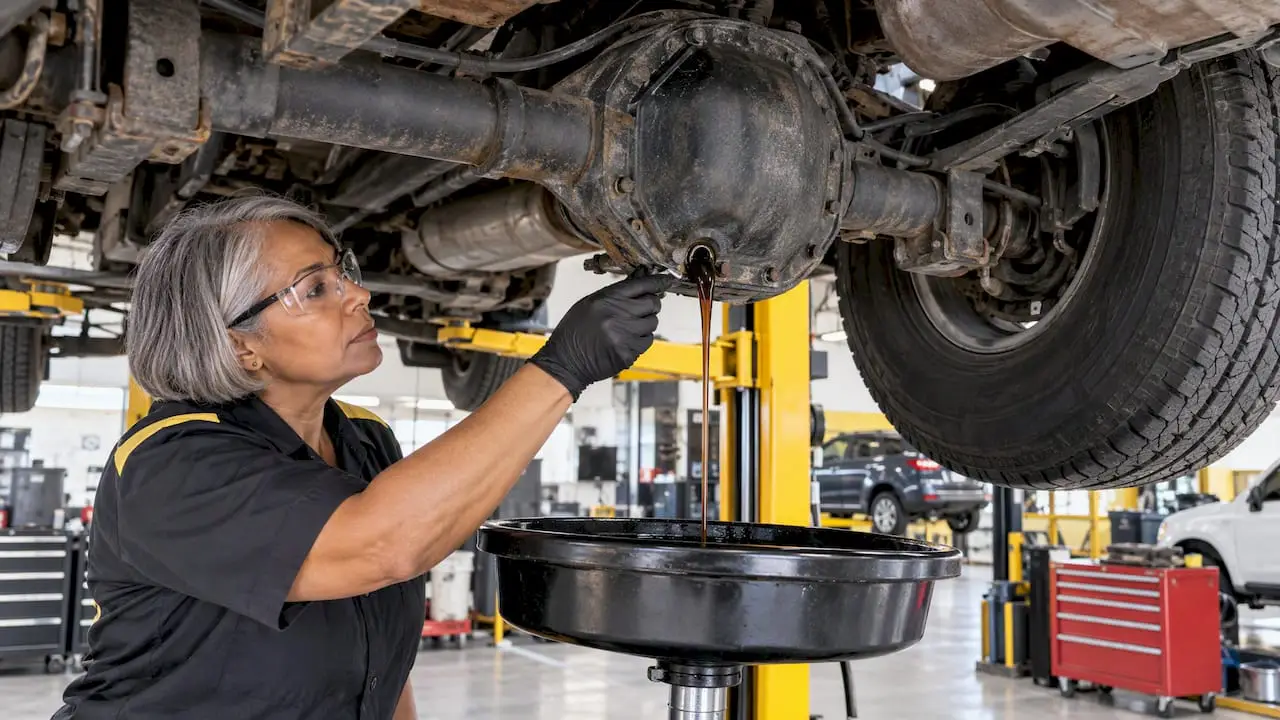
A differential fluid change replaces the gear oil that protects the ring-and-pinion gears and bearings in your axle. The right timing is whatever your owner’s manual says. Many vehicles fall somewhere between 30,000 and 60,000 miles, and towing or hard use can shorten that. Consumer Reports estimates the service at $85 to $150 depending on the model. Here is how to work out what your vehicle needs.
TL;DR
- Follow your owner’s manual first. Without one handy, 30,000 to 60,000 miles is a common range for a rear differential fluid change.
- Towing, hauling, dusty roads, mountain driving and water exposure can call for shorter intervals, and some manufacturers say so in writing.
- Whining, humming, vibration in turns, a hot gear-oil smell or a wet housing are reasons to have the differential inspected.
- A proper service means draining, checking for debris, using the specified fluid and filling to the correct level.
- Cost varies by vehicle. Ask for a quote based on your exact year, make and model.
Table of Contents
- What does differential fluid do?
- Which vehicles have a differential to service?
- When should you change differential fluid?
- How do driving conditions change the interval?
- What are the signs your differential needs attention?
- What happens during a rear differential service?
- Can you change differential fluid yourself?
- How much does a differential fluid change cost?
- Do you need a Texas inspection with a differential service?
- Our perspective: treat the differential as part of the drivetrain
- Ready to have your differential checked?
- Differential fluid change FAQ
- Sources
What does differential fluid do?
Your engine sends power through the driveshaft to the axles. The differential sits between them and does two jobs. It turns the power toward the wheels, and it lets the inner and outer wheels turn at different speeds in a corner. Mobil explains that these gears depend on high-pressure oil to prevent accelerated wear on the gear teeth.
The fluid, often called gear oil or differential oil, does several things at once:
- Lubricates gears, bearings and, in some designs, clutches.
- Carries tiny wear particles to a magnet, according to a differential service training document.
- Moves heat into the housing.
Nissan notes that heat and contaminants eventually reduce the oil’s lubricating properties. That is the reason it is on a maintenance schedule at all. Unlike engine oil, differential oil usually has no filter and no dedicated cooling system, so old fluid stays in contact with the gears until someone changes it.
Which vehicles have a differential to service?
Every vehicle has at least one. Rear-wheel-drive cars, trucks and SUVs have a rear differential. Four-wheel-drive and many all-wheel-drive vehicles can also have a front differential and sometimes a transfer case or rear drive unit. Front-wheel-drive cars usually combine the differential with the transmission, so it shares the transmission fluid.
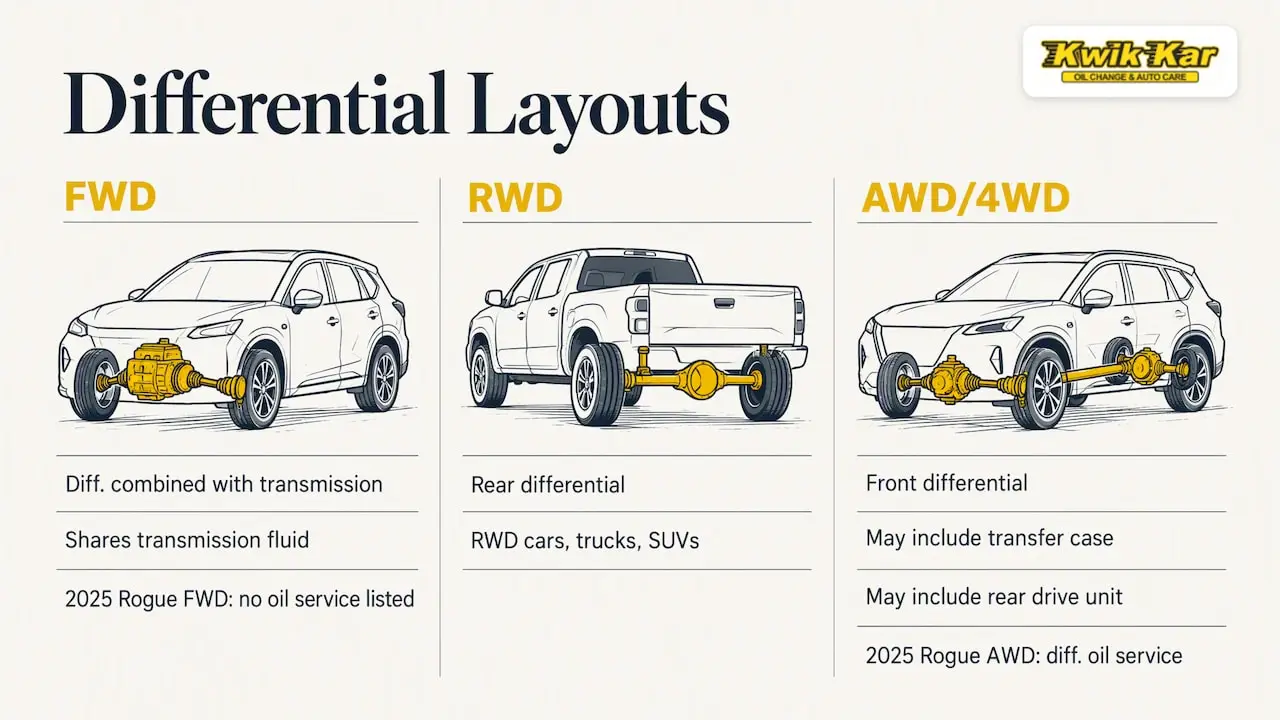
That last point matters. Nissan’s schedule for the 2025 Rogue lists differential oil service for AWD models but none for FWD trims. Two versions of the same model can have different needs, so check the schedule for your exact drivetrain.
If you are not sure what your vehicle has, we can look it up. Many Texas drivers with trucks, SUVs and European performance cars have more than one differential to account for.
When should you change differential fluid?
The short answer is when your manufacturer says to. The longer answer is that intervals vary a lot.
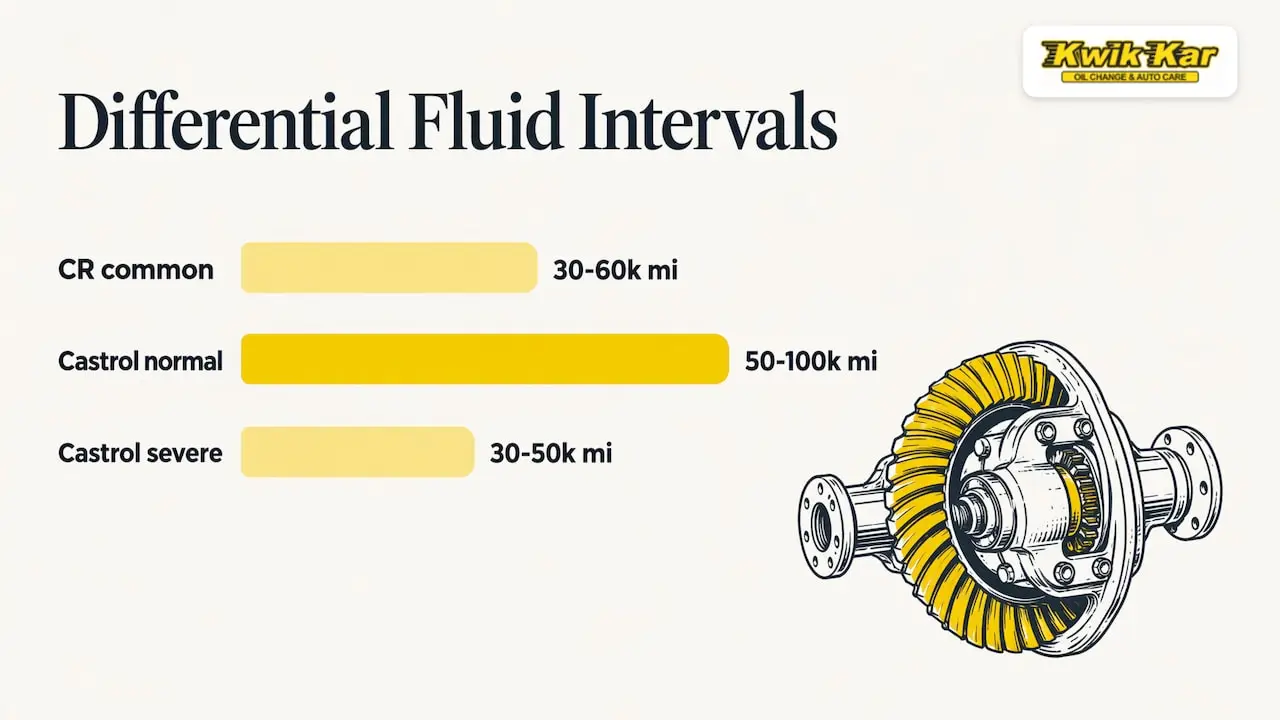
- Consumer Reports: 30,000 to 60,000 miles is a common interval, and the owner’s manual comes first.
- Castrol: many manufacturers recommend roughly 50,000 to 100,000 miles under normal driving with modern synthetic fluids, and about 30,000 to 50,000 miles under severe service.
- Nissan Frontier (2026): inspect every 15,000 miles or 12 months, replace every 20,000 miles or 24 months.
Those figures disagree because vehicles and drivetrains differ. Treat the ranges as context, not as a schedule for your car. Your manual or the manufacturer’s maintenance page is the authority. If you cannot find the information, bring the vehicle in and we will check what the manufacturer specifies for it.
One more point from Consumer Reports’ certified mechanic Michael Crossen: he advises sticking to the manual rather than paying extra for a fluid upgrade the manufacturer does not require. We agree. Use the fluid your vehicle specifies.
How do driving conditions change the interval?
The schedule printed in your manual often has two tracks: normal and severe. Severe does not mean you drive recklessly. It means the oil works harder.
Several manufacturers spell out what counts:
- Hyundai lists rear differential oil replacement every 72,000 miles under severe-use conditions, including rough or dusty roads, mountain driving and towing.
- Mazda’s U.S. CX-3 manual calls for replacement more often when towing, using a roof carrier, driving in dusty, sandy or wet conditions, idling or driving slowly for long periods, or making repeated short trips. It also calls for replacement after water submersion.
- Acura says mountainous low-speed driving or trailer towing increases fluid shear stress, and its 2021 RDX Maintenance Minder calls for earlier service under those conditions.
- A Ram technical bulletin specifies more frequent service for police, taxi, fleet, off-road or frequent trailer-towing use.
For Celina drivers, the practical version is this. If you tow a boat or camper to Lake Lavon or Ray Roberts, haul heavy loads for work, or run a fleet vehicle through stop-and-go routes all day, read the severe-use column of your manual. Texas summer heat adds to the load on every drivetrain fluid. Our notes on how heat affects engine oil cover the same principle for the engine.
What are the signs your differential needs attention?
A differential rarely fails without warning. These are the symptoms worth acting on, drawn from AutoZone’s list and from CarParts.com’s guidance:
- Humming, whining or howling that changes with speed.
- Groaning or choppy, binding feel in tight turns.
- Rhythmic clicking or clunking when you ease on or off the throttle.
- Vibration from under the vehicle.
- A sharp, burning gear-oil smell.
- Seepage around the pinion seal, the cover or the axle seals.
A Ram bulletin adds that degraded rear-axle fluid can contribute to chatter, shudder or vibration during turns, especially after heavy towing.
Noise alone does not prove the fluid is the problem. Worn bearings, tire noise, a driveshaft issue or a damaged gear can sound similar. A changed fluid will not fix a damaged part. That is why we inspect first: we look at the drained fluid, check for leaks and test-drive before recommending anything. If your vehicle has a warning light, our diagnostic services can narrow down the cause. A trouble code points to a system to investigate. It does not prove a particular part has failed.
What happens during a rear differential service?
The steps differ by design, but a thorough service follows this order. The steps below describe the general process from Mobil, Castrol and Autoblog.
- Secure the vehicle on a lift or stands so it sits level.
- Loosen the fill plug first. If you cannot open the fill plug, you do not want to drain the housing and then discover you cannot refill it.
- Drain the old oil. Some differentials have a drain plug. Others require removing the cover, as AutoZone points out.
- Inspect the magnet and the fluid. A fine paste of gray on the magnet is normal wear. Metal chunks or shavings are not.
- Clean and reseal. If a cover came off, the mating surfaces are cleaned and a new gasket or sealant goes on.
- Torque to specification. Over-tightening can strip threads. An NHTSA-hosted Honda bulletin warns about exactly this on one AWD rear differential and gives 47 N·m (35 lb-ft) for that specific drain plug. Other vehicles have other values.
- Refill with the specified fluid. A typical light-duty differential holds about 1 to 3 quarts, but the real figure comes from your manual. Fill until fluid reaches the fill opening.
- Add a friction modifier when required. Limited-slip differentials often need one, and some fluids already include it.
- Test-drive and recheck for leaks.
Why the right fluid matters
Gear oil comes in different weights and formulations. A limited-slip differential can chatter in turns if the wrong fluid goes in. Many European vehicles specify particular fluids. Our European repair service handles these vehicles, and we match the fluid to what the manufacturer calls for on your model.
AWD couplings are a separate service
Some all-wheel-drive vehicles use a Haldex-type coupling with its own oil and filter, separate from the rear differential. If yours has one, a Haldex oil drain plug removal guide shows what that part of the system looks like. Ask us whether your vehicle has one so it is serviced at the right interval.
Can you change differential fluid yourself?
Some drivers do. The job needs a lift or sturdy stands, a fluid pump, the correct gear oil, the right torque tools and a plan for disposing of used oil. Mistakes tend to be small but costly: a missed fill plug, a stripped drain plug, a leaking cover or the wrong fluid.
Many drivers in Celina would rather hand it off, particularly with warranty-covered vehicles, trucks that sit high or European models with unusual fluid specs. That is a perfectly reasonable choice, and it is what we are here for.
How much does a differential fluid change cost?
Consumer Reports puts a U.S. rear differential fluid change at $85 to $150, depending on the model. Your final cost depends on:
- Fluid type and quantity. Capacities and specifications differ by axle design.
- Front, rear or both. Four-wheel-drive vehicles may have more than one unit.
- Access method. Cover-off jobs need a new gasket or sealant and more labor than a plug-drain job.
- Extra parts. A worn seal, a leaking cover or a damaged plug adds work.
- Additives. Limited-slip units may need a friction modifier.
We do not publish a flat price for this service because it depends on your vehicle. Call us with your year, make, model and drivetrain, and we will tell you what to expect before any work starts.
Do you need a Texas inspection with a differential service?
Not for the differential itself, but the Texas inspection rules changed recently, so here is where things stand. As of January 1, 2025, most noncommercial vehicles in Texas no longer require an annual safety inspection, following House Bill 3297, per the Texas Department of Public Safety. Qualifying vehicles in Collin County, where Celina sits, still require emissions testing. The DPS also notes that emissions tests are different from safety inspections.
Commercial vehicle inspection rules differ from the noncommercial rules. If you manage a work truck or fleet, confirm what applies to each vehicle. Our fleet services team can help keep those vehicles on schedule, and our fleet maintenance checklist is a good starting point.
Our perspective: treat the differential as part of the drivetrain
We see differential service skipped more than almost any other fluid job. The reason is simple: nothing reminds you. There is no dipstick, no dashboard light and no sticker on the windshield.
Our approach is to read the manufacturer’s schedule for your exact vehicle, then look at how you actually drive. A commuter on the Dallas North Tollway and a truck owner who tows every weekend should not get the same recommendation.
When a vehicle comes in, our ASE-certified technicians can use a Digital Vehicle Inspection so you can see what we see, including leaks, seal condition and fluid state, before you approve anything. We recommend what the vehicle needs and explain what can wait.
Any repair we perform comes with our 2-year/24,000-mile warranty. If your drive is busy, after-hours drop-off and our complimentary ride service are there to keep your day moving.
Kwik Kar
Ready to have your differential checked?
If you are near a manufacturer interval, tow regularly or have noticed a whine or vibration, we can inspect the differential and tell you where it stands. Kwik Kar of Celina, TX works on everyday cars, trucks, SUVs and European models, and we can service the fluids that keep your drivetrain healthy, from oil changes to transmission fluid.

See everything we do on our services page, or contact us to schedule a visit.
Differential fluid change FAQ
Is differential fluid the same as transmission fluid?
No. They are separate fluids with different jobs and formulations. Differential fluid is typically a heavier gear oil for the ring-and-pinion gears. On many front-wheel-drive cars, the differential sits inside the transmission case and shares its fluid. Check your manual for how your vehicle is built. For transmission questions, see our transmission fluid service.
Can old differential fluid damage the differential?
It can contribute to wear. Heat and contaminants reduce the oil’s ability to lubricate, and the gears depend on it. Whining, vibration and a burning smell are reasons to have the unit looked at. Any noise should be inspected, because it can also come from parts that fluid will not fix.
Do I need a flush or just a drain and fill?
Follow your manual. Most differentials are serviced by draining and refilling with the specified oil. Consumer Reports’ mechanic says that fluid flushes outside scheduled maintenance depend on the vehicle model and how it is used. We will tell you what your vehicle calls for.
How long does a differential fluid change take?
It depends on the vehicle and whether the cover has to come off. A simple drain-and-fill is quicker than a cover-off job that needs resealing. We do not promise a set time without seeing the vehicle, so call us and we will give you a realistic estimate.
Sources
- Consumer Reports: Guide to Car Maintenance
- Nissan USA: 2026 Frontier differential oil schedule
- Nissan USA: 2025 Rogue differential oil schedule
- Castrol USA: How to change differential fluid
- Mobil: Six steps to changing rear differential fluid
- Differential Service Basic Theory and Procedure
- Hyundai owner’s manual: severe-usage maintenance
- Mazda CX-3 scheduled maintenance
- Acura 2021 RDX Maintenance Minder
- NHTSA: Ram technical service bulletin
- NHTSA: Honda service bulletin on drain plug torque
- AutoZone: How to replace differential fluid
- Autoblog: How to replace rear differential fluid
- Texas DPS: Vehicle safety inspection program changes
- Haldex oil drain plug removal guide