



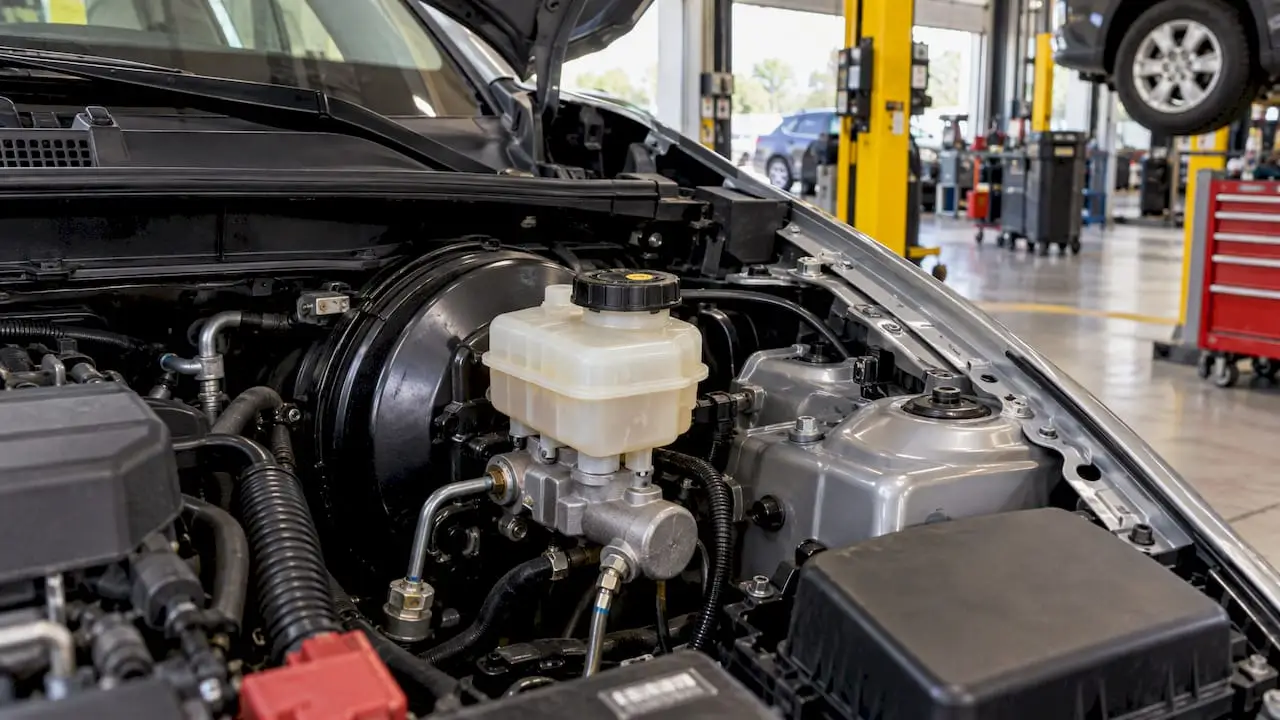
The classic sign of a failing brake master cylinder is a pedal that slowly sinks toward the floor while you hold steady pressure. Other signs include a spongy pedal, falling fluid in the reservoir, a wet spot near the firewall and dirty fluid. Any of these means your brakes need a professional look before you keep driving. At Kwik Kar of Celina, we see drivers wait on this one because the car “still stops”, and we would rather you call early.
TL;DR
- The most telling symptom is a brake pedal that slowly sinks while you hold pressure, usually with the engine running.
- A master cylinder can fail inside, with no puddle under the car, so a dry driveway does not rule it out.
- A spongy pedal alone is not proof. Air in the lines, a sticking caliper slider or a booster problem can feel the same.
- Unexplained brake fluid loss or a pedal that goes to the floor is a reason to stop driving and arrange a tow.
- Kwik Kar of Celina can inspect the brake system and explain what we find before any repair starts.
Table of Contents
- What does a master cylinder do?
- What are the symptoms of a bad master cylinder?
- Can a master cylinder fail without leaking?
- What causes master cylinders to fail?
- Is it the master cylinder, the booster or something else?
- How do you check for a bad master cylinder?
- Is it safe to drive with a failing master cylinder?
- What happens during a master cylinder repair?
- Texas inspection rules and your brakes
- Brake service at Kwik Kar of Celina
- How can you reduce the risk of master cylinder trouble?
- FAQ
- Questions about your brakes?
- Sources
What does a master cylinder do?
The master cylinder is the part that turns your foot pressure into hydraulic pressure. When you press the pedal, pistons inside the cylinder push brake fluid through the lines to the brakes at each wheel. Rubber seals around those pistons keep the fluid moving forward instead of leaking past them.
It sits on the driver’s side of the firewall, usually under the fluid reservoir, often attached to the brake booster. When the seals or the bore (the polished inner wall of the cylinder) wear, the system cannot build the pressure it needs. Haynes explains that bore wear, especially with corrosion or water-contaminated fluid, lets fluid slip past the piston seal.
What are the symptoms of a bad master cylinder?
There are six signs worth knowing. You may notice one or several.
A brake pedal that slowly sinks
You press the pedal, it feels firm, and then it creeps down under your foot at a red light. Brake & Front End magazine describes this slow sink as the classic symptom of a failing master cylinder. The common underlying problems are wear in the piston bore and piston seal failure.
The fluid is not necessarily escaping. Often it is bypassing the internal seal and returning to the reservoir, so the pressure you built bleeds away.
A soft or spongy pedal
A pedal that feels mushy, or needs a second pump to firm up, is another common complaint. One veteran brake technician writing in Underhood Service explains that a worn rear seal can let air in as the pedal is released, and air compresses, which is why the pedal feels spongy.
Spongy is the least specific symptom on this list, so see the section on look-alikes below.
A pedal that feels fine, then suddenly isn’t
Some failures come and go. The brakes feel normal one moment and weak the next. That kind of inconsistency is a reason to get the car checked right away, not to wait for it to get worse.
Brake fluid level dropping
If you keep topping off the reservoir, the fluid is going somewhere. Brake fluid does not get “used up” like engine oil. The brake pads wear and the level drops slightly over time, but a steady or sudden drop means a leak.
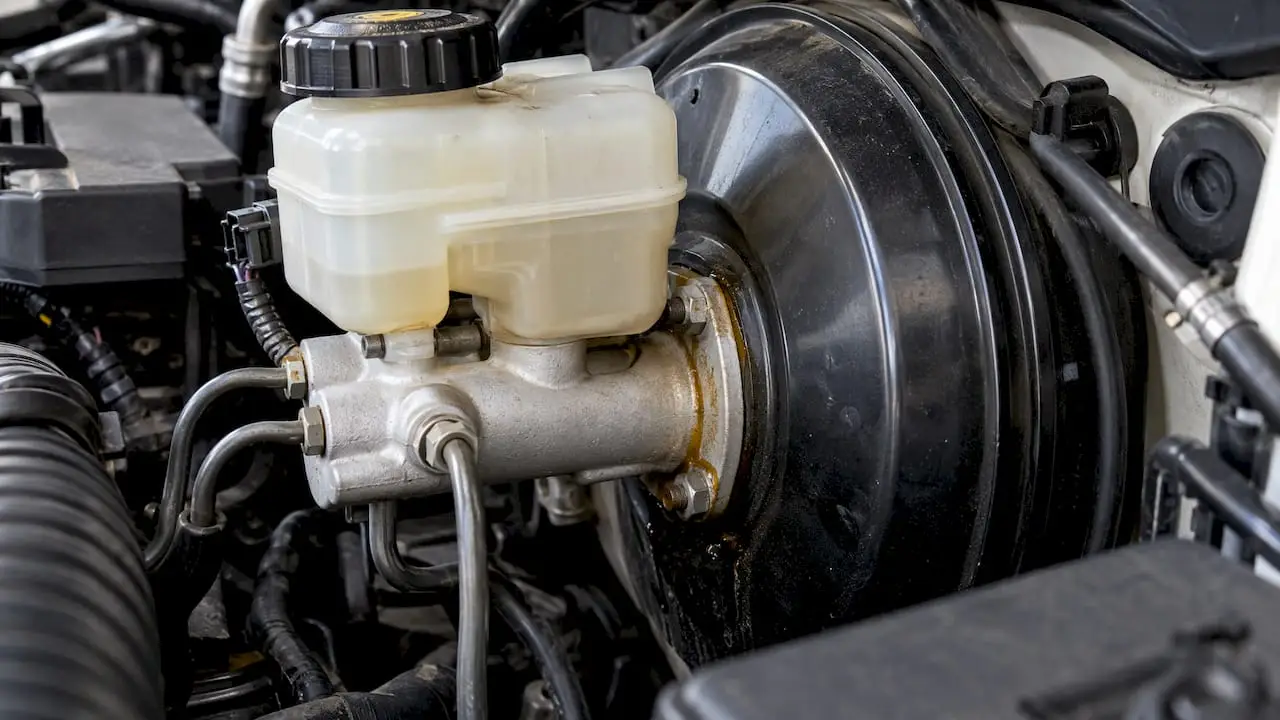
A wet spot or stain on the firewall
Look where the master cylinder meets the firewall or the booster. Underhood Service notes that a wet area around the mounting flanges is one indicator of a leaking master cylinder. Brake fluid is typically clear to amber and slippery, and it can strip paint.
Dark or dirty fluid
Fluid that looks dark or has debris in it points to contamination. Moisture in the fluid lets corrosion attack the piston bores, and pitting makes seals wear faster and may cause leaks. That is one reason fluid condition matters even when the pedal feels fine.
Can a master cylinder fail without leaking?
Yes. Internal seals can wear out so fluid bypasses the piston and goes back to the reservoir rather than to the brake lines. The result is lost hydraulic pressure with no puddle under the car.
There is also a hidden external version. NAPA’s technical guidance explains that a rear master cylinder leak may be hidden inside the vacuum booster. In that case, the reservoir slowly empties and you see nothing on the ground. Underhood Service adds that fluid can end up in the booster and ultimately the engine intake, so “no leak” does not always mean “no problem”.
So if your pedal sinks and the driveway is dry, do not assume the brakes are fine.
What causes master cylinders to fail?
Three causes show up again and again.
- Normal wear. Seals harden and the bore wears over many years of pressing the pedal.
- Contaminated fluid. Brake fluid absorbs moisture over time. Water can corrode the inside of the cylinder.
- Corrosion and pitting. A rough or scuffed bore chews up seals. Underhood Service says most master cylinder failures start with leaks around the piston seals as the seals wear or the bore becomes scuffed or pitted.
Fluid maintenance is the part you can control. We cover that in our guide to brake fluid flushes, including when a flush makes sense. We cannot promise a flush will prevent a failure on your specific vehicle, but clean fluid keeps moisture-driven corrosion from getting a head start.
Is it the master cylinder, the booster or something else?
Several brake faults feel alike. J.D. Power cautions that reduced braking, a spongy pedal, fluid leakage, warning lights and grinding can have other brake-system causes, and that professional diagnosis is needed.
Here is how the common look-alikes compare.
| What you notice | Could be the master cylinder | Could also be |
|---|---|---|
| Spongy pedal | Worn seal letting air in or fluid bypass | Air in the lines, a sticking caliper slider |
| Pedal slowly sinks under steady pressure | Internal seal bypass (the classic sign) | An external leak elsewhere in the system |
| Low fluid, no puddle | Rear seal leaking into the booster | Worn pads (a small drop), a leak at a hose or caliper |
| Grinding when braking | Rarely the cause by itself | Worn pads or rotors |
| Pulling to one side | Less common | Sticking caliper, uneven pad wear, tire or alignment issues |
| Brake warning light | Low fluid or a pressure imbalance | Several other brake or ABS faults |
NAPA Know How stresses that a spongy pedal is not diagnostic by itself, because air, caliper-slider problems and other mechanical faults can mimic a master cylinder problem.
A few related pages may help narrow it down:
- Grinding or noise: see why brakes squeal or grind and signs you need new brake rotors.
- Brake lights staying on or off: read about brake light switch symptoms.
- ABS or traction warning lights: see wheel speed sensor symptoms.
A warning light code can point you in a direction, but it is not proof that a specific part is bad. A scan tells us where to look, and a hands-on test confirms it.
How do you check for a bad master cylinder?
The sinking pedal test is the starting point for most technicians. Please do this only in a safe place, such as a parked car on level ground with the parking brake set.
- Start the engine.
- Press the brake pedal firmly with steady pressure.
- Hold it for 30 to 60 seconds.
- Watch whether the pedal slowly sinks toward the floor.
Anthony Calhoun, an ASE Master Technician writing for Apex Technation, calls this test definitive: a pedal that sinks over that time while you hold constant pressure suggests the master cylinder is bypassing internally. He also notes it is the most commonly misdiagnosed brake component. He has seen technicians bleed brakes for hours and replace calipers, pads and rotors, and still have a sinking pedal because the master cylinder was never tested.
If the pedal sinks, stop there. Do not drive the car to test it further, and have it inspected.
A shop goes further than a driver can. Under ASE’s A5 brake task list, technicians check for master cylinder leaks, measure pedal height, travel and free play, test for fluid contamination, and bleed or replace fluid. A bench test can also confirm a removed unit. Tomorrow’s Technician explains that with the ports plugged and air bled from the bore, a pedal that still sinks means the seal is damaged and the master cylinder should be replaced.
For a car that is mid-repair, that is the sort of test a bench-bled replacement should also pass.
Is it safe to drive with a failing master cylinder?
No. A master cylinder problem affects the whole brake system, and failure can get worse without warning.
Stop driving and call for a tow if:
- the brake pedal goes to the floor,
- you are losing brake fluid and cannot explain why,
- you see a puddle or fluid spray near the master cylinder or at a wheel,
- the brake warning light is on along with a soft pedal.
Hagerty Media advises towing instead of driving when brake fluid loss is unexplained, visibly puddled or tied to a pressurized brake-component leak. NAPA’s guidance is blunt too: any brake fluid leak puts people in danger.
Do not keep topping off the reservoir and carrying on. Adding fluid hides the symptom and leaves the cause in place.
If you are on the Dallas North Tollway or US-380 and the pedal feels wrong, pull over safely first. Use the parking brake gently and call for help.
What happens during a master cylinder repair?
When testing confirms a bad master cylinder, the usual fix is replacement. NAPA notes that a confirmed master cylinder fault is a reason to replace it, followed by bleeding the whole system and following vehicle-specific procedures where required.
In general, a repair looks like this:
- Inspect the brake system and confirm the cause, including the pedal test and a check of the lines, calipers and booster.
- Replace the master cylinder.
- Bench bleed or bleed the new unit as the vehicle requires.
- Bleed the full system and replace fluid if it is contaminated.
- Test the pedal feel and check for leaks.
Steps vary by vehicle. Some European models, for example, have specific bleeding procedures. Our European repair service handles those with the vehicle in mind. We do not quote a price or time for a master cylinder job in an article because it depends on the vehicle and what the inspection finds.
Our perspective: why we start with the pedal
When a driver tells us the brakes feel soft, our first question is how long it has felt that way and whether the pedal ever sinks at a stop. That tells us where to look before we touch a tool.
We do not want you to pay for parts you may not need. Pads, rotors, calipers, air in the lines and a master cylinder can all make a pedal feel wrong. Our ASE-certified technicians work through them in order and test before replacing.
That is also why we use Digital Vehicle Inspections. You can see what we see, in plain terms, and decide with full information. We would rather explain a finding twice than leave you guessing.
Brakes are not the place to wait and see. If something feels different, bring it in. We stand behind our work with a 2-year/24,000-mile warranty.
Kwik Kar
Texas inspection rules and your brakes
Most noncommercial vehicles in Texas no longer need an annual safety inspection as of January 1, 2025. The Texas DPS confirms the change came from House Bill 3297 and that non-commercial vehicles no longer need a safety inspection before registration. Owners still pay a $7.50 inspection program replacement fee at registration.
Two points matter for Celina drivers:
- Emissions testing. Qualifying vehicles in Collin County still require emissions testing, according to Local Profile’s reporting of the Texas DMV. Check your vehicle’s requirements with the county or state before registering.
- Commercial vehicles. Commercial vehicle inspection rules differ from noncommercial rules, so fleet managers should confirm what applies to each vehicle.
With no yearly inspection, nobody checks your brakes unless you do. A failing master cylinder will not wait for a sticker deadline. See our Texas vehicle inspection checklist for what still applies, or our TX state inspections page.
Brake service at Kwik Kar of Celina
If your pedal sinks, feels soft or your fluid keeps dropping, we can inspect the system and tell you what we find. Our brake repair service covers the wider brake system, and our diagnostics service helps when the cause is not obvious.
If your schedule is tight, we offer after-hours drop-off and a complimentary ride service. Our work carries a 2-year/24,000-mile warranty. See all of our services for the full list.
How can you reduce the risk of master cylinder trouble?
You cannot stop wear, but you can avoid the conditions that speed it up.
- Check the reservoir. Look at the fluid level and color from time to time. Do not open the cap longer than necessary, since fluid absorbs moisture from the air.
- Watch the pedal. Learn how it normally feels. Changes matter more than absolute firmness.
- Keep fluid fresh. Contaminated fluid contributes to corrosion inside the cylinder. Our brake fluid flush guide explains when it makes sense.
- Act on small signs. A faint wet patch or a slight drop in the reservoir is the cheapest time to investigate.
- Follow your manufacturer’s schedule. Our factory scheduled maintenance service follows the intervals for your vehicle. Intervals vary by make and model, so your owner’s manual is the guide.
FAQ
How do I know if my master cylinder or my brake booster is bad?
A failing master cylinder tends to show as a pedal that sinks under steady pressure or fluid that disappears. A booster problem more often shows as a hard pedal and more effort needed to stop. Because symptoms overlap, a technician should test both.
Can a bad master cylinder cause the brake pedal to go to the floor?
Yes. Wagner Brake’s technical guidance says a master cylinder can develop an external leak or an internal leak from a damaged piston seal, and either one reduces hydraulic pressure so the pedal can drop. If this happens, stop driving and arrange a tow.
Can I just add brake fluid and keep driving?
No. Low fluid means a leak somewhere or a seal failing. Topping off covers the sign without fixing the cause, and the brakes may still fail. Have the system inspected first.
Is a master cylinder problem a big repair?
It depends on the vehicle and on whether other parts, such as lines or calipers, are affected. The repair usually includes replacing the unit and bleeding the system. We can give you a clear estimate after an inspection.
Questions about your brakes?
If your pedal feels different, or you are not sure what you are seeing under the hood, contact Kwik Kar of Celina in Celina, TX. We can look it over and explain the next step in plain language.
Sources
- Understanding Your Car’s Master Cylinder, Haynes Manuals
- Basic Brake Hydraulics: Classic Symptoms of a Failing Master Cylinder, Brake & Front End
- Diagnostic Solutions: Master Cylinder Diagnosis, Underhood Service
- Replacing Master Cylinders, Brake & Front End
- How Do You Test a Brake Master Cylinder?, NAPA Know How
- What Is A Brake Master Cylinder?, J.D. Power
- Hydraulic Brakes, How They Work and What Fails, Apex Technation
- ASE A5 Brakes task list
- Brake Tech Tip: Low Sinking Or Spongy Brake Pedal, Tomorrow’s Technician
- What It Means When You’re Losing Brake Fluid, Hagerty Media
- Causes of Spongy Brakes, Wagner Brake
- Vehicle Safety Inspection Program Changes Now in Effect, Texas DPS
- What To Know About 2025 Texas Vehicle Safety Inspections In Collin County, Local Profile