


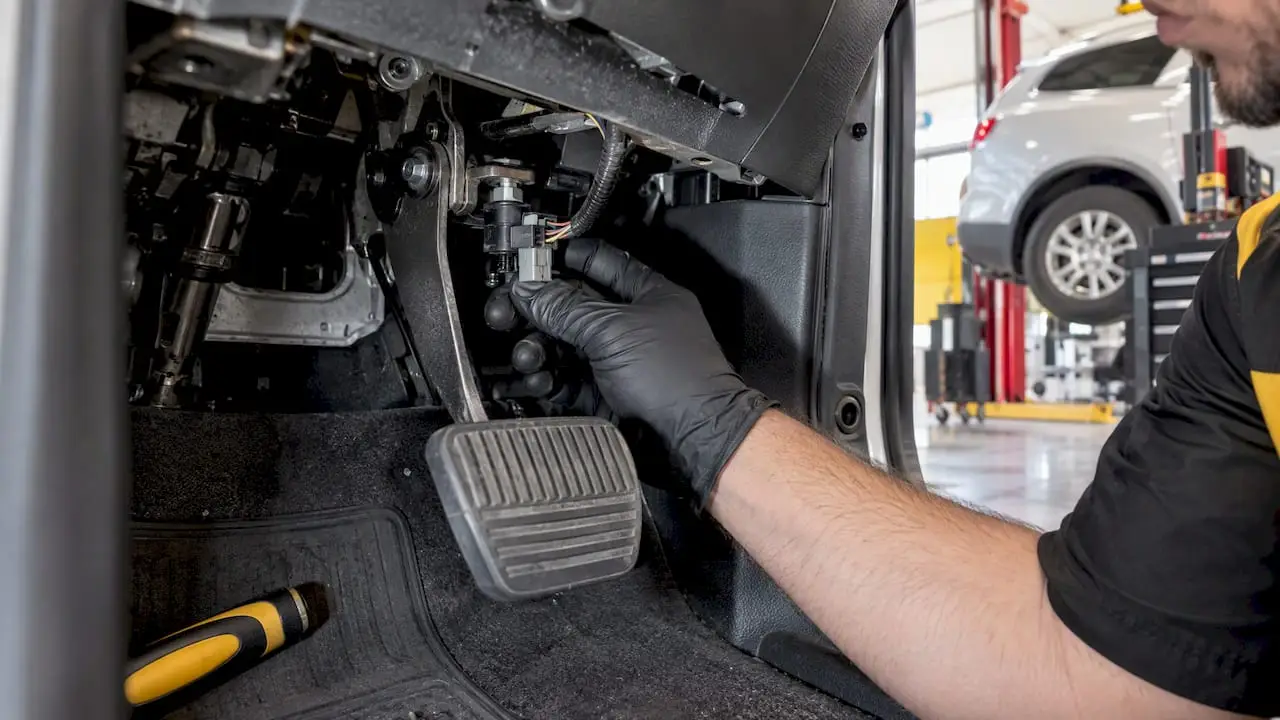
The most common brake light switch symptoms are brake lights that stay on, brake lights that never come on, cruise control that acts up, and a shifter that moves out of Park without your foot on the brake. The switch is a small part with a big job, and it feeds more than the lights behind you. At Kwik Kar of Celina, we see drivers in Celina, TX who assume a blown bulb when the real cause is the switch, or the reverse. This guide helps you tell them apart, explains what you can safely check, and covers when to have a technician take over.
TL;DR
- A bad brake light switch most often shows up as brake lights that stay on, brake lights that do not light, cruise control problems, or a shift lock that fails to hold the shifter in Park.
- A blown bulb, a bad fuse, or a switch that is simply out of adjustment can look the same, so rule those out first.
- A trouble code can point toward the switch, but it is not proof the switch is the failed part.
- Part cost is modest, but a brake light failure is a safety issue because drivers behind you cannot see you slow down.
- If the lights are not working at all, have the car checked before you keep driving it.
Table of Contents
- What does a brake light switch do?
- What are the symptoms of a bad brake light switch?
- What else can mimic a bad brake light switch?
- How do you test a brake light switch?
- Can you replace a brake light switch yourself?
- How much does it cost to replace a brake light switch?
- What about resetting a brake switch?
- Is it safe to drive with a bad brake light switch?
- What about Texas inspections?
- Our perspective at Kwik Kar of Celina
- Need the switch checked in Celina, TX?
- FAQ
- Sources
What does a brake light switch do?
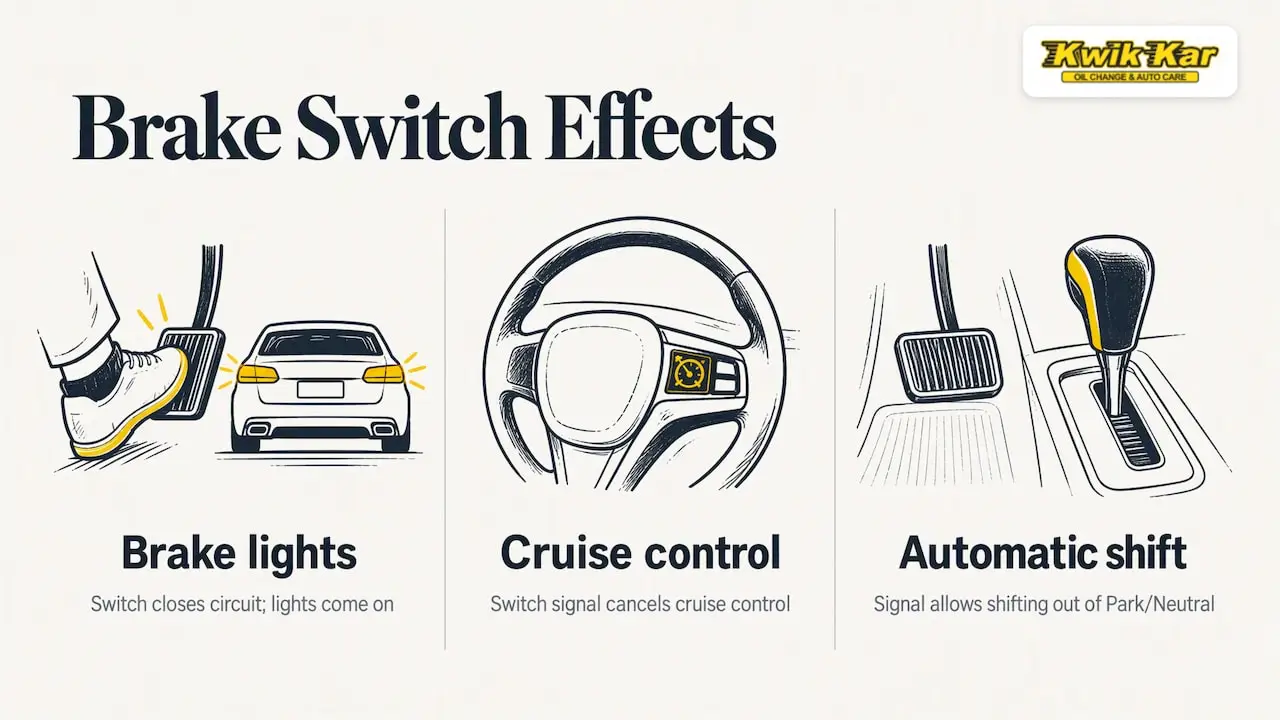
The brake light switch, also called the brake pedal switch or stop lamp switch, sits at the top of the brake pedal arm under the dashboard. When you press the pedal, it closes a circuit and the brake lights come on. When you let off, the circuit opens and they go out.
That is only part of the job. The switch also sends a signal to the vehicle’s computer. According to one technical explainer on brake switches, that signal is used to cancel cruise control and, in automatics, to allow the gear lever to move out of Park and Neutral. Some newer vehicles use a hydraulic switch built into the braking system that senses pressure instead of pedal position. Which type you have depends on the make and model.
Because one small part feeds several systems, one failure can produce several unrelated-looking symptoms. That is why the switch is a good suspect when odd things happen together.
What are the symptoms of a bad brake light switch?
These are the signs we hear about most, roughly in order of how often drivers notice them.
Do the brake lights stay on all the time?
If the lights stay lit with your foot off the pedal, the switch may not be opening the circuit. This is easy to miss from the driver’s seat. You may find out from a neighbor, a passing driver, or a dead battery in the morning, since lights that stay on can drain it.
A quick check: park facing a garage door or storefront window at night and look at the reflection, or ask someone to look at the back of the car while you stay in the driver’s seat with the pedal released.
Do the brake lights fail to come on?
This is the dangerous one. Common signs of switch failure include lights that stay on or do not illuminate. If the lights are dead, you have no way to warn the driver behind you, so do not treat it as something to put off.
Intermittent behavior counts too. Lights that work one stop and not the next often point to a switch that is worn, loose, or sticking.
Does cruise control stop working or refuse to cancel?
The cruise control system depends on the brake signal to disengage. Federal recall documents describe a malfunctioning stop lamp switch that may not deactivate cruise control when the brake pedal is pressed. If cruise will not engage at all, the computer may also be seeing a brake signal that does not make sense and refusing to set.
If cruise does not cancel when you press the brake, turn it off with the cruise control switch and have the car looked at before using it again.
Can you shift out of Park without pressing the brake?
Most automatics have a brake shift interlock that keeps the shifter in Park until you press the brake. A faulty switch can break that link. A manufacturer recall filing with NHTSA notes that a malfunctioning switch may allow the driver to shift out of Park without pressing the pedal. The opposite can happen too: you press the brake and the shifter will not release.
What other signs can show up?
A recall for specified Hyundai vehicles listed several effects of stop lamp switch malfunction, including problems with the brake lights, shift interlock, the ESC warning light and cruise control, and a possible increased crash risk. So a stability control warning light, along with any of the signs above, can be worth mentioning to your technician. Other dash lights have their own safe-driving checklists, such as these safety checks for an airbag light.
A quick reference:
| What you notice | What the switch may be doing | Other things to rule out |
|---|---|---|
| Lights always on | Not opening the circuit | Switch out of adjustment, worn pedal stopper pad |
| Lights never on | Not closing the circuit | Blown bulbs, blown fuse, wiring |
| Cruise control won’t set or cancel | Sending a wrong or missing signal | Cruise control switch, other sensors |
| Shifter moves out of Park freely, or sticks | Shift interlock not getting a signal | Interlock solenoid or linkage |
| Stability warning light with other signs | Brake signal mismatch | Wheel speed sensor, steering angle sensor |
What else can mimic a bad brake light switch?
Before blaming the switch, rule out the simpler causes. Brake lights may stay on or fail to come on because of a failed switch, a blown fuse, or a bulb problem, and a misadjusted switch or a worn pedal stopper pad can cause the same thing.
Here is how we think through it:
- One brake light out, others fine. That is usually a bulb or socket. A switch failure normally affects all of them, including the third light.
- All brake lights out. Check the fuse, then suspect the switch. A switch problem is likely, but wiring is possible.
- Lights stay on. Look at the switch adjustment and the small pad or bumper at the top of the pedal arm. If it has worn or fallen off, the plunger may never get pushed in far enough.
- Stability warning light plus other odd signs. A failing wheel speed sensor can also trigger warnings. We cover those in our guide to wheel speed sensor symptoms.
- Electrical gremlins across the car. Corrosion and moisture can affect connectors anywhere. See our notes on common electrical problems after winter moisture.
Adjustment deserves its own mention. One technician training resource says that a switch adjusted too tight can keep the lamps on, while one adjusted too loose can stop them from coming on, and calls misadjustment probably the most common failure technicians see. Some switches self-adjust and cannot be repaired. If one is damaged, it is replaced.
How do you test a brake light switch?
A proper test depends on your vehicle. The steps below are the general approach, and you should follow the factory procedure for your exact model.
- Check the bulbs and fuse first. This takes minutes and rules out the most common lookalikes.
- Look at the switch. With the car off, look under the dash near the top of the pedal arm. Check for a loose connector, a missing pedal pad, or a plunger that is stuck or cracked.
- Watch the lights. With a helper behind the car, press and release the pedal slowly. Lights should come on within the first part of the pedal’s travel and go out when it returns fully.
- Test the switch electrically. A technician uses a multimeter to check continuity across the switch terminals with the pedal released and pressed. The pin pairs differ by vehicle. In one factory manual for a 2007 Jeep Liberty, for example, specific pin pairs should read as continuous at rest and others when pressed, and the switch is replaced if any check fails. Do not apply those pin numbers to a different vehicle.
- Scan for codes. A failing switch may set a stored brake switch correlation code. Treat a code as a clue, not a verdict. It tells the technician where to look, and the same code can come from wiring, adjustment or another sensor. That is why we rely on a full OBD-II diagnostic test and a hands-on inspection instead of swapping parts from a code alone.
Can you replace a brake light switch yourself?
Some drivers can. The switch is generally under the dashboard, and one repair guide says many drivers can swap it in under 15 minutes and that the new switch must be adjusted so its plunger touches the pedal arm at rest. But models differ a great deal, and a few points matter:
- Some vehicles use twist-lock switches, some use bolt-on types, and some use hydraulic units that are part of the brake system.
- Pedal position matters. A manufacturer service bulletin for one vehicle warns not to press, lift or move the brake pedal during removal or installation, to avoid damaging the switch or setting it wrong. Follow your own vehicle’s procedure.
- Disconnect the battery if the manual calls for it, particularly on cars with airbags near the pedal area.
- After the swap, confirm that the lights go off when the pedal is released, that cruise cancels, and that the shifter behaves normally.
If the switch is hard to reach, if your car has a hydraulic unit, or if warning lights are on, a shop visit is the safer path. Brake light switch work is simple on paper, but a poorly set switch can bring the same symptoms right back.
How much does it cost to replace a brake light switch?
The part itself is inexpensive. One repair guide puts it at about $10 to $40 for most makes and models. For professional replacement, a repair-pricing service reports a typical range of $82 to $120 for the whole job, because labor is short. These are national figures. European models, hydraulic switches and cars where the switch is hard to reach can cost more.
We do not publish a fixed price for this repair at Kwik Kar of Celina, because it depends on your vehicle and what the inspection finds. We can give you a quote after we look at it.
What about resetting a brake switch?
There is no universal reset button. In most cases, “resetting” means adjusting the switch and pedal free play to the manufacturer’s specification, which is where a misadjusted switch gets fixed. If a code was stored, a technician clears it after the repair and checks that it does not return. Clearing a code without fixing the cause only hides the problem for a short time.
Is it safe to drive with a bad brake light switch?
It depends on the symptom, but you should not wait long.
- Lights not working: Avoid driving, especially at night or in traffic. Drivers behind you cannot see you slow down. Texas drivers on busy roads like Preston Road and the Dallas North Tollway corridor have little margin for that.
- Lights stuck on: Less dangerous in the short term, but it confuses other drivers and can drain the battery.
- Cruise control that will not cancel: Use the cruise control off switch and avoid the feature until it is fixed.
- Shifter issues: A car that moves out of Park without the brake is a safety concern, particularly with kids around.
If you are unsure, call us before driving. Our brake repair service includes inspection of the braking system, and you can read more about brake fluid flushes if you are also unsure about the condition of your fluid.
What about Texas inspections?
A brake light that does not work is a safety defect, but you will not be failed at an annual inspection for it in most cases anymore. As of January 1, 2025, most noncommercial vehicles in Texas no longer require annual safety inspections under House Bill 3297. A $7.50 inspection program replacement fee is collected at registration instead.
Emissions testing is separate. Vehicles registered in emissions counties, which include Collin County, still need an emissions test. Gasoline vehicles from 2 through 24 years old receive an OBD-II test there. Commercial vehicle inspection rules differ from the noncommercial rules, so fleet managers should confirm what applies to their vehicles on the official DPS site. We handle TX state inspections and fleet needs, and we can walk you through which category your vehicle falls under.
Our perspective at Kwik Kar of Celina
The brake light switch is one of those parts that rarely gets attention until something goes wrong. Most of the time, the problem we find is not dramatic. It is a switch that has drifted out of adjustment, a worn pedal pad, or a connector that has come loose. Sometimes it is the switch itself.
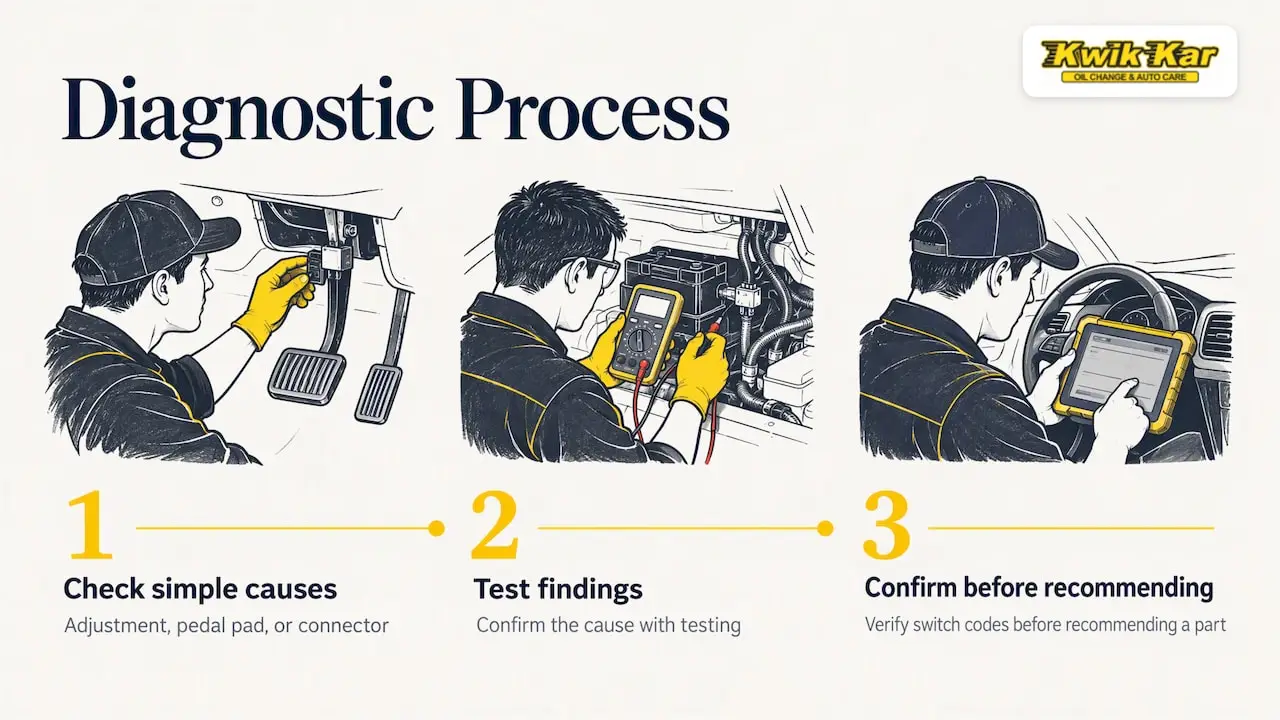
What matters is that nobody guesses. Our ASE-certified technicians check the simple things first, then confirm with testing, and we use Digital Vehicle Inspections so you can see what we see. If a code points toward the switch, we confirm it before recommending a part. If the cause is a bulb or fuse, we will tell you so.
We also know that a driver in Celina does not always have a free afternoon. After-hours drop-off and our complimentary ride service are there so a safety repair does not get pushed back. Our repairs are backed by a 2-year/24,000-mile warranty.
— Kwik Kar
Need the switch checked in Celina, TX?
If your brake lights are staying on, not coming on, or your cruise control and shifter are acting strangely, we can inspect the switch, bulbs, fuse and wiring, and tell you plainly what is wrong. See everything we handle on our services page, or reach out to Kwik Kar of Celina to schedule a visit. European owners can also learn about our European repair service.
FAQ
Can a bad brake light switch drain my battery?
Yes, it can. If the switch holds the circuit closed, the brake lights can stay on after you park and wear the battery down. If your battery dies repeatedly, ask for a check of the charging system as well, since a weak alternator causes similar trouble. See our guide to alternator failure symptoms.
Will a bad brake light switch cause a check engine light?
It can. A failing switch may set a stored brake switch correlation code, and other warning lights, such as the stability control light, may appear. A code only points to a circuit or system. It does not prove the switch is the failed part, so a proper diagnosis should come before any parts are replaced.
Why do my brake lights work but cruise control doesn’t?
The switch can send the lights a signal while the computer gets a bad or missing one, or the problem may be in the cruise control switch itself. The only way to know is testing the circuit on your specific vehicle. A technician can check both signals and see which one is wrong.
Can I drive with brake lights that stay on?
For a short trip, it is generally possible, but it is not a good idea to keep doing it. Stuck-on lights confuse drivers behind you and can drain your battery. Have the switch adjustment and pedal pad checked soon.
Sources
- Brake switch explainer, PSBrake
- Understanding the Brake Light Switch, Innova
- NHTSA recall filing, Hyundai stop lamp switch, 2009
- NHTSA recall filing, brake shift interlock, 2021
- NHTSA technical service bulletin, 2025
- Brake Light Switch Symptoms, Core Brake Parts
- Brake lamp switch diagnosis, 2007 Liberty KJ service manual
- Bad Brake Light Switch, YouCanic
- Symptoms of a Bad Brake Light Switch, The Motor Guy
- Brake system warning lights, MasterTech Prep
- Brake light switch replacement cost, Jerry
- Texas DPS, vehicle safety inspection program changes
- Texas DPS, emissions inspection criteria
- Safety checks for an airbag light, Underground Dynamics