


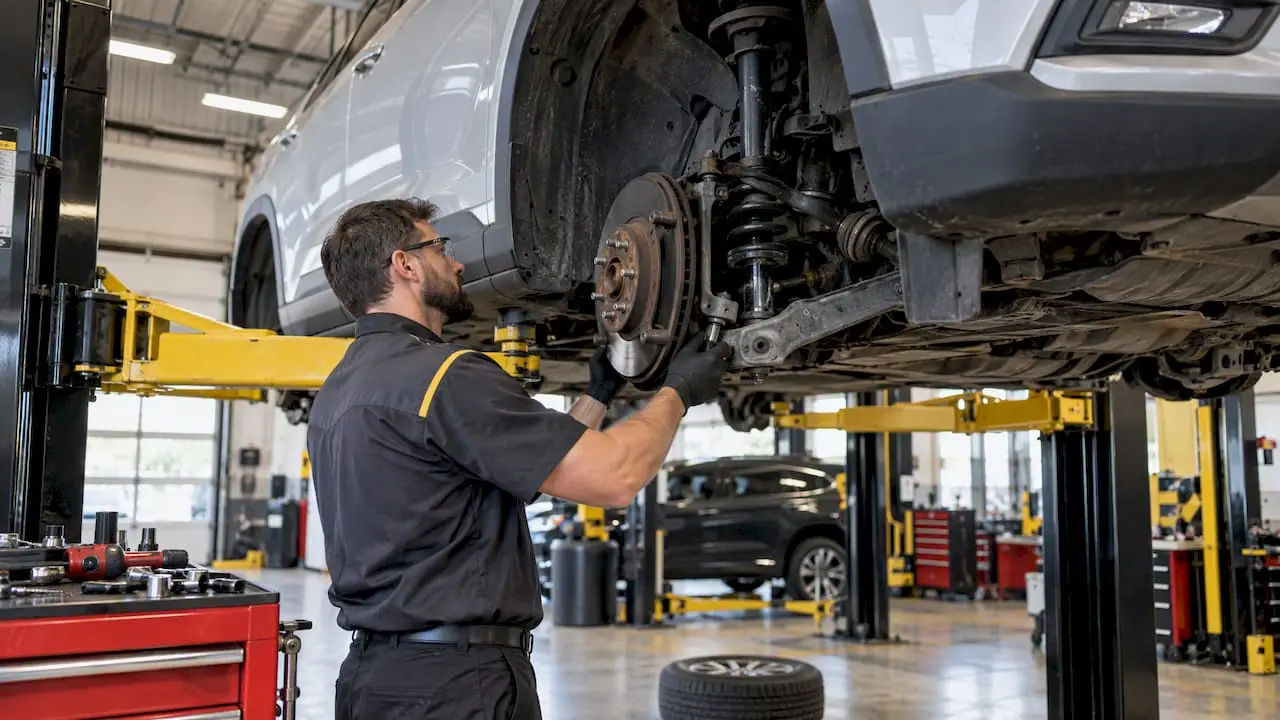
A squeak over bumps most often comes from dry or worn rubber bushings, the soft joints that let your suspension move quietly. Worn ball joints, sway bar links, struts and mounts can make similar sounds. The noise tells you where to start looking. It doesn’t tell you which part has failed, and that takes a hands-on inspection.
At Kwik Kar of Celina, we hear this complaint a lot from drivers around Celina, TX, especially after a dry stretch of summer or on roads with speed bumps and rough pavement. Below, we explain what each sound usually means, what you can check yourself, and when it’s time to book service.
TL;DR
- A squeak over bumps is usually dry or worn rubber bushings, such as those in control arms or sway bars. Worn ball joints or struts can also be the cause.
- A squeak is often the early warning. A clunk or thump suggests a part has developed play, and that deserves a prompt inspection.
- Don’t spray petroleum-based products like WD-40 on rubber bushings. They can break the rubber down.
- Noise is a symptom, not a diagnosis. Ask for the worn part to be found and shown to you before anything is replaced.
- Most noncommercial vehicles in Texas no longer need an annual safety inspection, but a suspension check is still smart if you hear noises.
Table of Contents
- What is the squeaking sound when I go over bumps?
- How do I tell what kind of noise I’m hearing?
- Why does my car clunk when going over bumps?
- What causes suspension noise when turning?
- What can I check myself before calling a shop?
- Can I spray lubricant on a squeaky suspension?
- Is a squeaky suspension dangerous to drive on?
- How much does it cost to fix a squeaky suspension?
- How do you diagnose a suspension squeak without guessing?
- What are the repair options?
- Our perspective: why we start with the sound and finish with proof
- What does a Texas inspection have to do with suspension noise?
- How can I keep the squeak from coming back?
- Need suspension work in Celina, TX?
- FAQ
- Sources
What is the squeaking sound when I go over bumps?
Your suspension is a network of metal arms, springs, shocks or struts, and rubber or polyurethane bushings. When the car hits a bump, these parts pivot and flex. Rubber bushings cushion that movement. As they age, dry out or crack, the metal parts rub or twist against them and you hear a squeak, creak or groan.
The most common sources, based on Auto Barn’s symptom guide, are:
- Dry or worn bushings in the control arms or sway bar
- Worn ball joints
- Worn struts or shocks
Temperature and moisture matter too. Rubber stiffens as it ages, and a squeak that shows up on small bumps at low speed often points to bushings or sway bar parts rather than the shocks.
How do I tell what kind of noise I’m hearing?
Different sounds point toward different parts. This table gives a starting point, not a verdict. Verification still requires someone to reproduce the noise and check the parts.
| What you hear | When it happens | Parts to check first |
|---|---|---|
| High-pitched squeak | Small bumps, low speed, driveway dips | Sway bar bushings, control arm bushings, dry joints |
| Creak or groan | Turning into a driveway, steering at low speed | Ball joints, strut mounts, control arm bushings |
| Rattle | Small, low-speed bumps | Sway bar end links |
| Clunk or knock | Larger bumps, braking, accelerating | Ball joints, end links, strut mounts, worn bushings |
| Squeak plus a bouncy ride | Any bump, repeated bouncing afterward | Struts or shocks |
The general pattern, with squeaks tied to dry bushings and a rattle over small bumps tied to end links, matches how ASE-style training teaches front suspension diagnosis. It’s a pattern, though. Vehicles differ, and the same sound can come from more than one part.
Why does my car clunk when going over bumps?
A clunk usually means something has play in it. Worn ball joints, sway bar end links, strut mounts or control arm bushings are common causes. A part that used to squeak because it was dry may now knock because it has loosened.
Here is how the progression often goes:
- Dry bushing. Squeak, usually on small bumps. The part is still tight.
- Worn bushing. The squeak becomes a creak, and the car may feel looser in turns.
- Loose joint or link. Clunks or thumps over bigger bumps, and sometimes a vague feel in the steering.
Per ASE-aligned guidance, letting a squeak turn into clunks or thumps usually means components have developed physical play. That can bring handling instability, uneven tire wear and bigger repair bills. If your noise has changed from a squeak to a clunk, don’t wait for the next oil change to mention it.
What causes suspension noise when turning?
Turning loads the suspension from the side, so it exposes parts that stay quiet on a straight road. Common suspects include:
- Ball joints. They let the wheel pivot as you steer. A dry or worn joint can creak or pop at low speed, like when you turn into a parking space.
- Strut mounts. The top mount lets the strut turn with the wheel. A worn one can groan or clunk when you turn the wheel.
- Sway bar bushings and links. They work hardest in corners, so they can squeak or clunk on turns.
- Control arm bushings. Worn ones can let the wheel shift slightly and make a noise on bumps taken mid-turn.
A noise only on left or right turns can give a technician a useful clue about which side to inspect first. Tell the shop which direction, because it speeds up the diagnosis.
What can I check myself before calling a shop?
You can gather helpful details without lifting the car. This is for describing the problem, not for fixing it.
- Note the conditions. Is it cold or hot? Is it only on the first drive of the day?
- Note the speed and bump size. Small ripples at low speed, or big dips only?
- Note steering. Does it happen while turning, going straight, or both?
- Try the bounce test. With the car parked, push down firmly on one corner of the hood or trunk and release. A healthy corner settles quickly. If it keeps bouncing, tell the shop.
- Watch your tires. Cupping, or wear on only the inner or outer edge, can be a sign of a worn suspension part or an alignment problem.
- Notice the feel. Pulling, drifting, a loose steering wheel, or the nose diving when you brake all matter.
Don’t crawl under a car supported only by a jack, and be careful if your vehicle has air suspension. ASE-based training notes say the system should be disabled before anyone jacks up or works near such a vehicle. That’s a job for a technician.
Can I spray lubricant on a squeaky suspension?
It’s tempting, and it’s the first thing many drivers try. Be careful about what you use. Study material for ASE technicians warns that petroleum products like WD-40 or engine oil degrade rubber and lead to premature failure. If a temporary lubricant is used to help locate a noise, the guidance calls for silicone-based or vegetable-based products.
Two other cautions:
- Silencing a noise isn’t fixing it. If the squeak stops after lubricant, you may have found the dry part. You haven’t made a worn one healthy.
- Lubricant can hide the clue. A technician trying to locate the source may have a harder time if it’s been sprayed everywhere.
Some parts are also sealed and not meant to be greased. A technician can tell you which is which on your vehicle.
Is a squeaky suspension dangerous to drive on?
A light squeak with normal steering and braking is usually not an emergency. Still, suspension parts hold your wheels in position, and some wear can affect safety. Federal vehicle regulations list conditions such as cut or cracked ball joint seals, bent structural parts and disconnected stabilizer bars as suspension defects, which shows how seriously these parts are treated.
Get the car checked soon if you notice any of these:
- Clunking that is new, getting louder, or happening on every bump
- Steering that feels loose, wanders, or pulls
- A bouncy or floaty ride, or the car leaning more in corners
- Uneven or fast tire wear
- A visibly sagging corner or leaking strut
If the steering suddenly feels wrong or you hear a loud bang followed by odd handling, pull over safely and call for help rather than driving on.
How much does it cost to fix a squeaky suspension?
It depends entirely on the part. ConsumerAffairs reports that suspension repairs for standard vehicles typically run between $150 and $800, while luxury models or repairs involving several components can exceed $2,000. Those are national figures, not Kwik Kar of Celina prices.
A few things move the number:
- Which part. A sway bar link is a different job than a control arm or a strut assembly.
- How many parts. Parts often wear in pairs, and some repairs make sense to do together.
- Your vehicle. Luxury and European models often use more specialized parts.
- Alignment. Some suspension work calls for an alignment afterward.
We don’t publish suspension prices, because a fair quote needs the actual diagnosis. We’ll explain what we find and what it will take before you decide.
How do you diagnose a suspension squeak without guessing?
Here is the standard we hold ourselves to. Noise is a symptom, and professional diagnosis involves physically reproducing the sound, through bounce tests or by prying on components, rather than assuming the cause from the noise alone.
In practice, a good inspection includes:
- Talking through when and where you hear the noise
- A road test to reproduce it
- A visual check of bushings, boots, links, mounts, struts and springs
- Checking for movement or play in the joints
- A clear explanation of what was found, and what is urgent versus what can wait
AAA also advises drivers to choose a facility with qualified technicians who can perform a formal diagnostic inspection to validate why a part needs replacing. We agree. If a shop wants to sell you parts based only on a sound over the phone, ask more questions.
What are the repair options?
Once the source is found, the fix usually falls into one of these groups:
- Bushing replacement. Worn or cracked bushings are replaced, sometimes as part of a control arm or sway bar assembly.
- Sway bar end link replacement. A common fix for rattles and clunks over small bumps.
- Ball joint replacement. For joints with play, or damaged seals.
- Strut or shock replacement. If the ride is bouncy or the parts leak. Our guide on how ASE technicians decide between struts and shocks explains the difference.
- Strut mount or spring-related repair. When noise comes from the top of the strut or from the spring seats.
- Alignment. Often recommended after replacing steering or suspension parts, so the tires wear evenly.
Sometimes the “suspension” noise isn’t from the suspension. Loose exhaust hangers, heat shields, and brake components can also rattle over bumps. A careful inspection rules these in or out.
Our perspective: why we start with the sound and finish with proof
Most drivers who call us about a squeak want one of two things: for it to stop, or to know whether it’s serious. Both are fair. What we try to avoid is a quick guess that costs you money and doesn’t fix the noise.

That’s why our shop leans on Digital Vehicle Inspections. When a technician finds a worn part, we want you to see what we see and understand why it matters, so the decision stays yours. Our technicians are ASE-certified, and we pair old-fashioned, honest advice with modern tools.
Our honest take on timing: a squeak by itself gives you room to schedule a visit at a convenient time. A clunk, loose steering or uneven tire wear tells us to look sooner. Texas summers and rough roads are hard on rubber, so this is the kind of wear we expect to see on vehicles around Celina, TX.
— Kwik Kar
What does a Texas inspection have to do with suspension noise?
Most noncommercial vehicles in Texas no longer require an annual safety inspection as of January 1, 2025. According to the Texas Department of Public Safety, those vehicles are still subject to a $7.50 inspection program replacement fee.
Two more points matter for drivers here:
- Emissions testing still applies in some counties. Collin County is among the counties where qualifying vehicles still need an emissions inspection.
- Commercial vehicles are different. The DPS inspection criteria state that commercial vehicles continue to need an annual inspection, so fleet rules don’t match noncommercial rules.
The end of the safety inspection for most passenger vehicles means nobody will check your suspension for you each year. A worn part that would once have been flagged can now go unnoticed. If you hear squeaks or clunks, a check is up to you. For inspection questions, see our TX State Inspections page.
How can I keep the squeak from coming back?
Suspension parts wear with miles, heat and road conditions, so you can’t stop it entirely. You can slow it down:
- Have the suspension looked at whenever you’re in for other service, like tires or brakes.
- Address new noises early, while the fix is smaller.
- Keep tires properly inflated and rotated, and get an alignment checked if the car pulls or tires wear unevenly.
- Avoid hitting potholes and curbs at speed when you can.
- Follow your owner’s manual for scheduled maintenance, since intervals vary by make and model.
Our article on suspension system maintenance for winter driving covers more seasonal habits.
Need suspension work in Celina, TX?
Kwik Kar of Celina handles steering and suspension repair, diagnostics and wheel alignments for all vehicle types, including European cars. You can read about our steering and suspension service or our diagnostics. Repairs come with a 2-year/24,000-mile warranty, and we offer after-hours drop-off and a complimentary ride service if you can’t wait at the shop.
If a scan tool shows a trouble code on the dash, treat it as a clue and not a final answer. Our piece on avoiding costly parts swaps explains why. You can browse everything we do on our services page.
FAQ
Why does my suspension squeak only on small bumps?
Small, low-speed bumps often point to dry sway bar bushings, sway bar end links or control arm bushings. Those parts move even on light bumps, while shocks and struts do more work on bigger hits. A technician needs to reproduce the sound to confirm which one it is.
Is it safe to keep driving with a squeaking suspension?
A mild squeak with normal steering and braking is usually okay for a short time until you can schedule an inspection. Clunking, loose steering, pulling or uneven tire wear mean you should have it checked soon. If the car suddenly feels unstable, pull over safely and call for help.
Can I fix a suspension squeak with WD-40?
We don’t recommend it. Petroleum-based products can break down rubber bushings and cause them to fail sooner. Even if the noise goes quiet, the underlying wear is still there.
Does a clunk over bumps mean I need new struts?
Not necessarily. Clunks can come from ball joints, end links, strut mounts or bushings as well as the struts themselves. Replacing parts based on sound alone is a guess, so ask for the inspection findings first.
Sources
- Auto Barn: Squeaking Over Bumps
- MasterTechPrep: ASE G1 front suspension noises
- Derham’s Alignment: common suspension noises
- OpenExamPrep: suspension symptom troubleshooting
- eCFR: 49 CFR 570.8 Suspension systems
- ConsumerAffairs: Car Suspension Repair Cost
- AAA: Estimate Car Repair Costs
- Texas DPS: Vehicle Safety Inspection Program Changes
- Texas DPS: Emission Inspection Criteria
- Texas DPS: Inspection Criteria