



If your check engine light is on alongside falling fuel economy or a rough idle, a failing oxygen sensor is a likely cause. Our advice is to get an OBD-II diagnostic with a live-data check before you replace anything. The EPA treats emission-related faults as worth fixing quickly, and a proper test tells you whether the sensor is the real problem.
TL;DR:
- A trouble code alone does not prove the sensor has failed; technicians should confirm sensor data, test the heater circuit, and inspect wiring and exhaust.
- Repairing an emission fault, including a failed oxygen sensor, can improve fuel economy by an average of 6% to 13%.
- Short trips are usually possible, but avoid long drives and stop for a flashing check engine light, severe power loss, or strong fuel odor.
- Common service benchmarks are about 30,000 miles for unheated sensors and 60,000 miles for heated ones, though automaker guidance varies.
- Oil, coolant, silicone, or rich running can contaminate a sensor, so replace it only after addressing the source of the contamination.
Table of Contents
- What are the symptoms of a bad O2 sensor?
- What causes an oxygen sensor to fail?
- What happens if you ignore a failing oxygen sensor?
- How do technicians diagnose a bad oxygen sensor?
- Can you keep driving with a bad oxygen sensor?
- What does it cost to fix, and how long does it take?
- When should you inspect or replace oxygen sensors?
- Why we verify before we replace
- Book a diagnostic with our ASE-certified team
- FAQ
- Sources
What are the symptoms of a bad O2 sensor?
Most drivers notice a change in how the car feels before they notice anything else. Here is what we hear about most often:
- A lit check engine light (the malfunction indicator lamp)
- Gas mileage that drops without a change in how you drive
- A rough idle that shakes the steering wheel or seat
- Hesitation when you accelerate or climb a hill
- Stalling at stops or at low speed
- A strong fuel smell from the exhaust
None of these points only to the sensor. A trouble code narrows the search, but it does not prove the part is dead, which is why testing matters.
The scale of the fuel penalty is worth knowing. Repairing emission-related faults, including failed oxygen sensors, can improve gas mileage by an average of 6% to 13%. If your mileage has slipped, a failing sensor could be costing you real money at every fill-up.
What causes an oxygen sensor to fail?
Sensors live in a harsh spot, bathed in hot exhaust, so wear is normal. Several things shorten their lives:
- Age and mileage: Walker Products notes that heated sensors are usually checked or replaced around 60,000 miles, while unheated sensors are typically serviced around 30,000 miles.
- Contamination: Oil ash, coolant or antifreeze leaking into the exhaust, and silicone sealant fumes can coat the sensing element. A rich-running engine can also foul it with carbon.
- Heater circuit or wiring faults: A heated sensor depends on its internal heater and wiring. A broken wire or failed heater keeps the sensor from reaching operating temperature.
- Physical damage: Road debris, impact, or thermal shock from cold water on a hot exhaust can crack the element.
Knowing the cause matters because contamination often points to another repair, such as a leaking gasket, that a new sensor will not fix.
What happens if you ignore a failing oxygen sensor?
When the sensor stops reporting accurate data, the engine computer falls back on default settings. Those defaults tend to run the engine richer than necessary, so you burn more fuel and put out more pollution. The same EPA guidance explains that ignoring these faults can force the engine to rely on defaults, raising fuel consumption and emissions.
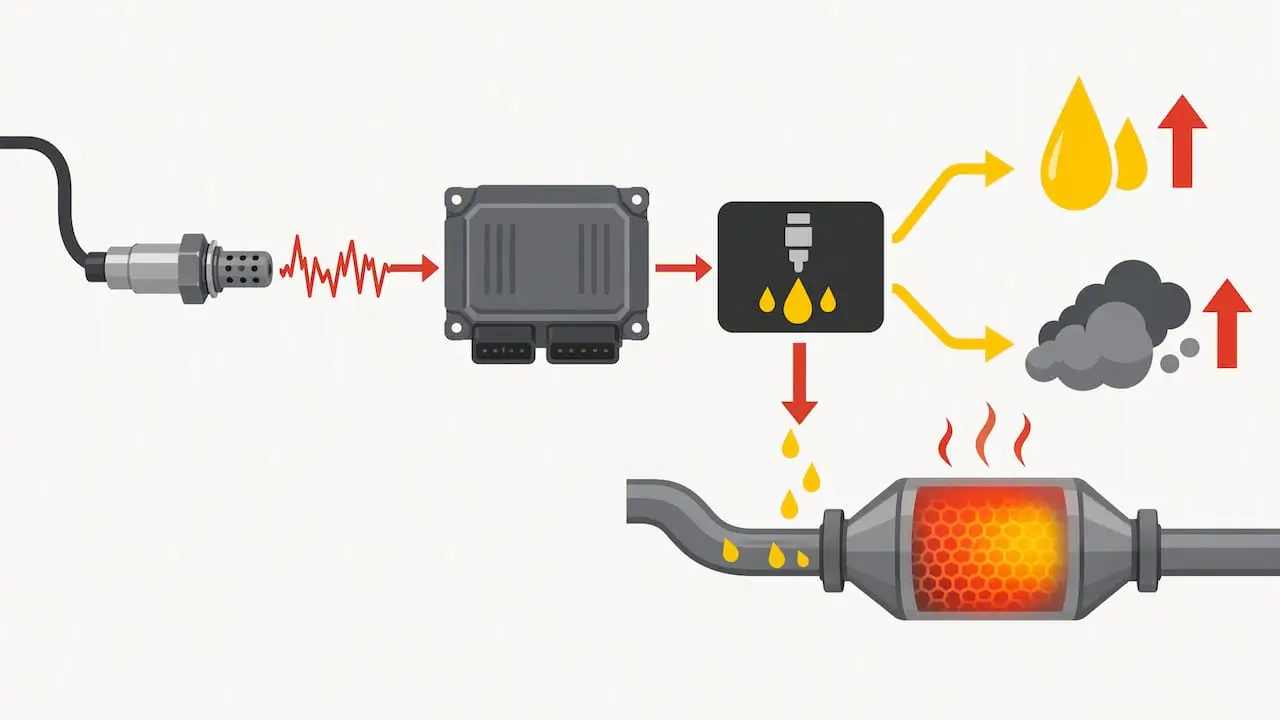
Fixing the fault early can avoid catalytic converter damage, because unburned fuel can overheat the converter.
That is where a modest repair turns into an expensive one. A sensor swap is typically a small job compared with replacing a converter. If your scan also shows catalyst-related codes, our P0420 code guide explains why we verify before replacing parts. The EPA’s OBD guidance makes a related point: the check engine light exists to flag small faults before they become large repairs.
How do technicians diagnose a bad oxygen sensor?
A trouble code is the starting line, not the finish. A proper diagnosis follows steps like these:
- Scan the OBD-II codes and note any freeze-frame data.
- Watch live data and the sensor waveform to confirm how fast and how often the sensor switches.
- Test the signal with a multimeter and check the heater circuit.
- Inspect the sensor, wiring, and exhaust for contamination, damage, and leaks.
- Look for root causes such as vacuum leaks or leaking injectors that can make a healthy sensor report bad readings.
For reference, a working sensor’s voltage typically swings between about 0.2 and 0.8 volts, according to Walker Products’ testing guidance. A lazy or flat signal suggests trouble, but the cause still needs confirming.
Pro Tip: Ask for live-data screenshots or a digital vehicle inspection report before you approve any parts replacement.
You can read more about how live data prevents wasted repairs in this check engine light diagnosis walkthrough, and our own OBD-II diagnostic test page explains what we do on our end.
Can you keep driving with a bad oxygen sensor?
For a short time, usually yes. Expect worse mileage and a car that feels less sharp. Plan on getting it checked soon rather than putting it off for months, and skip long road trips while the light is on. Pull over and call for service if you see any of these:
- A flashing check engine light, which signals a misfire
- A severe loss of power
- A strong fuel odor
A flashing light means raw fuel may be reaching the converter, so stop driving and have the car looked at.
What does it cost to fix, and how long does it take?
Once testing confirms the sensor is the culprit, replacing it is often a straightforward repair. If the data points elsewhere, we fix that root cause first. What shapes the final bill:
- Part choice: Sensor retail prices vary widely. An EPA/Radian analysis of sensor pricing found that some original equipment prices historically exceeded state inspection program repair-cost limits.
- Access: Labor depends on how hard the sensor is to reach on your engine and how seized the old one is.
- Related repairs: Damaged wiring, exhaust leaks, injectors, or an affected catalytic converter add to the work. Our exhaust system page covers those repairs.
- Workflow: Diagnostic check first, then a quote, then the replacement, with warranty terms explained before you commit.
Pricing for your vehicle is something we quote after the diagnosis, since the part and the labor differ from car to car.
When should you inspect or replace oxygen sensors?
Guidance varies by sensor type and automaker. Common benchmarks put unheated sensors near 30,000 miles and heated sensors near 60,000 miles, and many manufacturers suggest keeping an eye on them somewhere in the 50,000 to 80,000 mile range. To stretch sensor life:
- Use only sensor-safe sealants on or near the engine
- Fix coolant and oil leaks promptly
- Keep up with the air filter and fuel system service
- Ask us to include an O2 sensor check whenever we run routine diagnostics
Pro Tip: If your car is past 60,000 miles and has never had its sensors checked, mention it at your next service visit.
Why we verify before we replace
Our technicians confirm the root cause before a single part goes on your car, because a sensor code often points to a vacuum leak or an injector problem instead. Parts swapped on a guess tend to bring the same light back. Our ASE-certified technicians use Digital Vehicle Inspections so you can see the evidence yourself, and we encourage you to ask for the live data and the inspection report every time.
— Kwik Kar
Book a diagnostic with our ASE-certified team
We offer OBD-II diagnostics, Digital Vehicle Inspections, and sensor replacement. Our repairs are backed by a 2-year/24,000-mile warranty. A visit includes a clear report and a quote before any repair begins. Book your diagnostic appointment and see our full range of auto repair services for everything else your car may need.

FAQ
What are the symptoms of a faulty oxygen sensor?
The most common signs are a lit check engine light, worse fuel economy, a rough idle, and hesitation when you accelerate. These overlap with other problems, so a diagnostic scan with live data is the reliable way to confirm the sensor is at fault.
What are some temporary fixes for a bad O2 sensor?
There is no dependable fix that restores a failed sensor, and clearing the code only hides the light for a while. Keeping trips short and getting the car tested soon limits fuel waste and protects the catalytic converter.
Can I clean an oxygen sensor?
Cleaning rarely helps, because contamination from oil, coolant, or silicone usually damages the sensing element for good. If testing confirms a contaminated sensor, replacement plus a fix for the source of the contamination is the better route.
What is the function of an oxygen sensor in a car?
An oxygen sensor measures how much oxygen is left in the exhaust so the engine computer can fine-tune the air-fuel mix. That balance supports fuel economy and keeps emissions in check, as described in the EPA’s overview of on-board diagnostics.
Sources
- Epa
- Troubleshooting Oxygen Sensors – Walker Products
- OBD: Frequently Asked Questions (EPA-420-F-02-014, August 2002) (Rev September 2012)
- Analysis of Original Equipment and Aftermarket Manufacturer Oxygen Sensor Constructional, Functional, and Retail Price Differences