



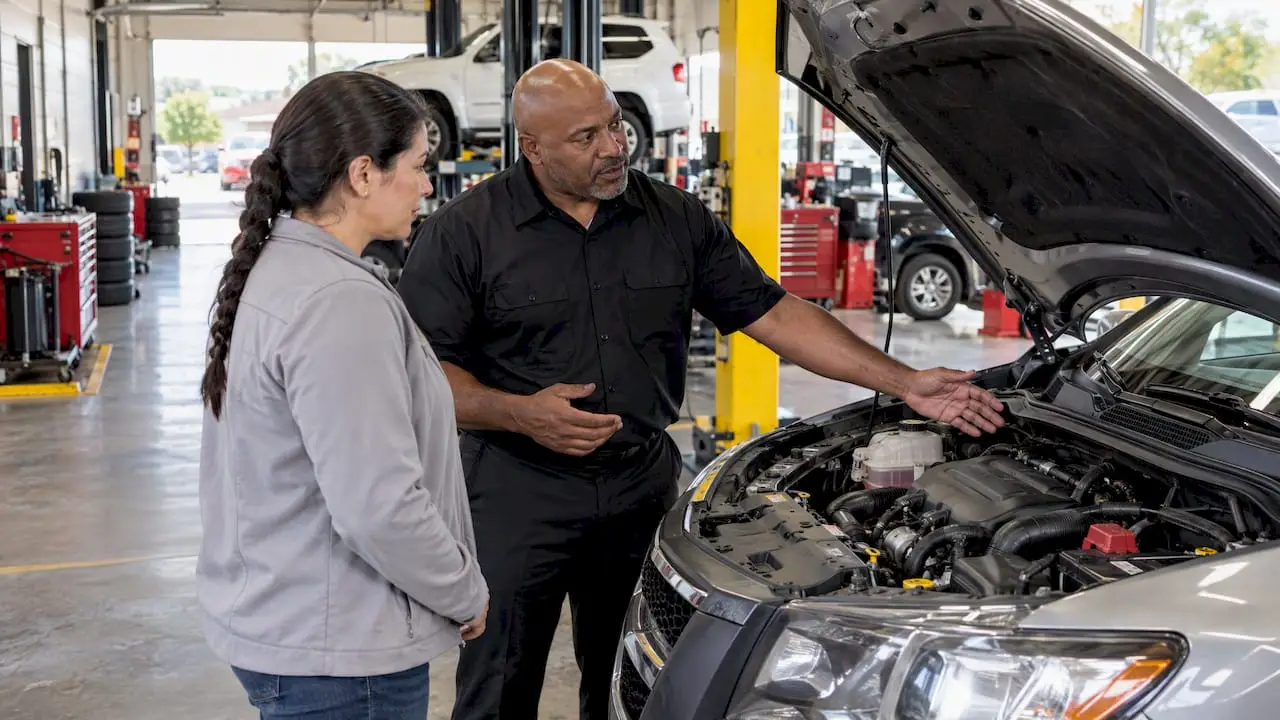
An ASE certified mechanic is a technician who has passed at least one exam from the National Institute for Automotive Service Excellence (ASE) and has documented hands-on work experience. ASE says certification requires passing a test for each credential and completing at least 2 years of qualified work experience. At Kwik Kar of Celina, our technicians are ASE-certified, and we think every driver in Celina, TX should know what that does and doesn’t tell you.
TL;DR
- ASE certification is an independent, third-party credential. A technician passes a specialty exam and has at least 2 years of qualified work experience.
- Certifications expire. Technicians must retest every five years to keep them current.
- ASE tests specific areas, such as brakes or engine repair. A technician certified in one area isn’t automatically certified in all of them.
- You can ask a technician to show current credentials, and you can look for the ASE Blue Seal of Excellence at a shop.
- Certification is a strong starting point, but clear communication and a written inspection matter just as much.
Table of Contents
- What does it mean to be ASE certified?
- What are the ASE certification levels and specialties?
- Does ASE certification actually matter?
- How can you check an ASE certified mechanic in Celina, TX?
- What questions should you ask any mechanic before approving a repair?
- Why a trouble code is not a verdict
- Our perspective: certification is the floor, not the finish line
- Which repairs call for a certified technician most?
- What about Texas inspections in 2026?
- Frequently overlooked: certification and your warranty
- Need a technician in Celina, TX?
- FAQ
- Sources
What does it mean to be ASE certified?
It means a technician has proven their knowledge to an outside organization, not just to an employer. ASE is an independent, non-profit organization established in 1972 that assesses, certifies and credentials automotive professionals to promote high standards of service and repair.
Two things earn the credential:
- A passed exam. Each certification has its own test.
- Qualified work experience. ASE requires a minimum of 2 years. A technician can sometimes take most tests before reaching that mark, but the official certificate is not issued until the experience is verified.
ASE says the exams are written in workshops by subject matter experts, including working technicians, manufacturer and aftermarket representatives, and educators. That matters because the questions come from people who do the work, not only from textbook authors.
In plain terms: a certified technician has shown they can diagnose and repair a particular vehicle system to a national standard. It doesn’t say how that person communicates, how carefully they work, or whether the shop is honest. Those parts come from the shop itself.
What are the ASE certification levels and specialties?
ASE doesn’t use a simple ladder of levels. It uses specialties, plus a top status for technicians who earn several of them.
- Individual specialty certifications. ASE offers over 50 tests across areas such as automobile, medium-heavy truck, collision repair and refinish, school bus and parts specialist.
- Master Technician status. A technician reaches this by passing 4 to 8 specified tests within a series and meeting the work experience requirement. It shows broad knowledge across that series rather than depth in one area.
- Entry-level certification. For students and people starting out, ASE offers an entry-level program that validates workforce readiness. It is valid for two years and has no work experience requirement.
For a passenger car or light truck, the specialties map onto systems you already know: engine repair, brakes, steering and suspension, electrical, heating and air conditioning, and so on. When a shop says a technician is “ASE-certified,” ask which areas. A brake specialist and an engine specialist are both certified, yet they have proven different skills.
Does ASE certification actually matter?
Yes, with a clear understanding of what it is. It is third-party validation. The shop didn’t write the test, grade it or hand out the credential.
That has practical value for drivers:
- Diagnosis is where mistakes get expensive. A technician who has been tested on how a system works is better placed to find the actual cause of a symptom instead of swapping parts and hoping.
- Recertification keeps knowledge current. Vehicles change quickly. Because technicians must retest every five years, the credential reflects relatively recent knowledge.
- It gives you something to verify. You can’t judge a transmission rebuild yourself. You can ask to see a credential.
What it doesn’t do is guarantee a perfect repair. A certified technician can still misread a problem, and a good technician can work at a poor shop. Treat certification as one strong signal among several, along with how a shop explains the work, what it shows you, and what it backs up in writing.
How can you check an ASE certified mechanic in Celina, TX?
You have a few simple options, none of which require any technical knowledge.
Ask to see current credentials
ASE advises drivers to ask to see a technician’s current credentials. A confident shop won’t mind. Look for the specialty areas listed and for a current date, since certifications lapse without retesting.
Look for the Blue Seal of Excellence
The ASE Blue Seal of Excellence logo identifies shops that employ a high percentage of ASE-certified professionals. ASE also runs an online locator so vehicle owners can find Blue Seal businesses in their area.
Ask which technician will work on your car
A shop might have a few certified technicians and several who aren’t. Ask who will handle your specific repair and whether that person holds the certification for that system.
Ask how the shop documents its findings
Certification tells you about skills. Documentation tells you about transparency. A digital vehicle inspection lets you see what the technician found, so you can match the recommendation to the evidence instead of taking it on faith.
What questions should you ask any mechanic before approving a repair?
Certification helps you choose a shop. These questions help you choose how to proceed once your car is there.
- What symptom did you confirm, and how?
- Which part or system is the likely cause, and what else could produce the same symptom?
- What needs attention now, and what can safely wait?
- Is the repair backed by a warranty, and what does it cover?
- Will you call me before doing any work beyond what we agreed?
A good shop welcomes these. Clear, patient answers are often a better sign than a framed certificate.
Why a trouble code is not a verdict
Diagnostics is where certification pays off most. When the check engine light comes on, the car stores a diagnostic trouble code. That code points to a circuit or system that reported a problem. It does not prove that a particular part has failed.
A code for an oxygen sensor, for example, can come from the sensor, its wiring, an exhaust leak or an engine running problem that affects the readings. Replacing the sensor without testing can cost money and leave the light on.
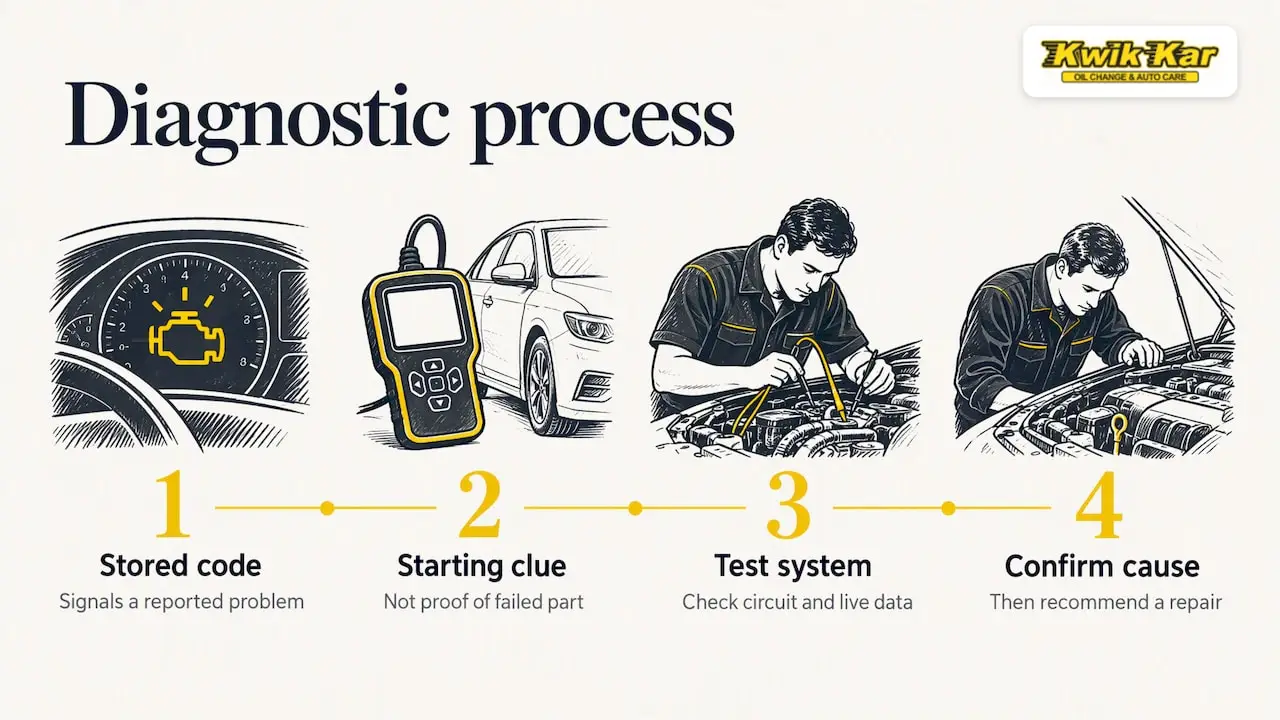
A technician trained in diagnostics reads the code as a starting clue, then tests the circuit, checks live data and confirms the cause before recommending a repair. Shops that rely on tools beyond the manufacturer’s own scan software apply scope tests and pass-through diagnostics in the same spirit: measure, then decide. You can read more about how we approach this on our diagnostics page and in our guide to an OBD-II diagnostic test.
Our perspective: certification is the floor, not the finish line
At Kwik Kar of Celina, we see ASE certification as the minimum a driver should expect from whoever works on their car. It proves a technician knows the systems. It doesn’t prove they will explain the work in plain language, and that second part is what builds trust.
That’s why we pair our ASE-certified technicians with Digital Vehicle Inspections. When we find something, we want you to see it, understand it and decide with full information. Our approach blends old-fashioned service, meaning honest recommendations and clear communication, with modern tools that make the findings easy to follow.
We also stand behind our work. Our repairs carry a 2-year/24,000-mile warranty, and we offer after-hours drop-off and a complimentary ride service so that getting your car fixed doesn’t have to wreck your schedule.
If you ever want to know who is working on your vehicle and what they are certified in, ask us. We would rather you ask.
Kwik Kar
Which repairs call for a certified technician most?
Any repair benefits from a skilled technician, but some jobs leave little room for error because they affect safety or are costly to redo.
- Brakes. Pad, rotor and fluid work affects stopping distance. See our brake repair service and our guide to signs you need new brake rotors.
- Transmissions. Slipping, delayed shifts and harsh engagement have several possible causes, some inexpensive. Our guide to causes of transmission slipping shows what to check first.
- Steering and suspension. Worn components change how the car handles. Our article on struts versus shocks explains how technicians decide between them.
- Engine and cooling. Overheating can damage an engine fast. A failing fan is one common cause, covered in our radiator fan diagnosis page. For deeper work, see our engine repair overview.
- AC. In a Texas summer, a weak system is more than an inconvenience. Before replacing an expensive part, it pays to diagnose before you replace an AC compressor.
- European vehicles. These often have system designs and software that reward specific experience. We cover this on our European repair page.
For model-specific questions, such as exact service intervals or fluid types, your owner’s manual and the manufacturer’s guidance come first. A good technician works from those, not from a one-size-fits-all rule.
What about Texas inspections in 2026?
Drivers often ask about inspections right alongside repairs, so here is where things stand.
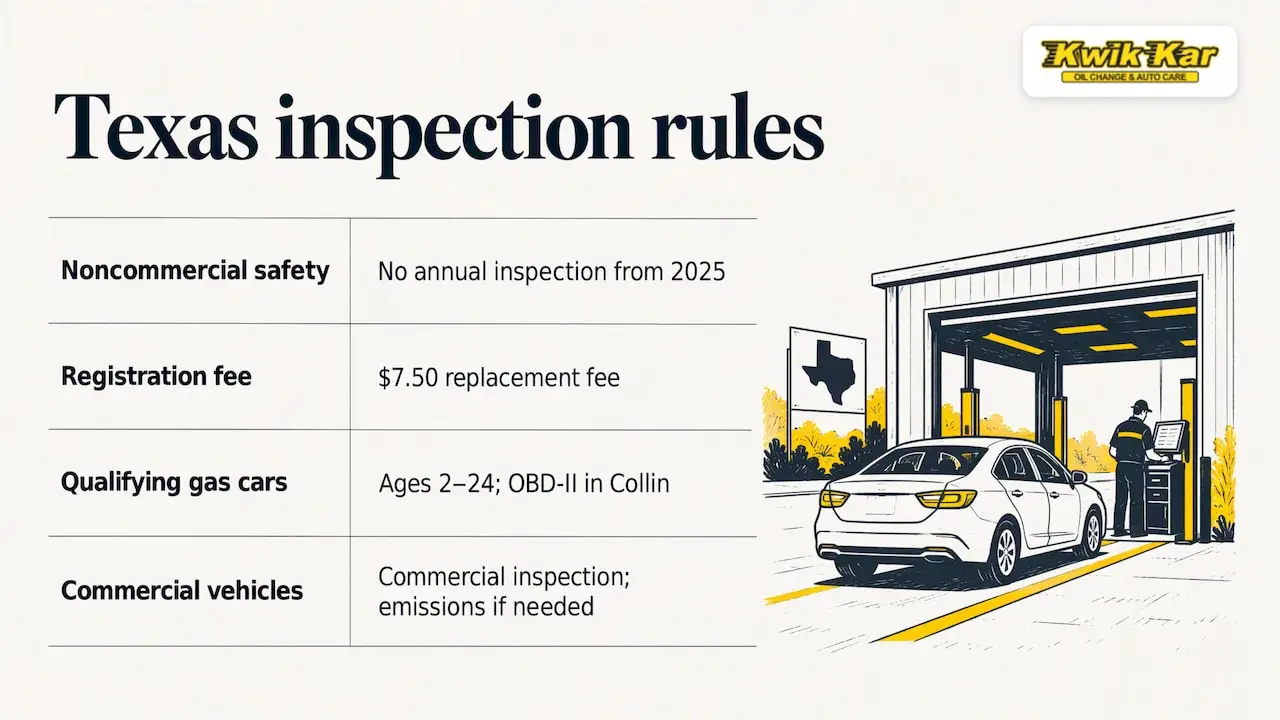
Most noncommercial vehicles in Texas no longer need an annual safety inspection. House Bill 3297 abolished the program for noncommercial vehicles beginning January 1, 2025. Owners now pay a $7.50 inspection program replacement fee at registration instead.
Emissions testing is a separate matter. Collin County is on the Texas Department of Public Safety’s list of emissions counties, so qualifying vehicles registered here still need an emissions inspection. DPS says gasoline vehicles from 2 through 24 years old in those counties receive the OBD-II test, and that vehicles exempt from emissions testing, such as electric-only vehicles, remain exempt.
Commercial vehicles follow different rules. DPS states that commercial vehicles still require a commercial inspection and, if needed, an emissions inspection. If you manage a fleet, confirm the requirements for each vehicle with DPS.
This connects back to certification. If the check engine light is on, your car may not pass the OBD-II emissions test until the cause is found and fixed. That is a diagnosis job, not a guess-and-replace job.
Frequently overlooked: certification and your warranty
A certified technician is not the same as a warrantied repair. Ask both questions. Who does the work, and what happens if the repair doesn’t hold?
Our claim is simple: we back our repairs with a 2-year/24,000-mile warranty. Ask us for the terms that apply to your specific repair before you approve it. For how a shop’s overall approach affects your costs, see the benefits of professional auto mechanic services and our general auto repair guide.
Need a technician in Celina, TX?
Kwik Kar of Celina handles routine maintenance and complex repairs, from oil changes and brakes to diagnostics, transmissions, AC, European vehicles and fleet service. Our ASE-certified technicians document what they find with a Digital Vehicle Inspection, so you see the evidence before you approve anything.
You can browse everything we do on our services page.
FAQ
Can I get ASE certified on my own?
Yes. Technicians register and take the exams themselves, and no employer has to sponsor them. They must still document the required work experience, and ASE won’t issue the official certificate until it is verified. Visit ASE’s site for current registration and test details.
How long does ASE certification last?
Certification doesn’t last forever. ASE requires technicians to retest every five years to keep a credential current. If a technician shows you a certificate, check that it is still within that window.
Is an ASE certified mechanic better than one who isn’t?
Certification shows a technician has met a tested, independent standard, which is a meaningful signal. It isn’t a guarantee on its own, so also look at how clearly the shop explains its findings, what it documents and what warranty it offers.
What is the ASE Blue Seal of Excellence?
It is a recognition program for repair shops. The logo identifies businesses that employ a high percentage of ASE-certified professionals. It speaks to the shop as a whole, while individual certifications speak to each technician.
Does ASE certification mean a mechanic can fix every kind of vehicle?
No. ASE tests by specialty and vehicle category, such as automobiles, medium-heavy trucks and collision repair. Ask which areas a technician holds and whether they have experience with your make, especially for European or specialty vehicles.
If you have a question about a symptom, a warning light or an upcoming service, contact Kwik Kar of Celina or schedule a visit when it suits you. We are glad to explain what we would check and why.
Sources
- Resources for Drivers, ASE
- About ASE, The National Institute for Automotive Service Excellence
- ASE Certification Pathway
- ASE Certification: What You Need to Know
- ASE Certification FAQs
- ASE Work Experience Form Instructions
- ASE Blue Seal of Excellence Recognition Program
- Texas DPS: Vehicle Safety Inspection Changes
- Texas DPS: Emission Inspection Criteria
- Texas DPS: Inspection Criteria
- Diagnostics Without OEM Tools: J2534 and Scope Tests