


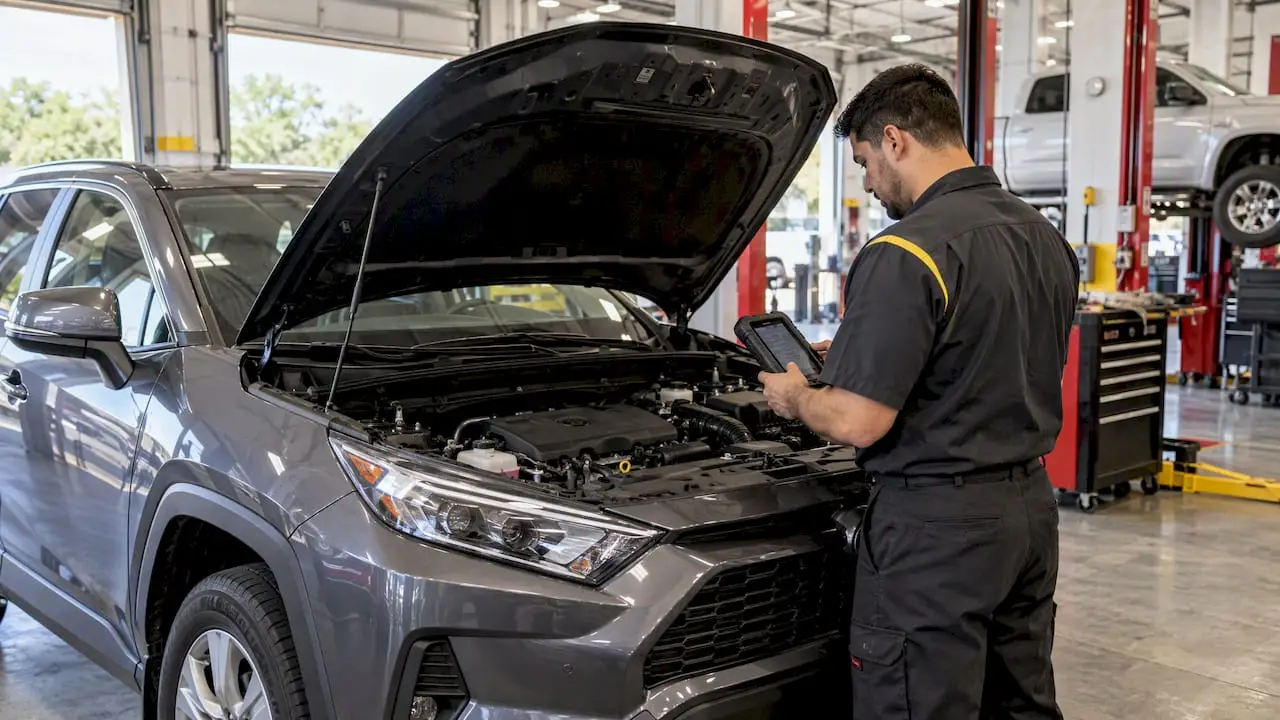
If your car starts right up in the morning but cranks and cranks after a hot stop, you are dealing with a pattern that has a short list of likely causes. Most often it is fuel pressure draining away while the engine sits, a heat-sensitive sensor that drops out, or heat soak in the engine bay. All three can be tested, and none of them means the engine is worn out.
This guide explains what is happening under the hood, what you can safely notice on your own, and when it is time to hand the car to a shop. We wrote it for Celina, TX drivers who run errands in North Texas summer heat, stop for ten minutes, and then find the car doesn’t want to restart.
TL;DR
- A hard start only when the engine is hot usually points to fuel pressure loss, vapor lock, or a heat-sensitive sensor, not internal engine wear.
- Heat soak after shutdown can push underhood temperatures higher than during driving, which is why a 10 to 20 minute stop is the classic trigger.
- A trouble code is a clue, not a verdict. Replacing the fuel pump on a code alone is a common way to spend money and keep the problem.
- Note when it happens, how long it cranks and whether the engine turns over normally, then ask for a hot-condition diagnosis.
Table of Contents
- Why does my car struggle to start when it’s hot?
- What are the most common causes?
- Why does it start rough or run fine after it finally fires?
- What can I check myself before calling a shop?
- Does a trouble code tell me which part to replace?
- How do technicians diagnose a hot-start problem?
- What does Texas heat have to do with it?
- When is it time to stop driving and call for help?
- What is our experience with hot-start complaints?
- Will it pass inspection if the problem is still there?
- Need the car looked at?
- FAQ
- Sources
Why does my car struggle to start when it’s hot?
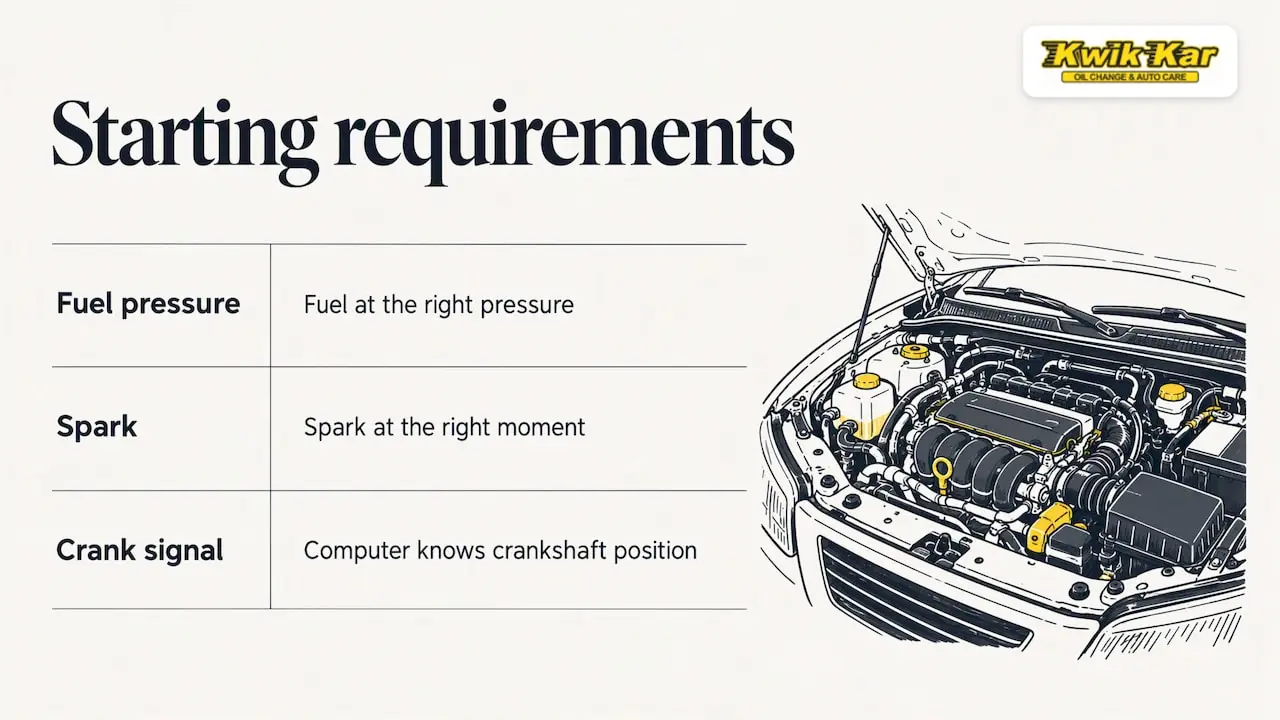
An engine needs three things to start: fuel at the right pressure, spark at the right moment, and a computer that knows where the crankshaft is. Heat can interfere with any of them.
When you shut the engine off, the cooling fan and water pump stop too. The heat in the engine block, exhaust and transmission keeps moving into the intake manifold, fuel rail and sensors. Course material from MIT on engine heat transfer notes that heat transfer to the fuel strongly affects fuel evaporation and starting behavior. That is the core of heat soak.
So a car can run perfectly while you are driving, then struggle after sitting briefly in a parking lot. Airflow and fuel flow are keeping things cool on the road. Once you stop, they are not.
What are the most common causes?
Technicians group the causes into three families: fuel pressure loss, fuel vapor, and thermal failure of electronic sensors. A fourth, the starter and its wiring, is worth adding because it looks the same from the driver’s seat.
| Cause | What it feels like | Why heat matters |
|---|---|---|
| Fuel pressure bleed-down (leaking injector or weak pump check valve) | Long crank, then it fires and runs normally | Pressure drops while the engine sits hot, so the system has to rebuild it |
| Fuel vapor or vapor lock | Cranks well but won’t catch, sometimes rough at first | Heat turns liquid fuel into vapor in the lines or rail |
| Crankshaft position (CKP) sensor failure | Cranks but no start at all, then starts fine after cooling | Internal windings expand and break the circuit when hot |
| Starter or wiring resistance | Slow, labored or clicking crank | Heat raises resistance in starter, cables and grounds |
| Weak battery | Slow crank worse in heat | Heat accelerates battery wear, and hot engines are harder to turn over |
The first three are the ones we see discussed most in diagnostic references, so let’s go through them.
Fuel pressure bleed-down
Your fuel system holds pressure in the fuel rail even after you shut the engine off. A check valve in the fuel pump, or the injectors themselves, keep that pressure in place. If an injector leaks or the check valve is tired, pressure drains away during a hot soak.
When you turn the key, the pump has to work longer to rebuild pressure before the engine will fire. That shows up as a long crank. Study material for technicians describes injector leakage bleeding down rail pressure as a frequent cause of hot restart problems.
A leaking injector can also let extra fuel into the cylinder, which is why some drivers notice a fuel smell or a puff of rough running right after it starts.
Vapor lock and fuel vapor
Fuel boils at lower temperatures when pressure drops and heat rises. If vapor forms in the lines or rail, the pump and injectors are trying to move gas instead of liquid. The engine cranks but can’t get a proper fuel charge.
Vapor problems are more famous on older carbureted vehicles. On modern fuel-injected cars, a pressure-holding fault is usually part of the story, because a healthy pressurized system resists vapor formation.
Crankshaft position sensor failure
This one catches people off guard. The CKP sensor tells the engine computer how fast the crankshaft is turning and where it is. Without that signal, the computer does not trigger fuel or spark.
Technician references explain that the sensor’s internal wire windings can expand with heat and break the circuit. The engine cranks strongly but won’t start. Once the sensor cools, the connection comes back and the car starts as if nothing happened. That is why it feels random.
The giveaway is usually that the engine turns over at normal speed but never catches, and that waiting 20 to 30 minutes makes the problem disappear. A tachometer that does not move while cranking can also point to a missing crank signal, though it should be confirmed with scan tool data.
Starter and electrical resistance
If the engine cranks slowly or you hear a click, think electrical. Heat raises resistance in cables, connections and the starter motor. A starter sitting close to a hot exhaust is especially prone to this. Corroded grounds or loose battery terminals make it worse.
This is a different symptom from a long normal-speed crank. Slow cranking suggests the starter circuit or battery. Normal-speed cranking with no start suggests fuel or signal. Telling those apart is the most useful thing you can report to a technician.
Our article on the alternator and electrical system in summer heat covers related warning signs.
Why does it start rough or run fine after it finally fires?
This is one of the most common follow-ups, and it is a clue in itself. If the engine runs normally once started, the engine is probably mechanically sound. Compression, valve timing and the basic ability to make power are fine.
The problem is in the starting conditions: fuel pressure, a signal, or electrical delivery. A reference for technicians says that a car that starts perfectly cold but struggles hot often points to thermal issues in sensors or fuel evaporation rather than mechanical wear inside the cylinders.
A rough start that smooths out within a few seconds often fits excess fuel or low pressure during the first crank. A rough start that continues, with a flashing check engine light, could be a misfire and deserves prompt attention.
What can I check myself before calling a shop?
You don’t need tools to gather good information. These observations help a technician narrow the search.
- Try the key-on test. Turn the key to the on position without cranking, wait about three seconds so the fuel pump can run, then start. A technician source describes this as a simple way to spot fuel pressure loss: if the car starts faster, pressure is the likely issue rather than spark or a sensor. Treat it as a hint, not proof. Some vehicles prime differently.
- Listen to the crank. Normal speed, slow and labored, or clicking? Each points in a different direction.
- Watch the tachometer. If the needle stays at zero while the engine cranks, mention it.
- Time it. Does it happen after 10 minutes, or only after an hour? Does waiting 30 minutes fix it?
- Note the conditions. After highway driving, after short stop-and-go trips, or only on 100-degree afternoons?
- Check the dashboard. Is the check engine light on, or has it ever come on? Don’t clear codes before the visit, because stored data helps.
- Look at the battery terminals. Fuzzy corrosion or loose clamps are an easy find.
Write these down on your phone. A clear description saves diagnostic time and reduces the chance of guessing.
Does a trouble code tell me which part to replace?
No. This is where many hot-start repairs go wrong.
A code reports what the computer saw, not why. A low fuel pressure code can be triggered by a leaking injector or a bad relay just as easily as by the pump itself, according to the kind of diagnostic guidance used in technician training. Swapping the pump on the code alone can leave you with a new pump and the same problem.
Professional diagnosis relies on live data and measurements taken when the fault is present. The ASE L1 study guide used for advanced engine performance training lists diagnosing hard starting and no-starting as a core task, and it frames the work as systematic testing, not parts replacement.
If you want to see what a careful process looks like from the outside, this cold-start test drive guide from a used car dealer’s blog shows how much a cold start and a warm restart can reveal about an engine. The same principle applies in a repair bay: compare the car cold and hot, and let the evidence lead.
How do technicians diagnose a hot-start problem?
The key word is hot. A fault that only appears when the engine is at operating temperature can disappear in the five minutes it takes to roll a cold car into a bay. Good diagnosis means reproducing the condition.
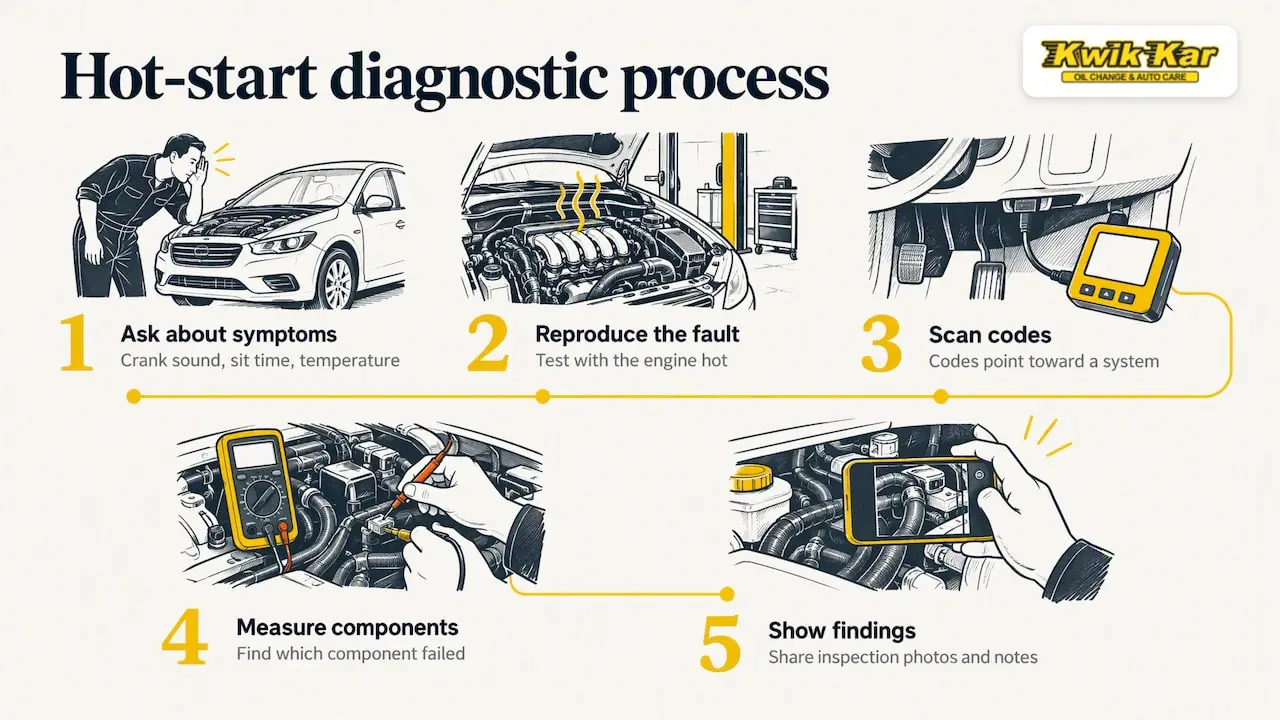
A typical approach, based on the diagnostic steps technicians describe, includes:
- Checking fuel system pressure at key-on, during cranking, and after shutdown, to see whether pressure holds or bleeds down.
- Scanning for stored and pending codes and reviewing live data, including crankshaft and camshaft signals.
- Monitoring for crank signal loss with diagnostic equipment when the engine is at operating temperature.
- Inspecting the starter circuit, battery condition, cables and grounds.
- Checking for leaking injectors, a weak pump check valve, and fuel pressure regulator behavior, where the vehicle has one.
At Kwik Kar of Celina, our ASE-certified technicians use this kind of evidence-first approach, and our Digital Vehicle Inspections let us show you what we found instead of just telling you. You can read how we approach it on our diagnostics page and in our guide to avoiding costly parts swaps with an OBD-II diagnostic test.
What does Texas heat have to do with it?
North Texas summers give heat soak plenty to work with. Parking on blacktop in the afternoon, sitting in a school pickup line, then shutting off at a store for a short errand is the exact setup that makes a marginal part show itself.
A healthy cooling system doesn’t cure a bad injector, but an engine that runs hotter than it should makes every heat-related fault worse. If your temperature gauge climbs, the cooling fan seems idle, or coolant disappears, address that first. We cover those topics in our guides on preventing overheating in early summer and radiator fan diagnosis, and you can learn about our cooling system service too.
Some practical habits help while you wait for a repair:
- Park in shade or face the car so the engine bay isn’t baking in direct sun.
- Don’t pump the accelerator repeatedly on a fuel-injected car. It rarely helps and can flood some engines.
- Give a no-start a few minutes, then try again with the key-on pause described above.
- Avoid repeated long cranking. It heats the starter and drains the battery. Crank in short bursts and rest in between.
When is it time to stop driving and call for help?
A car that occasionally takes a few extra seconds to start is a nuisance. A car that sometimes will not start is a safety and reliability issue, particularly if it could stall in traffic.
Book a diagnosis soon if:
- The problem is happening more often or lasting longer.
- The engine stalls while driving or at stops.
- The check engine light is on or flashing.
- You smell raw fuel near the car.
- The starter clicks or cranks slowly.
- You depend on the vehicle for commuting, school runs or work, or manage a fleet where downtime costs you.
If you smell gasoline strongly, see fuel leaking, or the engine stalls in traffic, don’t keep driving it. Have it towed. A fuel leak near a hot engine is a fire risk.
The longer a failing part stays in service, the more likely it is to leave you stranded, and the harder it can be to catch during a visit. Intermittent faults are easier to find when the owner can say, “it happened yesterday afternoon after a 15 minute stop.”
What is our experience with hot-start complaints?
Here is how we think about it at Kwik Kar of Celina.
We start with the story, not the part. When a customer says the car is hard to start when hot, we want to know what the crank sounds like, how long the car sat, and what the temperature was. That tells us whether we are chasing fuel, signal or electrical delivery before we touch anything.
We try to reproduce the problem. A fault that only shows when the engine is hot needs a hot engine. We would rather test properly than guess and send you home with a part you did not need.
We treat codes as clues. A code can send us to the right system. It can’t tell us which component failed. That takes measurement.
We show you what we found. With a Digital Vehicle Inspection, you see photos and notes about what the technician saw, so you can approve the repair you understand. Our recommendations are meant to be honest, and we explain which items are urgent and which can wait.
We also know your schedule is tight. That’s why after-hours drop-off and our complimentary ride service exist: leaving the car for a proper diagnosis shouldn’t wreck your day.
European models can have their own quirks, since fuel systems, sensors and electrical layouts differ from make to make. If you drive one, our European repair team can look at it, and we’d qualify any model-specific advice until we’ve seen the car.
— Kwik Kar
Will it pass inspection if the problem is still there?
A hard-start issue doesn’t automatically fail anything, but an illuminated check engine light can affect emissions testing, and fuel or ignition problems can raise emissions.
Here’s where Texas stands. As of January 1, 2025, most non-commercial vehicles no longer need an annual safety inspection. Emissions testing is still required for qualifying vehicles registered in certain counties, and Collin County, where Celina sits, is one of them. The TxDMV lists 17 counties in total.
Commercial vehicle inspection rules differ from the non-commercial rules, so fleet managers should check the requirements for their specific vehicles. For details on what we handle, see our TX state inspections page. If you aren’t sure whether your vehicle qualifies for emissions testing, the TxDMV registration page is the official place to check.
If your registration renewal is coming up and the car has an unresolved driveability issue, get it diagnosed first. It is much easier to fix a problem before the testing deadline than the day before.
Need the car looked at?
If your car keeps fighting you after hot stops, we’d be glad to take a look. Kwik Kar of Celina performs diagnostics, fuel and electrical system work, starter and cooling system service for drivers in Celina, TX, backed by a 2-year/24,000-mile warranty. Start with our diagnostics service, or browse everything we offer. Pricing isn’t published online, so reach out and we’ll talk through your situation.
FAQ
Why is my engine hard to start when it’s hot but fine when cold?
Heat soak after shutdown affects fuel pressure, fuel temperature and sensors in ways a cold engine doesn’t experience. The most common culprits are a leaking injector or weak fuel pump check valve, a heat-sensitive crankshaft position sensor, or a starter circuit with high resistance. A hot-condition test can tell them apart.
Why does my car start rough when it’s hot?
A rough first few seconds often means the engine got too much or too little fuel during the first crank, which can happen when pressure bled down or a leaking injector let fuel into a cylinder. If the roughness lasts or the check engine light flashes, have it scanned soon, since a misfire can damage the catalytic converter.
Can a bad battery cause hard starting only when hot?
Yes, though it usually shows as slow cranking, not a long crank at normal speed. Heat is hard on batteries, and a weak one may have just enough power in the cool morning but struggle on a hot restart. A battery and charging system test is quick and worth doing before chasing other parts.
Should I replace the fuel pump if I get a low fuel pressure code?
Not on the code alone. A low-pressure code can come from a leaking injector, a bad relay, a weak check valve or the pump, and replacing the wrong part leaves the problem in place. Pressure testing at key-on, cranking and after shutdown shows which it is.
Is a hard-starting car a problem for Texas emissions testing?
It can be, mainly if a check engine light is on or the fault affects emissions. Texas dropped most non-commercial safety inspections on January 1, 2025, but qualifying vehicles in Collin County still need emissions testing, and commercial vehicles follow different rules.
Sources
- Hard Starting When Hot: Causes, Checks & Next Steps, Auto Barn
- Starting, Stalling, & General Driveability, OpenExamPrep
- Internal Combustion Engines, Lecture 18: Engine heat transfer, MIT OpenCourseWare
- ASE L1 Study Guide 2024, Las Positas College
- Texas vehicle inspection changes, TxDMV
- Register Your Vehicle, TxDMV