




Parasitic battery drain is current that keeps leaving your battery after the engine is off. A small amount is normal, because clocks, memory and modules need power. When the draw is too high, a healthy battery can be flat by morning. The fix is to find the one circuit pulling too much, and that takes patience, the right meter and enough waiting time for the car’s computers to go to sleep. If your car battery keeps dying and a new battery didn’t solve it, our team at Kwik Kar of Celina in Celina, TX can trace the drain with our diagnostics service.
TL;DR
- A normal draw with the car asleep is roughly 50 milliamps (mA) or less, and many sources put the upper limit near 70 to 85 mA depending on the vehicle. A reading above 100 mA is worth chasing.
- A draw under 1 amp usually takes a couple of days to flatten a battery. A draw near or above 1 amp can do it overnight.
- The most common culprits are aftermarket accessories, lights or switches that stay on, and a control module that never goes to sleep.
- The biggest testing mistake is reading the meter too early. Modules can need 20 minutes or much longer to power down.
- Check the battery and charging system first. A weak battery or a failing alternator looks a lot like a drain.
Table of Contents
- What is parasitic battery drain?
- How do I know if my battery is draining overnight?
- How much battery drain is normal?
- What causes a car battery to keep dying?
- How do you test for parasitic draw?
- Why does a test show a drain when there isn’t one?
- Can a trouble code tell me what is draining my battery?
- How is parasitic drain repaired?
- Perspective: why we trace the drain before we replace the battery
- What does Kwik Kar of Celina do about a battery that keeps dying?
- How do Texas inspection rules affect a battery problem?
- How can I prevent a battery drain?
- FAQ
- Sources
What is parasitic battery drain?
Every modern vehicle draws a little power with the key out. The radio presets, the alarm, the clock and the engine computer’s memory all need it. That small, expected draw is not a problem.
Parasitic drain is the abnormal version. Something keeps pulling current after the car should have shut down, and the alternator isn’t running to replace it. Left alone, the draw can drain the battery overnight or over a few days.
The drain also isn’t limited to the morning you can’t start the car. Repeated deep discharges are hard on a lead-acid battery and shorten its life, so a drain you ignore tends to cost you a battery as well.
How do I know if my battery is draining overnight?
The pattern is the clue. A parasitic drain usually shows up as a car that starts fine after a drive, then won’t start after sitting for a night or a few days.
Watch for these signs:
- Slow cranking or a rapid clicking sound when you turn the key
- Dim headlights or interior lights at startup
- Dash lights that come on while the engine won’t turn over
- Frequent jump starts
- A brand-new battery that goes dead anyway
- Accessories that act strangely, such as a radio that resets or a screen that stays lit
UTI’s automotive training blog lists several of these same symptoms as signs of a worn or discharging battery. That overlap is the catch: none of them proves a drain. A tired battery, corroded cables or a weak alternator can produce the same complaint. If your battery warning light has also come on, read our guide on what to do when the battery light comes on.
How much battery drain is normal?
There is no single number for every vehicle, and that is worth knowing before you test. Published figures differ because manufacturers design their systems differently.
| Source | Normal draw after the car sleeps |
|---|---|
| NHTSA service bulletin (2025) | Typically less than 70 mA (0.070 A) |
| MOTOR magazine (2021) | Should not exceed 0.050 A (50 mA) |
| Fluke | Under 50 mA normal, over 100 mA suspect |
For your own car, the vehicle’s service information gives the right limit. Treat these numbers as a guide, and remember that some systems allow more. A diagnostic pico-scope guide notes that sleep-state current should typically be under 150 mA on some vehicles, so the figure depends on the model.
How fast does a drain kill a battery?
MOTOR magazine reports that a drain under 1 amp may take a couple of days to discharge a battery, while a drain over 1 amp commonly kills it overnight. In practice, a car that dies after a weekend usually has a smaller draw than one that dies every night.
What causes a car battery to keep dying?
Most drains fall into a few groups. Start with the simple ones.
Things left on or stuck on
A dome light, trunk light or glove box light that doesn’t switch off is the classic cause. So is a phone charger or dash cam that stays powered. Worn door-jamb switches and stuck relays can keep a circuit awake without you noticing.
Aftermarket accessories
Remote starters, alarms, GPS trackers, amplifiers and aftermarket stereos are frequent offenders, especially when they were wired in without a proper switched or fused connection. MOTOR specifically calls out amplifiers as a common source of drain from add-ons. If the drain began right after an install, that’s your first lead.
A module that won’t sleep
Modern cars run many computers: body control, engine control, infotainment, gateway and more. After you lock the car they are supposed to power down in stages. If one stays active because of a software fault, a failed component or a network wake-up signal, the whole vehicle keeps drawing current. Some modules also wake periodically on their own, which can make the draw come and go over many hours, as the Pico guide above explains.
Battery, cable and charging problems
These aren’t parasitic drains in the strict sense, but they produce the same complaint:
- A battery that is simply old and can’t hold a charge
- Corroded or loose terminals. MOTOR notes that heavy terminal corrosion can draw enough current to reduce charge overnight.
- An alternator that isn’t charging the battery fully while you drive
- Many short trips that never let the battery recover
If the alternator is a suspect, our article on alternator failure symptoms and voltage checks explains what the numbers mean. For a wider overview, see our guide to common car battery issues. In Celina, heat is hard on batteries, so our note on the alternator and electrical system in summer heat is worth a read too.
How do you test for parasitic draw?
This is the part most pages rank for, and it is also where most home tests go wrong. Here is the process in the order a technician follows it, with the step where it usually fails.
1. Check the battery and terminals first
A bad battery can fail by itself, so load-test and inspect it before you chase a drain, as MOTOR advises. Clean, tight terminals matter, because a reading taken through a corroded connection tells you little.
2. Prepare the car
Close the doors, turn everything off, remove the key and keep the fob away from the vehicle if the car uses a proximity key. Don’t open a door or press a switch once the test begins, because that can wake modules.
3. Set the meter correctly
A digital multimeter must be set to measure DC amps. Fluke’s guidance is to put the meter in series between the negative cable and the negative battery terminal. Battery Tender’s guide suggests starting on the 10A or 20A range. Put the leads in the correct ports before you connect anything.
This is where a mistake gets expensive. Fluke warns against cranking the engine or running high-current devices while the meter is in current mode, because the meter’s fuse or the meter itself can be damaged. You can also lose the connection when you disconnect the cable, which resets the sleep timer.
4. Wait for the modules to sleep
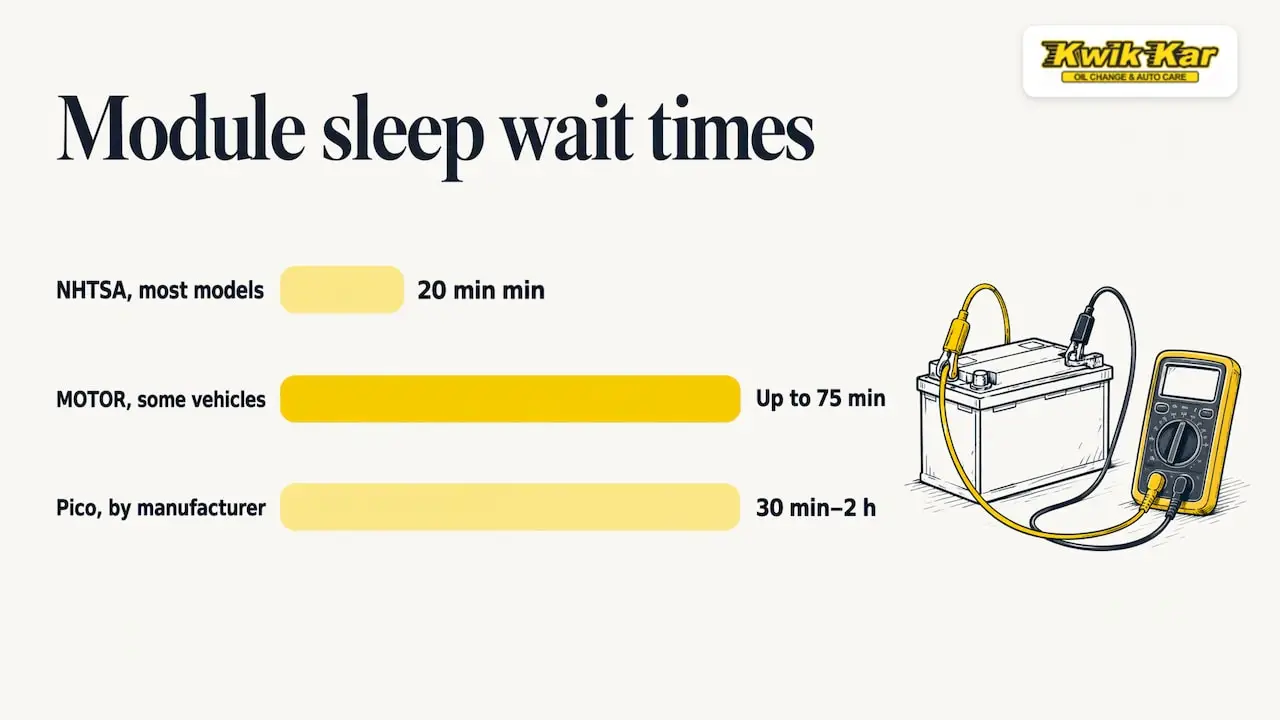
This is the step people skip. The NHTSA service bulletin says a frequent and critical failure in parasitic draw testing is not allowing enough time for all control modules to power down, and a premature reading gives a false indication of excessive draw, which leads to incorrect and time-consuming repairs. The same bulletin says the power-down process takes a minimum of 20 minutes on most models. MOTOR cites up to 75 minutes on some vehicles, and the Pico guide says shutdown periods can range from 30 minutes to 2 hours depending on the manufacturer.
In short: the number on the meter in the first few minutes means nothing.
5. Read the draw
Once the reading settles, compare it with the limit for your vehicle. If it is well above the normal range, you have a real drain to find.
6. Isolate the circuit
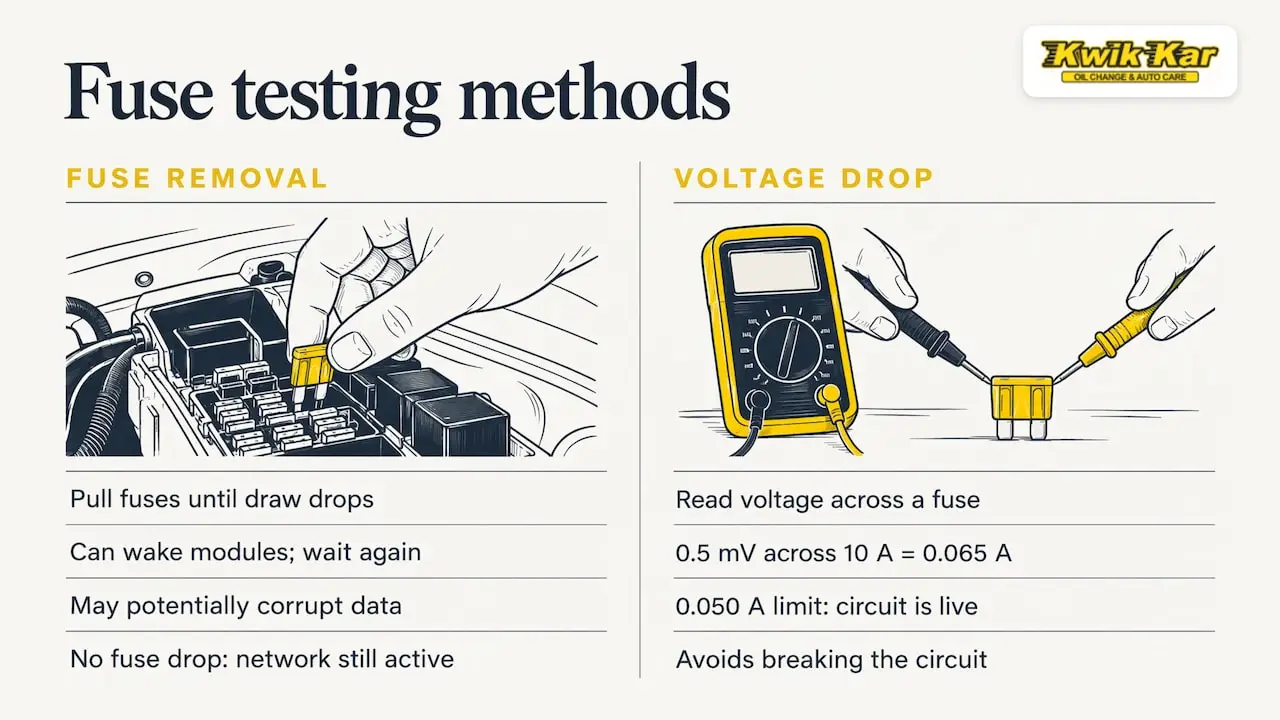
The traditional method is to pull fuses one at a time until the reading drops. The circuit on that fuse is the one with the problem. The catch is that pulling and replacing a fuse can wake a module, restoring the draw and forcing a fresh wait. The NHTSA bulletin warns about exactly that, and notes it can potentially corrupt data.
There are also cases where no single fuse brings the draw down. The bulletin says that suggests the vehicle’s network is still active and hasn’t entered low-power sleep. At that point the job moves from a quick fuse check to proper electrical diagnosis.
Technicians often use a voltage-drop reading across a fuse instead. ALLDATAdiy gives a worked example: a 0.5 mV drop across a 10-amp fuse equals 0.065 amps, which is above the 0.050 amp limit, so that circuit is live. That method avoids breaking the circuit, and it is why a shop’s approach can be faster and cleaner than pulling fuses by hand.
7. Pay attention to safety
Disconnecting a battery cable on a modern car can reset settings, and working near a battery calls for care with metal tools and jewelry. If your vehicle has driver assistance systems, push-button start or an expensive audio setup, hand the test to a technician rather than risk a reset.
Why does a test show a drain when there isn’t one?
Three things trip people up most:
- Reading too soon. The modules are still awake.
- Waking the car mid-test. Opening a door or touching a switch restarts the clock.
- Intermittent drains. A module that wakes only now and then can look fine during a 30-minute test and still empty the battery overnight.
The last one is the hardest to catch. The technician has to monitor over time, recreate the trigger and confirm the pattern before recommending any repair.
Can a trouble code tell me what is draining my battery?
A scan tool is useful, but a code isn’t proof of a failed part. Communication or low-voltage codes may point toward a system, not a specific component. They can even be a result of the dead battery, not the cause. We treat codes as clues and confirm with measurements. Our page on OBD-II diagnostic testing explains how that approach helps avoid swapping parts that were fine.
How is parasitic drain repaired?
The repair follows the cause:
- Accessory problem: correct the wiring, repair the connection or remove the device.
- Stuck switch or relay: replace the faulty part.
- Module that won’t sleep: depending on the vehicle, this may involve a software update, a component repair or a module replacement. Some models have manufacturer service bulletins for specific modules.
- Corrosion or loose connections: clean or replace terminals and cables.
- Weak battery or charging fault: replace the battery or repair the charging system.
What the job costs depends mainly on how long it takes to find the cause. A drain that shows up in one reading is a short job. An intermittent one takes monitoring time. We can’t quote a figure for a drain without seeing the vehicle, and a diagnosis tells you which of the repairs above you actually need.
Perspective: why we trace the drain before we replace the battery
We see the same story with a dead battery: someone replaces it, and the problem returns a few weeks later. A battery is often the victim, not the cause.
That’s why our approach starts with the whole picture. Our ASE-certified technicians check the battery, the connections and the charging system, then measure the draw with the car properly asleep. We use Digital Vehicle Inspections so you can see what we found, not just hear about it.
Electrical faults reward patience. A rushed reading leads to the wrong fix, and that costs you time and money. We would rather find the actual circuit, explain it plainly and let you decide what to repair.
Our work is backed by a 2-year/24,000-mile warranty.
Kwik Kar
What does Kwik Kar of Celina do about a battery that keeps dying?
If you’d rather not spend an evening with a meter and fuse box, we can handle it. Kwik Kar of Celina offers electrical and starter service and diagnostics for all vehicle types, including European vehicles, at our shop in Celina, TX. See our electrical and starter repair page for what we cover.

Busy schedule? We offer after-hours drop-off and a complimentary ride service, so your car can be looked at while you get on with your day. You can see everything we do on our services page.
How do Texas inspection rules affect a battery problem?
The two topics meet at registration time. Most noncommercial vehicles in Texas no longer require annual safety inspections as of January 1, 2025, under House Bill 3297. Qualifying vehicles in Collin County still require emissions testing, which is separate from the safety inspection. Commercial vehicle inspection rules differ from the noncommercial rules, so fleet managers should confirm what applies to each vehicle.
This matters because a weak battery or an electrical fault can cause trouble with computer readiness checks. If your car’s check engine light is on, get the underlying issue diagnosed before an emissions test. Our fleet maintenance checklist is a good reference for businesses.
How can I prevent a battery drain?
- Check that dome, trunk and glove box lights go out when closed.
- Unplug chargers and dash cams if the car sits for days.
- Have aftermarket installs wired properly and fused.
- Keep terminals clean and tight.
- Take longer drives now and then so the alternator can recharge the battery.
- Have the battery tested before extreme seasons. Our tips on winter moisture and electrical problems and winterizing your car cover the cold months.
If you’ve replaced a battery and it still goes flat, or you just want a clear answer, you’re welcome to contact Kwik Kar of Celina or schedule service when it suits you.
FAQ
How many milliamps is a parasitic draw?
A normal draw once the car is asleep is roughly 50 mA or less, and some manufacturers allow up to about 70 mA or more. Readings above 100 mA are generally considered suspect. The right limit depends on your vehicle.
Can a parasitic drain kill a new battery?
Yes. A new battery can’t keep up with a draw the alternator isn’t there to replace. A large drain can flatten it overnight, and repeated deep discharges shorten its life.
How long should I wait before testing the draw?
The NHTSA bulletin says the power-down process takes at least 20 minutes on most models. Some vehicles take much longer, up to 75 minutes or two hours. Reading too early gives a false high number.
Is it the battery or a parasitic drain?
It can be either, or both. A battery that is old or damaged may fail a load test on its own, while a drain will flatten even a good battery. Testing the battery first and the draw second separates the two.
Sources
- NHTSA Service Information Bulletin (2025)
- Diagnosing a Battery Drain, MOTOR
- How to Find Parasitic Battery Drain with a Multimeter, Fluke
- Parasitic battery drain (clamp method), Pico Automotive
- Parasitic Draw Test, ALLDATAdiy
- Parasitic Battery Drain, UTI
- Vehicle Safety Inspection Program Changes Now in Effect, Texas DPS