


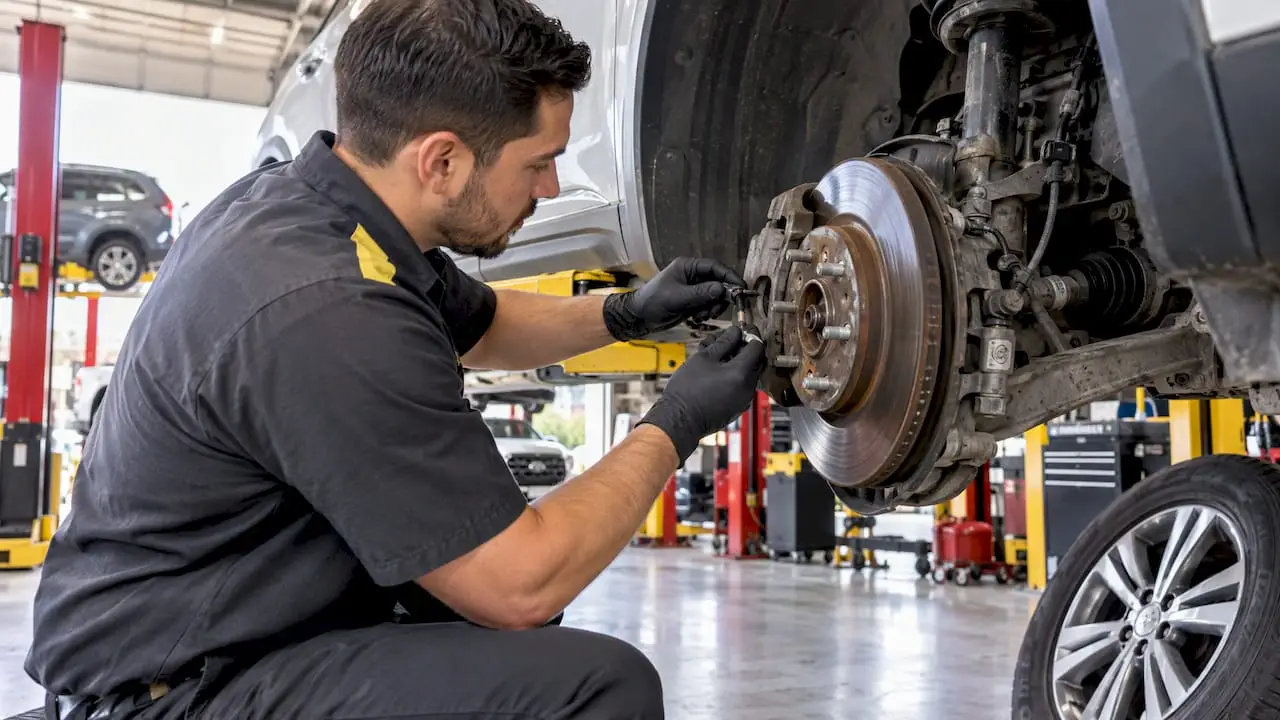
The most common sign of a failing wheel speed sensor is a lit ABS warning light, often with the traction control or stability control light beside it. You may also notice a brake pedal that pulses at odd moments, cruise control that quits, or, on some older vehicles, a speedometer that acts up. The car usually still stops, but some of its safety systems may be switched off. At Kwik Kar of Celina, we see this often, and the fix is usually simple once the right wheel is identified.
Below we cover each symptom, what causes it, what you can safely check yourself, what a repair typically costs nationally, and when to bring the vehicle in.
TL;DR
- A bad wheel speed sensor most often shows up as an ABS light, usually with the traction control and stability control lights too.
- Other signs: a pulsing brake pedal, cruise control that stops working, and on some older vehicles a wrong speedometer reading or a check engine light.
- Dirt, corrosion, wiring damage, a damaged tone ring, or a worn wheel bearing can all mimic a failed sensor, so diagnose before you replace anything.
- The national average to replace a sensor runs about $73 to $143, depending on the vehicle and labor rates.
- Your regular brakes still work with the ABS light on, but the anti-lock safety net may not. Have it checked soon.
Table of Contents
- What does a wheel speed sensor do?
- What are the symptoms of a bad wheel speed sensor?
- Quick reference: symptom, likely meaning, urgency
- What causes a wheel speed sensor to fail?
- Can you drive with a bad wheel speed sensor?
- How do you find out which sensor is bad?
- How much does it cost to replace a wheel speed sensor?
- Our perspective: why we diagnose before we replace
- What if the ABS light comes with other brake symptoms?
- Does a bad wheel speed sensor affect your Texas inspection or registration?
- When should you bring it in?
- Getting your ABS light checked at Kwik Kar of Celina
- FAQ
- Sources
What does a wheel speed sensor do?
Every wheel has a sensor that reads how fast it is turning. It sends that signal to the vehicle’s computer many times a second. The ABS module compares the four signals. If one wheel slows much faster than the others during hard braking, the system knows that wheel is about to lock and briefly releases brake pressure to it.
The same signals feed traction control and electronic stability control. These systems use them to spot a wheel that is spinning on a wet road or a car that is sliding sideways. Bosch’s technical material on ABS and ESP sensors explains that these sensors supply the key data for safe ABS and stability control, and that many modern designs read wheel speed all the way down to a near standstill.
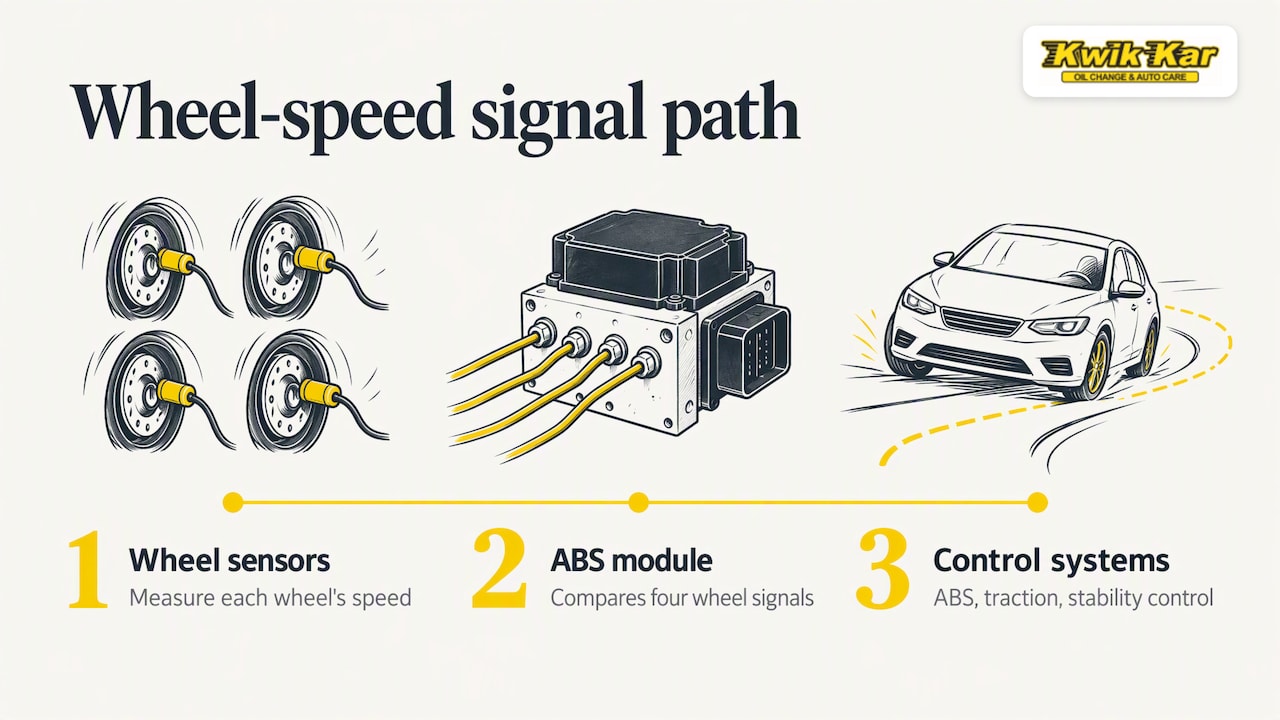
That sensitivity is also why small problems matter. A bit of dirt, corrosion or a weak signal can make the computer stop trusting the data. When it can’t trust the data, it turns the affected systems off and lights a warning.
What are the symptoms of a bad wheel speed sensor?
These are the signs drivers report most, from most to least common.
The ABS warning light comes on
This is the classic sign. When a sensor fails, the ABS, traction control and stability control lights typically illuminate, telling you those systems have been disabled. The light may stay on all the time, or it may come and go. An intermittent light often points to a loose connector, a damaged wire or a sensor that only misreads at certain speeds or temperatures.
The traction control or stability control light joins in
Because these systems share the same wheel speed data, a single bad sensor can light two or three dashboard lights at once. Some vehicles show a “traction off” or a car-with-skid-marks symbol. Don’t assume three lights means three problems. One sensor circuit can cause all of them.
The brake pedal pulses or feels different
If a sensor sends a false signal while you brake, the ABS may kick in when it shouldn’t. You feel a rapid pulsing or a buzzing through the pedal, sometimes at low speed as you roll to a stop on dry pavement. Owners on enthusiast forums describe this often, particularly at the end of a stop, when the sensor signal is weakest.
On the other hand, with the ABS disabled, you may notice the wheels lock more easily in a panic stop or on wet pavement. Your base brakes still work, but you lose the help that keeps the wheels turning.
Cruise control stops working
Some vehicles use wheel speed data for cruise control. When the data goes bad, cruise control may refuse to engage or drop out. RepairPal notes that a faulty sensor can cause a loss of cruise control along with the warning lights. If your cruise control quit at the same moment the ABS light came on, a sensor is a strong suspect.
An erratic speedometer or a check engine light
On older vehicles that take the speedometer signal from a wheel sensor, the needle may bounce, drop to zero or read wrong. The same source says a failed sensor can trigger a check engine light on some older models. Many newer vehicles take speed from other sources, so this symptom varies by make and model.
Rough or odd shifting on some vehicles
Some automatic transmissions use wheel or vehicle speed to decide when to shift. If a speed signal drops out, shifting can feel off on certain models. This is not a typical symptom and a transmission problem has many other causes, so don’t assume the sensor is to blame. If shifting is the main complaint, see our notes on torque converter shudder.
Quick reference: symptom, likely meaning, urgency
| What you notice | What it often points to | How soon to act |
|---|---|---|
| ABS light only | A sensor, wiring, or ABS module issue | Schedule within days |
| ABS, traction and stability lights together | A speed signal problem shared by all three systems | Schedule within days |
| Pulsing pedal on dry roads at low speed | A false or dropping sensor signal | Soon, drive cautiously |
| Brake warning light (red) plus ABS light | Possible brake fluid or hydraulic issue | Stop and get it checked now |
| Cruise control won’t engage | Speed signal missing | Not urgent alone, but check with the ABS light |
| Speedometer jumps or reads zero | Sensor signal loss (older vehicles) | Soon |
A red brake light is different from the amber ABS light. If you see red, pull over safely and have the vehicle inspected before driving further.
What causes a wheel speed sensor to fail?
The sensor is small, but it sits near the wheel, where it faces water, road salt, brake dust and heat. Common causes include:
- Dirt and metal debris. Many sensors are magnetic. Metal shavings and brake dust can collect on the tip and weaken the signal.
- Corrosion. Moisture can attack the connector or the sensor body.
- Damaged wiring. The wire runs through the suspension and flexes with every bump. It can chafe, crack or get pinched after other repairs.
- A damaged tone ring or reluctor. This toothed ring is what the sensor reads. Rust, cracks or missing teeth cause a bad signal even with a healthy sensor.
- Worn wheel bearings. A bearing with play lets the ring move away from the sensor. On many vehicles the sensor is built into the hub assembly.
- A wrong air gap. If the sensor sits too far from the ring after a repair, the signal can be weak.
Bosch notes that even a minor signal discrepancy from dirt, corrosion or bearing wear can lead the computer to shut these systems down. That is why the part that looks guilty is not always the one that failed.
Can you drive with a bad wheel speed sensor?
Usually yes, for a short time. The regular hydraulic brakes work without ABS. But you have lost a safety feature, and the loss matters most in the situations where you need it: a sudden stop, a wet road, a gravel shoulder. Texas storms and the slick first minutes of a rain after a dry spell are exactly those conditions.
If the light is on, a few habits help:
- Leave more following distance than usual.
- Brake earlier and more smoothly.
- Avoid fast highway driving in the rain until it is checked.
- Don’t ignore the light because the car “feels fine.” An ABS fault can hide other brake issues.
If the red brake warning light is also on, or the pedal feels soft or sinks, do not keep driving. Have the vehicle towed or inspected right away.
How do you find out which sensor is bad?
This is where many drivers get stuck. A scan tool can read stored codes from the ABS module, and those codes often point to a specific wheel circuit. But a code is a clue, not a verdict. A code that names the left front sensor circuit can come from the sensor, its wiring, the connector, the tone ring, the bearing, or occasionally the ABS module. We never treat a code as proof that a part needs replacing.
A thorough check usually looks like this:
- Scan the ABS module for codes and note which wheel circuit is flagged.
- Look at live data. A scan tool can show each wheel’s speed while the vehicle is driven. A wheel that drops out or disagrees with the others stands out.
- Inspect the sensor and wiring for debris, damage, corrosion and loose connectors.
- Check the tone ring and wheel bearing for rust, damage or play.
- Test the circuit with the right tools before deciding what to replace.
This is the same approach we use for other sensors. Our article on checking live data before replacing an oxygen sensor explains why measuring first saves money. You can read more about how we approach it on our diagnostics page.
What you can check yourself
You can safely do a few simple things at home:
- Note when the light appears: cold start, after rain, at certain speeds, after hitting a pothole.
- Look at the tires. Mismatched tire sizes or a recent tire swap can sometimes upset wheel speed readings.
- Make a note of any recent work near the wheels, such as brakes, struts or tires. Disturbed wiring is a common cause.
That last point matches what many drivers describe online: the light first appeared right after suspension work. If that fits your story, tell the shop. It narrows the search quickly.
Don’t unplug sensors to “see what happens,” and don’t clear codes and hope. The light will return, and you will have erased useful information.
How much does it cost to replace a wheel speed sensor?
Nationally, RepairPal lists a range of $73 to $107 for a wheel speed sensor replacement on some vehicles, and up to $143 on others. The final bill depends on your vehicle, local labor rates, and how hard the sensor is to reach. On some vehicles the sensor is part of the hub assembly, which changes the job and the cost.
Kwik Kar of Celina does not publish a flat price for this repair, because the right quote depends on what the diagnosis finds. The cheap part is not always the real problem. Replacing a sensor when the real fault is a damaged tone ring or a chafed wire means paying twice.
Our perspective: why we diagnose before we replace
We hear the same story often. A driver gets a code, a part is replaced, and the light comes back a week later. With wheel speed sensors, that happens because the sensor is only one piece of a circuit that includes wiring, a connector, a ring and a bearing.
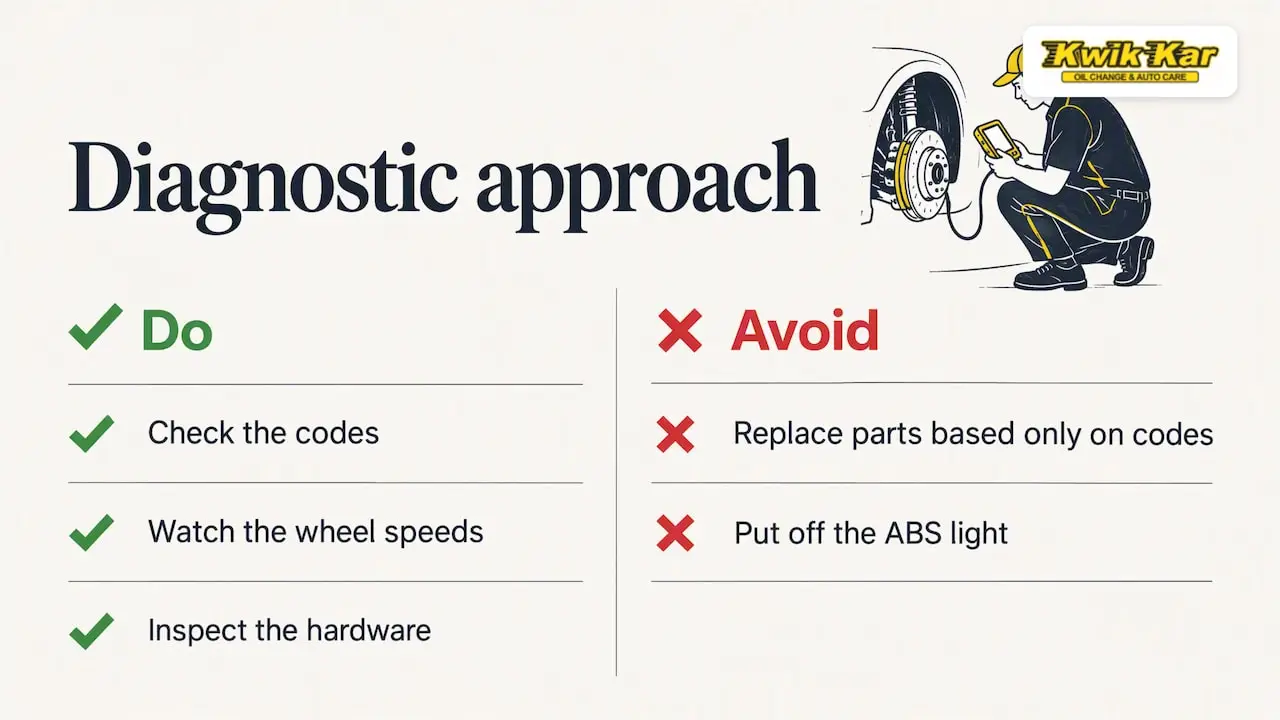
So we start with the evidence. Our ASE-certified technicians check the codes, watch the wheel speeds, and look at the hardware. When we inspect your vehicle, we use Digital Vehicle Inspections, so you can see what we see and decide with the facts in front of you. If the sensor is fine and the problem is somewhere else, we will say so.
We also think the ABS light is easy to put off, because the car still drives. We would rather you came in while it is a small repair than after a hard stop reminds you that the system was off.
— Kwik Kar
What if the ABS light comes with other brake symptoms?
A sensor fault can hide a wider brake problem, or show up at the same time. If you also notice any of these, mention them when you schedule:
- A grinding or squealing noise when you brake
- Steering wheel shake under braking
- A soft or low pedal
- A pull to one side when stopping
Those can point to worn pads, rotors, or fluid issues rather than a sensor. Our guides on signs it’s time for new brake rotors and brake rotor replacement can help you tell the difference. Old fluid can also affect brake feel, which is covered in our brake fluid flush article.
Does a bad wheel speed sensor affect your Texas inspection or registration?
The rules changed recently, so here is the current picture for Celina, TX drivers.
- Safety inspections: Most noncommercial vehicles in Texas no longer require an annual safety inspection as of January 1, 2025, according to the Texas DMV.
- Emissions testing: Qualifying vehicles in Collin County still need a passing emissions inspection before annual registration renewal, per the same TxDMV page.
- Commercial vehicles: Commercial vehicle inspection rules differ from the noncommercial rules and have not changed.
An ABS light is a safety issue first, whatever the rules say. If you want to know where your vehicle stands, our TX state inspections page explains what we offer. If you manage work vehicles, our fleet services page covers how we support businesses.
When should you bring it in?
Schedule service soon if:
- The ABS light, traction control light or stability control light stays on
- The light flickers on and off
- The pedal pulses when you stop gently
- Cruise control has stopped working along with a warning light
Get help right away if the red brake light is on, the pedal feels soft, or the car pulls hard to one side when braking.
Getting your ABS light checked at Kwik Kar of Celina
If your ABS light is on, we can start with diagnostics to find which circuit is at fault and why. If brake work is needed, our brake repair service covers it. Our work comes with a 2-year/24,000-mile warranty, and we offer after-hours drop-off and a complimentary ride service if you can’t wait at the shop. Ask us about the warranty terms when you schedule. You can see everything we do on our services page.
If you drive a European make, our European repair team knows that sensor locations and ABS systems vary a lot by brand and model.
FAQ
How do I know if my ABS speed sensor is bad?
The ABS light is the most common sign, often with the traction control and stability control lights. You may also feel a pulsing brake pedal or lose cruise control. Only a scan of the codes plus a check of the wiring, tone ring and bearing can confirm which part has failed.
Can I drive with the ABS light on?
Usually you can drive for a short time, because the regular brakes still work. You lose anti-lock help, so leave extra distance and avoid hard braking on wet roads. If the red brake light is on or the pedal feels soft, stop driving and get the vehicle checked immediately.
Can a dirty wheel speed sensor cause problems?
Yes. Brake dust, metal debris and corrosion can weaken the sensor signal, and the computer may then disable ABS and stability control. Cleaning is sometimes enough, but a professional should confirm that the sensor, wiring and tone ring are all in good shape.
How much does it cost to replace a wheel speed sensor?
National figures from RepairPal run from about $73 to $143, depending on the vehicle and labor. Your cost can differ if the sensor is part of a hub assembly or if wiring needs repair. We quote after the diagnosis so you know what the repair involves.
Will a wheel speed sensor problem fail an inspection?
Most noncommercial vehicles in Texas no longer need an annual safety inspection, but Collin County vehicles that qualify still need emissions testing before registration. Commercial vehicles follow different inspection rules. Either way, an active ABS light means a safety system is off and should be fixed.
Sources
- RepairPal: wheel speed sensor replacement cost and symptoms (Honda CR-V page)
- RepairPal: wheel speed sensor cost range (Nissan Armada page)
- Bosch Aftermarket: ABS/ESP sensors technical sheet
- Texas DMV: Register Your Vehicle