



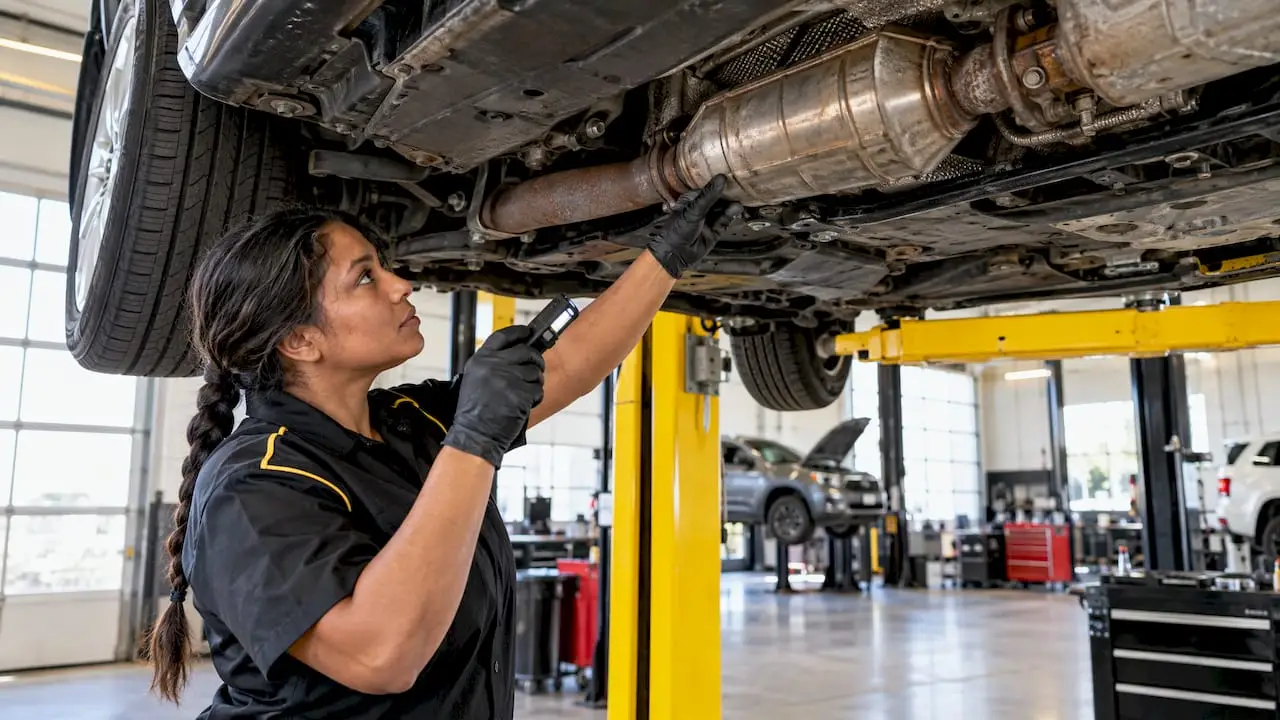
The most common signs of a failing catalytic converter are weak acceleration, a rotten-egg smell from the exhaust, dark exhaust smoke, and a check engine light. Those same symptoms can also come from an oxygen sensor, a misfire, or an exhaust leak. At Kwik Kar of Celina, we start with a proper diagnosis, because the converter is often the part that is affected by a problem, not the part that caused it.
This guide walks you through what a failing converter feels, smells, and sounds like. It also covers what else can mimic it, what a P0420 code does and does not tell you, and when it is time to bring your vehicle in.
TL;DR
- Watch for sluggish acceleration, a sulfur or rotten-egg smell, dark exhaust smoke, rattling from underneath, and a check engine light.
- A P0420 code means the catalyst system is reading below its efficiency threshold. It is a clue, not proof that the converter needs replacing.
- Oxygen sensors, misfires, and exhaust leaks can look just like a bad converter, so diagnose before you buy parts.
- Most noncommercial vehicles in Texas no longer need an annual safety inspection as of January 1, 2025, but qualifying vehicles in Collin County still need emissions testing.
- Do not keep driving for weeks on a clogged converter. Restricted exhaust flow can lead to more expensive damage.
Table of Contents
- What does a catalytic converter do?
- What are the most common catalytic converter failure symptoms?
- Can something else cause the same symptoms?
- What does the P0420 code actually mean?
- How is a failing catalytic converter diagnosed?
- Is it safe to keep driving with a failing catalytic converter?
- Can you unclog a catalytic converter?
- What causes catalytic converters to fail?
- What does catalytic converter replacement cost, and does a warranty help?
- Do you need an inspection in Celina, TX?
- Perspective: why we diagnose before we replace
- Ready to find out what is behind your symptoms?
- How can you help prevent catalytic converter problems?
- FAQ
- Sources
What does a catalytic converter do?
Your catalytic converter sits in the exhaust system between the engine and the muffler. Inside is a honeycomb-like core coated with precious metals. As hot exhaust gases flow through, the coating helps convert harmful pollutants into less harmful gases before they leave the tailpipe.
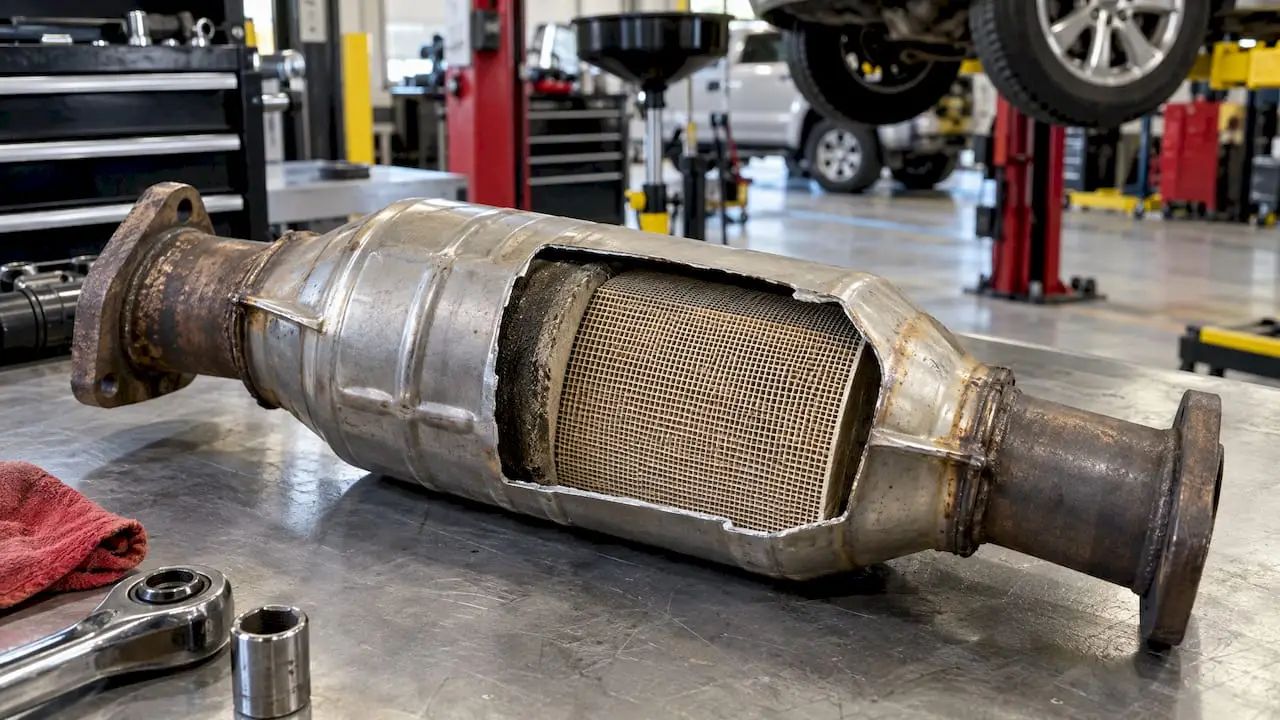
It works only when the engine feeds it properly. Sensors upstream and downstream of the converter let your vehicle’s computer compare what goes in with what comes out. When the readings get too close together, the computer concludes the converter is not doing its job and may set a code.
Because it is part of the exhaust system, a converter can also fail physically. It can crack inside, clog, or overheat. If you want to see how we approach the whole system, our exhaust system repair page explains what we look at.
What are the most common catalytic converter failure symptoms?
No single symptom is a guarantee. Here is what drivers usually notice, roughly in the order they show up.
Does a bad catalytic converter make the check engine light come on?
Often, yes. The onboard diagnostic (OBD) system continuously monitors emission controls and turns on the check engine light when it detects a fault. EPA’s overview of inspection and maintenance programs notes that the converter and the oxygen sensors are the most common sources of those faults.
That sentence matters for how you read the light. The converter is one possible cause. The oxygen sensor is another. The light tells you something is off, not which part is at fault.
Why is my car slow to accelerate?
A clogged converter restricts how easily exhaust leaves the engine. The engine has to push harder to move gases out, and you feel it as sluggish acceleration, especially going uphill, merging onto US-380 or the Dallas North Tollway, or pulling a trailer. Edmunds lists poor acceleration among the signs of a dirty or clogged converter.
Academic research on exhaust system design explains why: engineering studies of catalytic converters describe a trade-off in which higher exhaust resistance directly reduces engine power and efficiency. A converter that has partly melted or plugged adds exactly that kind of resistance.
Why does my exhaust smell like rotten eggs?
Gasoline contains small amounts of sulfur. A working converter helps process the resulting compounds. When it is not working well, you may notice a sulfur or rotten-egg smell from the tailpipe, a symptom Edmunds also connects to a dirty or clogged converter.
The smell can also show up when the engine is running rich, meaning it is burning more fuel than it should. That is another reason to look upstream before blaming the converter.
What does black exhaust smoke mean?
Dark or black smoke usually points to excess fuel. Edmunds lists it with the signs of a clogged converter, but a rich fuel mixture can cause it on its own, and a rich mixture can also damage a converter over time. Either way, it is worth having checked.
What other signs should you listen and look for?
- Rattling from under the vehicle. Broken internal material can rattle, especially at startup or idle. A loose heat shield can make a similar noise, so have someone look underneath.
- Poor fuel economy. An engine working against restricted exhaust flow generally burns more fuel for the same output.
- Unusual heat under the vehicle. A converter that runs far hotter than normal may be overheating internally.
- Hard starting or stalling. In severe clogs, exhaust can barely escape and the engine may struggle to keep running.
- A failed emissions test. In emissions-testing counties, this is sometimes how drivers find out.
Can something else cause the same symptoms?
Yes, and this is where many drivers lose money. Trade reporting on converter failures shows that oxygen sensor problems, misfires, and exhaust leaks can all trigger converter-related codes and symptoms. Fuel and engine problems can too.
Technicians often describe the converter as a fuse. When something upstream goes wrong, such as unburned fuel from a misfire, the converter takes the punishment. Replace only the converter and the original problem can destroy the new one.
Here is a quick comparison of look-alike causes:
| Symptom | Could be the converter | Could also be |
|---|---|---|
| Weak acceleration | Clogged or melted core | Fuel delivery issue, failing ignition parts, restricted air intake |
| Check engine light | Catalyst efficiency code | Oxygen sensor, exhaust leak, misfire |
| Rotten-egg smell | Converter not processing sulfur compounds | Rich fuel mixture, sensor issue |
| Rattling noise | Broken internal substrate | Loose heat shield, worn exhaust hanger |
| Rough running | Severe exhaust restriction | Bad spark plug or coil, vacuum leak |
If your engine is also running rough, read our guide on rough idle causes and our article on ignition coil failure symptoms. A misfire is one of the most common reasons converters fail early.
What does the P0420 code actually mean?
P0420 stands for “Catalyst System Efficiency Below Threshold (Bank 1).” In plain terms, the computer thinks the converter on that side of the engine is not cleaning the exhaust as well as it should. Bank 1 is the side of the engine that contains cylinder number one. On a four-cylinder, there is only one bank.
The key point: the code can also be set by problems unrelated to the converter, including oxygen sensor problems, misfires, and exhaust leaks. A trouble code is a starting point for testing, never proof that a specific part has failed.
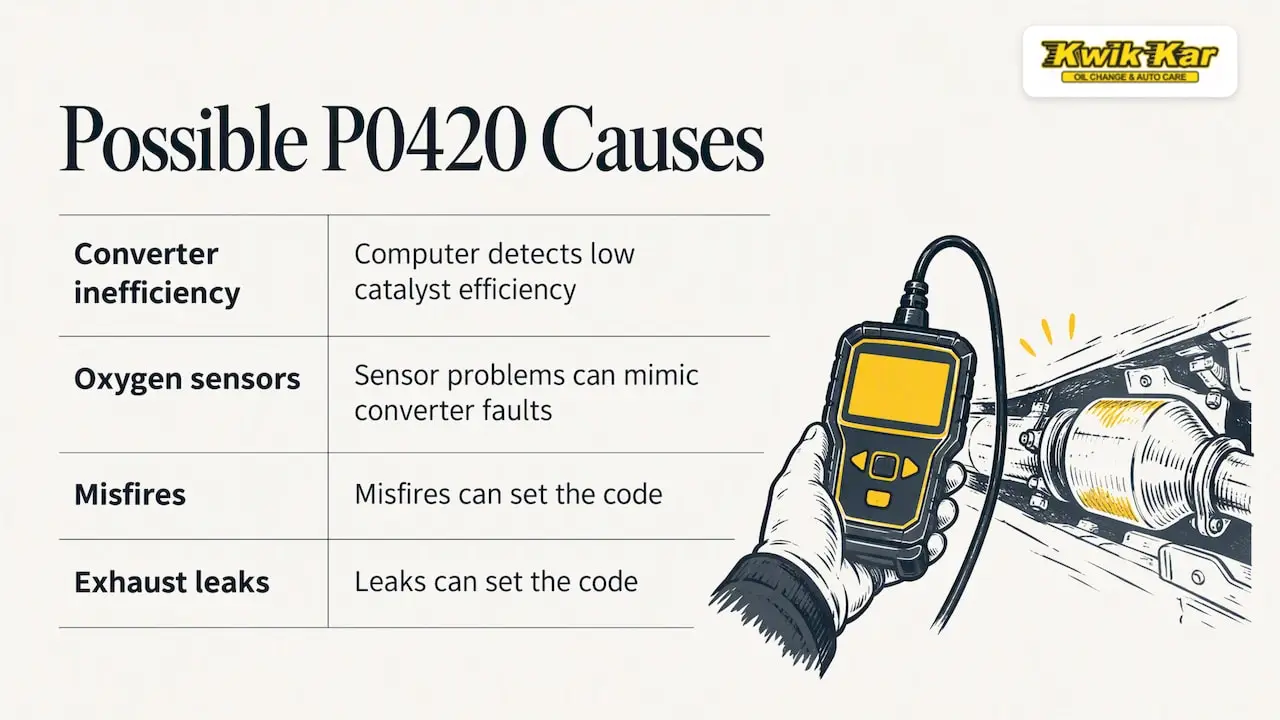
We wrote a deeper walkthrough on why diagnosing a P0420 code before replacing parts matters, and a related piece on oxygen sensor failure and live data checks. Sensor readings that look slow or biased can mimic a converter problem and are far cheaper to correct.
How is a failing catalytic converter diagnosed?
A code reader alone cannot answer the question. A proper diagnosis looks at the whole picture:
- Scan for codes and freeze-frame data. This shows what the engine was doing when the fault was recorded.
- Review live data. We watch how the upstream and downstream oxygen sensors behave while the engine warms up and runs.
- Check for misfires and fuel trim problems. If the engine is running rich or lean, the converter is only part of the story.
- Inspect the exhaust for leaks. A leak near a sensor can skew readings.
- Test for restriction. Industry sources describe vacuum, backpressure, and temperature tests as ways to confirm a converter is truly clogged or failing.
Our diagnostics service is built around this approach, and our explanation of an OBD-II diagnostic test shows what you should expect to get back. We also use Digital Vehicle Inspections so you can see findings for yourself. Our page on how to read a digital vehicle inspection explains the format.
Is it safe to keep driving with a failing catalytic converter?
A converter that is merely reading inefficient may let you drive for a while, but you should not treat that as permission to ignore it. A clogged one is more urgent.
Here is why. Restricted exhaust flow makes the engine work harder, and a converter that is overheating can reach very high temperatures underneath the vehicle. Unburned fuel reaching a hot converter is also a common path to damage. If the check engine light is flashing, that usually signals an active misfire. Reduce speed, avoid heavy loads, and get the vehicle checked promptly.
Signs that mean you should stop driving and call a professional:
- A flashing check engine light
- Strong fuel or sulfur smell with noticeable power loss
- Glowing or intensely hot components under the vehicle
- Engine stalling or struggling to stay running
- Smoke from under the hood or vehicle
If you see any of these, have the vehicle towed or diagnosed rather than driven across town.
Can you unclog a catalytic converter?
You will see plenty of fuel additives and cleaners advertised online. Whether they help depends on what caused the buildup and how severe it is. Mild carbon deposits are one thing. A converter whose internal core has melted or broken apart cannot be cleaned, and nothing poured into the fuel tank will repair it.
What we can say with confidence:
- Fixing the root cause comes first. If a misfire, leaking injector, or bad sensor is feeding the converter unburned fuel, any cleaning is temporary.
- A converter that is physically damaged, rattling, or melted needs replacement.
- Testing tells you which situation you have. Guessing wastes money.
We do not recommend a cleaner as a shortcut. Have the converter tested, then choose the repair that matches the findings.
What causes catalytic converters to fail?
Converters can last a long time, but they are not immune. Common contributors include:
- Misfires. Raw fuel entering the exhaust can overheat and damage the core.
- Rich fuel mixture. Leaking injectors or faulty sensors can load the converter with excess fuel.
- Oil or coolant entering the exhaust. Engine problems like worn rings, valve seals, or internal coolant leaks can contaminate the core.
- Physical damage. Road debris, speed bumps, or a hard impact underneath can crack the internal ceramic.
- Age and mileage. Over many years, the coating loses effectiveness.
On a European vehicle, sensor and fuel-trim behavior can be model specific, so a model-specific diagnostic approach matters. Our European repair team handles these vehicles regularly.
What does catalytic converter replacement cost, and does a warranty help?
Cost varies widely by vehicle. Converters for larger trucks, vehicles with multiple converters, and some imports are priced very differently from those for a compact sedan. Labor, whether the converter is bolted in or part of the exhaust manifold, and the type of replacement part all change the total. That is why we do not quote a number without looking at your vehicle, and why a diagnosis comes first. Replacing a converter because of a misread code can be one of the more expensive mistakes in car repair.
There is one money-saving check worth making before you authorize any work. EPA’s emissions warranty guidance states that for 1995 and newer vehicles, catalytic converters are among the major emission control components covered for the first 8 years or 80,000 miles, whichever comes first. Coverage can be denied if misuse or improper maintenance caused the failure. Check your owner’s manual or warranty booklet before paying out of pocket.
If your vehicle is outside that window, our repair work is backed by a 2-year/24,000-mile warranty. Our page on what an auto repair warranty covers lists what to ask any shop.
Do you need an inspection in Celina, TX?
This is a question we hear often, and the rules changed recently.
As of January 1, 2025, Texas ended the safety inspection requirement for noncommercial vehicles under House Bill 3297. The same state notice says emissions inspections are still required before registration in 17 counties, and Collin County is one of them. If your vehicle is subject to testing, a failing converter or an active catalyst code can get in your way at registration time.
Commercial vehicle inspection rules differ from the noncommercial rules, so fleet managers should confirm the requirements that apply to each vehicle. For the current details, check with the Texas DMV and the Texas Department of Public Safety.
Perspective: why we diagnose before we replace
We see the same pattern often. A driver arrives with a check engine light and a code that points to the catalytic converter, and a quote from somewhere else that adds up to a lot of money. The code is real, but it describes a symptom. It does not say why the converter is underperforming.
Our approach at Kwik Kar of Celina is to test first. Our ASE-certified technicians check sensor behavior, look for misfires and leaks, and document what they find in a Digital Vehicle Inspection so you can see it too. If the converter really is the problem, we say so plainly. If it is not, we tell you that as well.
We believe honest recommendations and fair pricing build the kind of trust that keeps families coming back. A repair that fixes the cause protects you from paying twice.
Kwik Kar
Ready to find out what is behind your symptoms?
If your vehicle is hesitating, smelling like sulfur, or showing a check engine light, we can help you sort out the cause. Kwik Kar of Celina offers diagnostics and exhaust system repair, along with after-hours drop-off and a complimentary ride service for busy schedules.
You can see everything we offer on our services page, or start with a diagnostic visit so you know what you are dealing with before you spend on parts.
How can you help prevent catalytic converter problems?
You cannot make a converter last forever, but you can avoid the things that shorten its life.
- Do not ignore a check engine light. A small misfire left alone can become a converter replacement.
- Fix leaks and rough running early. Oil, coolant, and fuel problems all reach the exhaust eventually.
- Follow your maintenance schedule. Spark plugs, ignition parts, and sensors are on schedules for a reason. Our factory scheduled maintenance service follows your vehicle’s own requirements.
- Avoid hard hits underneath. Take speed bumps and rough construction zones slowly.
- Use quality fuel and the right oil. Your owner’s manual lists what your engine needs.
If you run a business with several vehicles, a regular checklist catches problems before they cost you a day of work. Our fleet maintenance checklist is a good place to start.
FAQ
Can a bad catalytic converter damage other parts?
It can. A restricted converter forces the engine to work against back pressure, and the underlying causes, like misfires or a rich mixture, can harm spark plugs and sensors. A severely clogged converter can also leave the engine struggling to run. Having it diagnosed early limits the damage.
Does a P0420 code always mean I need a new converter?
No. P0420 means the catalyst system is reading below its efficiency threshold. Oxygen sensor problems, misfires, and exhaust leaks can all set it. A technician should test the system before recommending a replacement.
How long does a catalytic converter last?
There is no single number. Life depends on your vehicle, driving conditions, and how well the engine is maintained. For 1995 and newer vehicles, EPA says converters are covered by the federal emissions warranty for the first 8 years or 80,000 miles, whichever comes first, so check your booklet.
Can I pass an emissions test with a failing converter?
Usually not. In Collin County, qualifying vehicles still need emissions testing before registration, and a catalyst fault or an active check engine light can cause a failure. Diagnose and repair the cause first, then retest.
Do I still need a Texas safety inspection?
For most noncommercial vehicles, no. Texas eliminated that requirement as of January 1, 2025. Emissions testing still applies in certain counties, including Collin, and commercial vehicle inspection rules are different.
Sources
- Overview of Vehicle Inspection and Maintenance (I/M) Programs, EPA
- Catalytic Converters: The Complete Guide, Edmunds
- Catalytic Converters for Vehicle Exhaust: Fundamentals, MDPI
- What’s really wrong when a catalytic converter fails, Vehicle Service Pros
- Emissions Warranties for 1995 and Newer Cars and Trucks, EPA
- Texas vehicle inspection changes, Texas DMV