



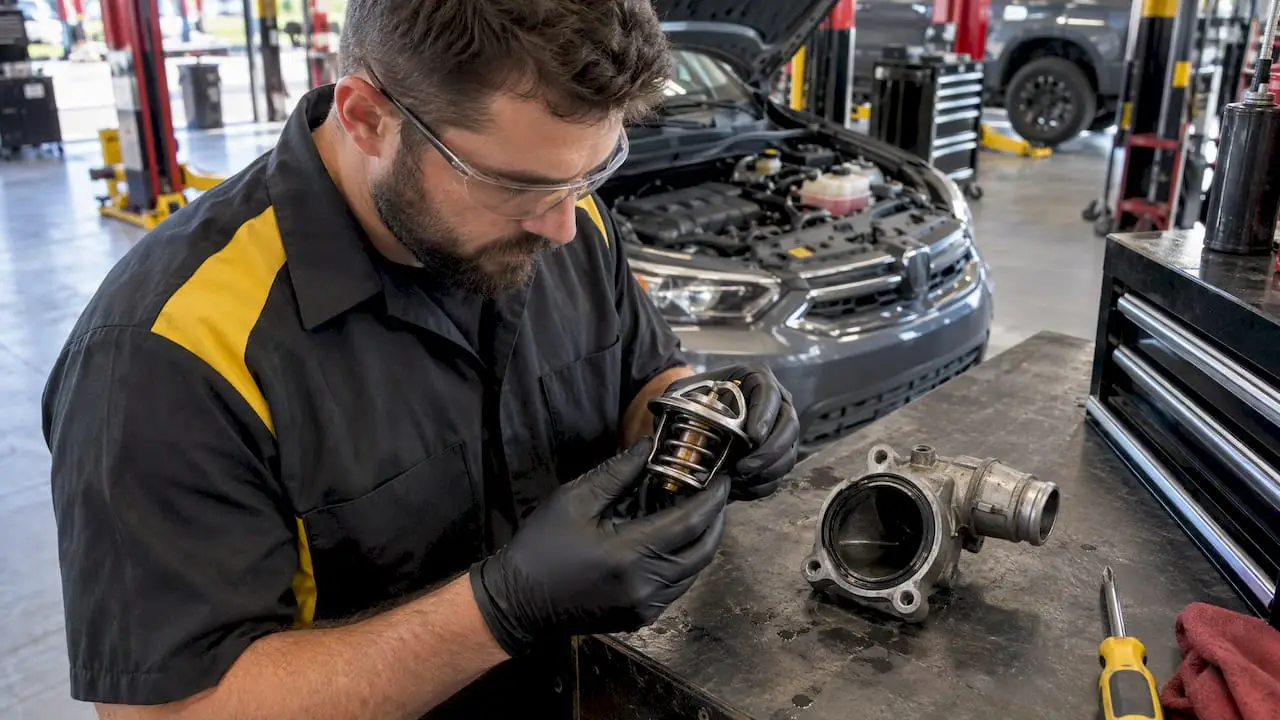
A thermostat stuck open keeps coolant flowing through the radiator when it should be held back, so your engine runs colder than it should. The usual signs are a temperature gauge that sits low, a slow warm-up, weak heat from the vents and worse fuel mileage. Sometimes the Check Engine light comes on too. It usually won’t overheat the engine right away, but it still needs a repair, and it can be confused with a bad radiator cap, a cooling fan problem or a sensor fault.
Below, we at Kwik Kar of Celina walk through what a stuck-open thermostat feels like from the driver’s seat, what else can mimic it, and when to stop driving.
TL;DR
- A stuck-open thermostat lets the engine run cold: the gauge stays low, the heater is lukewarm, fuel economy drops and the engine takes a long time to warm up.
- A gauge that swings up and down can be a thermostat, but it can also be trapped air, low coolant, a weak radiator cap, a cooling fan or a temperature sensor.
- A warning light or code such as P0128 points to a problem, not to a specific part. Testing comes before replacing.
- A short drive to a shop is usually reasonable if the gauge stays in its normal range. Stop right away if it climbs, steam appears or coolant is leaking.
- Texas dropped most noncommercial safety inspections on January 1, 2025, but qualifying vehicles in Collin County still need emissions testing.
Table of Contents
- What does a thermostat do, and how does it get stuck open?
- What are the symptoms of a thermostat stuck open?
- Why would the temperature gauge go up and down?
- Could it be a bad radiator cap instead?
- Does a code like P0128 prove the thermostat is bad?
- How can you check for a stuck-open thermostat?
- How long can you drive with a stuck-open thermostat?
- Can a stuck thermostat be fixed, or does it need replacing?
- What does this mean for emissions and inspections in Texas?
- Cooling system service at Kwik Kar of Celina
- FAQ
- Sources
What does a thermostat do, and how does it get stuck open?
The thermostat is a small valve between the engine and the radiator. When the engine is cold, it stays closed so the engine can warm up quickly. Once the coolant reaches the thermostat’s rated temperature, it opens and lets coolant circulate through the radiator to shed heat. Most thermostats use a wax-filled element that expands with heat, which is what pushes the valve open.
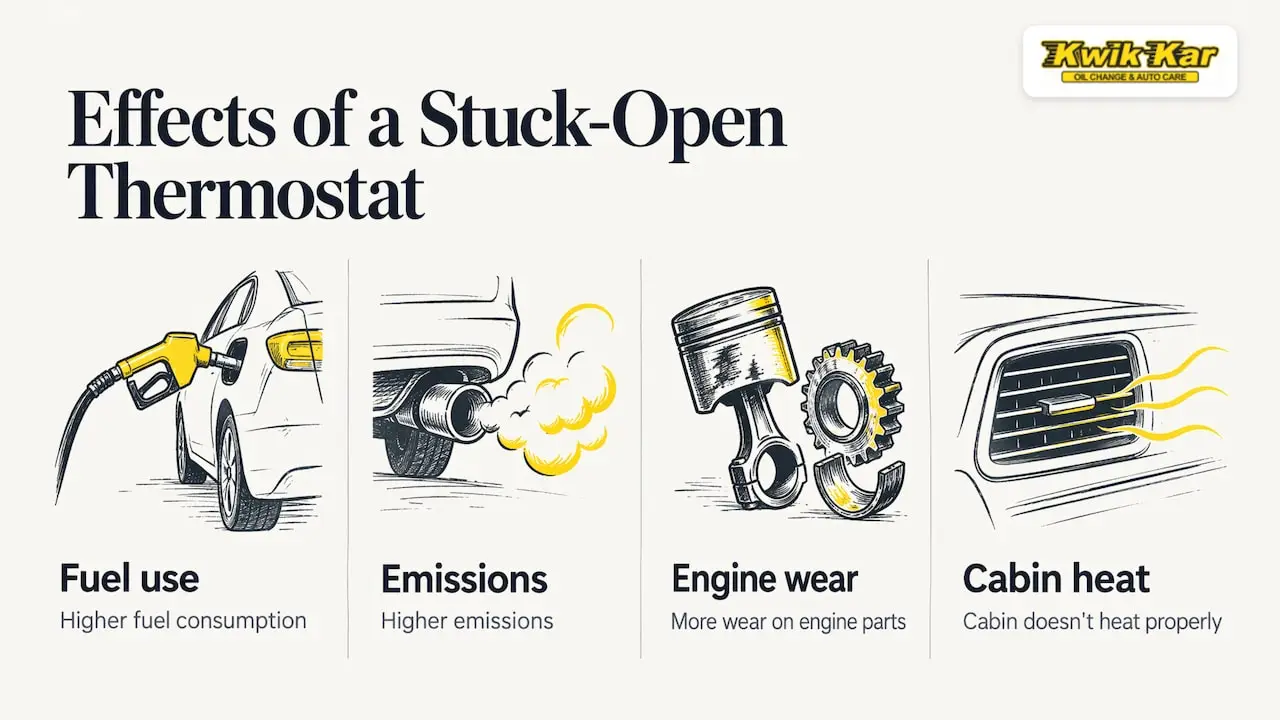
When it fails open, coolant circulates through the radiator all the time. Gates’ cooling system manual explains that this makes the engine run cold, with higher fuel consumption, higher emissions, more wear on engine parts and a cabin that doesn’t heat properly.
Thermostat failure is usually tied to age and mileage. Wax elements and springs wear, and debris or corrosion in old coolant can keep the valve from seating.
What are the symptoms of a thermostat stuck open?
Most drivers notice these first:
- The temperature gauge stays low. On a normal drive it should climb to the middle of its range and stay there. With a stuck-open thermostat, the needle sits below normal or creeps up very slowly.
- The heater blows lukewarm air. The heater uses hot engine coolant. If the coolant never gets hot, neither does the cabin. DENSO’s technical article points out that poor cabin heating is often blamed on the heater system when the real issue is an engine that isn’t reaching temperature.
- Fuel mileage drops. A cold engine runs richer and less efficiently. AutoZone’s thermostat guide lists poor fuel mileage alongside poor heater output as common signs.
- The engine takes a long time to warm up, especially on highway drives in cool weather.
- The Check Engine light comes on. AutoZone notes that the light can come on when engine temperature is too high or too low, and that excess emissions outside the normal range can cause a vehicle to fail an emissions test.
- A stored code. Many vehicles set a code such as P0128 when coolant doesn’t reach the expected temperature in the expected time.
Some models are known for this. A 2023 Mazda technical service bulletin describes a P0126 code (thermostat stuck open), long warm-up times, a fluctuating gauge and poor heat at idle on certain non-turbo Mazda3, Mazda6, CX-3, CX-5 and CX-30 vehicles. Model-specific issues like this vary, so a technician should check your exact vehicle.
Why would the temperature gauge go up and down?
A stuck-open thermostat usually gives a low, steady gauge. A swinging gauge is a different pattern, and it has more possible causes. As AutoScandi puts it, a moving gauge is a symptom, not a diagnosis. Possible causes include:
- Trapped air in the cooling system
- Low coolant
- A faulty sensor or wiring
- Poor water pump circulation
- Cooling fan control problems
- In serious cases, combustion gases getting into the coolant
The thermostat itself can cause swings in two ways. A thermostat that is slow to react can let temperature rise and fall depending on load, according to DENSO. And Steer describes one that sticks partly closed: the engine heats up until pressure forces it open, a rush of cold coolant drops the needle, and the cycle repeats. A fully stuck-open thermostat is the more common failure and looks different: the needle sits low and the heater is lukewarm.
How to tell the likely cause from the pattern
| What you see | Likely direction | What a technician checks |
|---|---|---|
| Gauge low and steady, weak heat | Thermostat stuck open | Warm-up behavior, live coolant temperature, thermostat test |
| Gauge climbs in traffic, drops at speed | Cooling fan or fan control | Fan operation and controls |
| Random swings, gurgling, low coolant | Air in the system, a leak, or a weak cap | Pressure test, coolant level, hoses |
| Gauge moves but engine feels normal | Temperature sensor or wiring | Scan tool data versus actual temperature |
| Gauge spikes, then drops suddenly | Thermostat sticking partly closed | Thermostat and coolant flow |
Steer notes that below roughly 25 to 30 mph there isn’t enough air moving through the radiator on its own, so the fan does the work. A needle that climbs at every red light and falls once you’re rolling points toward a fan problem, not the thermostat. If that sounds like your car, see our page on radiator fan diagnosis.
Could it be a bad radiator cap instead?
Possibly. The radiator cap isn’t just a lid. It holds the cooling system at a set pressure, which raises the coolant’s boiling point, and it releases pressure above its rating. A cap that can’t hold pressure causes trouble that overlaps with thermostat problems.
Elecdura lists these common bad-cap symptoms:
- Coolant pushed into the overflow bottle
- Coolant escaping around the cap
- Overheating under load
- A sweet coolant smell after driving
- Crust around the filler neck
- A soft or collapsed upper radiator hose after cool-down
A loose or worn cap can also let coolant escape as vapor, which leads to low coolant and swinging temperatures. The AAA car care guide says a collapsed upper hose after the engine reaches full temperature may mean a faulty cap, and a qualified technician should test it.
AAA’s guide on belts and hoses covers this. For testing, the Snap-on coolant system tester manual says a cap passes if it holds pressure in the proper range for a minute or more, and should be replaced if the gauge hand drops quickly.
The key difference: a bad cap tends to cause pressure and coolant loss symptoms (overflow, smell, hose collapse, overheating). A stuck-open thermostat causes cold-running symptoms (low gauge, weak heat). Both can share a Check Engine light and a fluctuating gauge, and the same cap symptoms can come from a head gasket, a restricted radiator, a weak fan or a leaking hose. Never open a hot radiator cap. Wait until the engine is fully cool, because hot coolant can spray out under pressure.
Does a code like P0128 prove the thermostat is bad?
No. A code tells us which system reported a problem, not which part failed. P0128 means the coolant temperature stayed below the expected level. A stuck-open thermostat is a common cause, but so can be low coolant, a faulty coolant temperature sensor or a wiring issue.
Replacement makes sense when the coolant level is right, the temperature readings are credible, nothing else explains the overcooling, and testing shows the thermostat stays open when it should close or opens too early. Engine Repair Zone describes this logic, and it’s how we approach it too. That’s the reason we start with a diagnostic scan and a look at live data, not a parts swap. Our OBD-II diagnostic page explains how that works.
How can you check for a stuck-open thermostat?
There are a few checks that help you describe the problem to a technician.
- Watch the gauge on a cold start. Note how long it takes to reach normal. If it never gets there on a long drive, the engine is running cold.
- Check the heat. Weak heat on a cool morning, after 10 to 15 minutes of driving, is a clue. Be aware that low coolant can cause this too.
- Check the coolant level only when the engine is cold. Look at the reservoir marks and never open the radiator cap on a hot engine.
- Compare hose warmth. Gates suggests an infrared thermometer on the upper radiator hose: if it gets hot before the engine has properly warmed up, the thermostat isn’t closing properly. Keep hands and tools clear of the fan and belts.
- Read live coolant temperature with a scan tool. This is quicker and more accurate than guessing.
Shops can also bench-test a removed thermostat. The Gates manual describes heating it in water with a thermometer to see that it fully opens at its rated temperature, then cooling it to confirm it fully closes. If it doesn’t, it needs replacement.
How long can you drive with a stuck-open thermostat?
There is no safe fixed distance. A stuck-open thermostat usually won’t overheat an engine right away, and one cooling-system explainer says a short trip to a shop may be possible if the engine stays in a safe range. Edmunds says driving a short distance with a P0128 code is generally safe, but ignoring it for a long period isn’t wise. Fuel economy suffers, and more serious mechanical issues can follow over time.
Stop driving and call for help if:
- The temperature gauge climbs above normal or into the hot zone
- A warning light comes on
- You see steam or smell hot coolant
- Coolant is leaking heavily
- Your windshield won’t defrost
The last one matters in a Texas cold snap: a car that can’t clear the glass isn’t safe to drive. Also, if the thermostat is actually stuck closed rather than open, temperature can reach the red zone quickly. That is an emergency, not a wait-and-see problem.
Can a stuck thermostat be fixed, or does it need replacing?
In practice, replacement. Gates states that a thermostat stuck open or closed should be replaced right away. There’s no reliable way to free a worn wax element, and a thermostat that has stuck once will likely do it again.
Gates also says that when you’re replacing other faulty cooling-system parts, replacing the thermostat at the same time is good preventive maintenance. Ageing isn’t always obvious, and a thermostat that needs replacing may not have failed completely.
A proper repair usually includes:
- Confirming the fault with testing, not just a code
- Replacing the thermostat (and gasket or housing if needed)
- Refilling and bleeding the system so air doesn’t stay trapped. Trapped air can cause its own gauge swings, as Friday Parts explains
- Checking the radiator cap, hoses and clamps
- Confirming the engine reaches and holds normal temperature
For more background on keeping the whole system healthy, read our guide to engine cooling and our tips for preventing overheating in Texas heat.
What does this mean for emissions and inspections in Texas?
A cold-running engine can set a Check Engine light and raise emissions, which matters at inspection time. Here is where Texas stands:
- Most noncommercial vehicles in Texas no longer require annual safety inspections as of January 1, 2025. Under House Bill 3297, the program ended for noncommercial vehicles, and an inspection replacement fee is collected at registration, according to local reporting on the DPS changes.
- Qualifying vehicles in Collin County still require emissions testing. A lit Check Engine light can be a problem there.
- Commercial vehicle inspection rules differ from noncommercial rules. If you manage fleet vehicles, confirm which rules apply to each one.
If your light is on because of a thermostat code, fixing the cause first usually makes more sense than going to a test with an open fault.
Our take on cold-running engines
We see the same pattern often: a driver says the heater has been weak for weeks, and the gauge never quite reaches the middle. It’s easy to shrug off, but a cold-running engine is telling you something about the cooling system.
Our approach is to find the cause before recommending a repair. Our ASE-certified technicians use Digital Vehicle Inspections so you can see what we see, and we scan for codes without treating any one code as proof that a part is bad. If it’s the thermostat, we say so. If it’s a radiator cap, a fan or a sensor, we say that instead.
Repairs at Kwik Kar of Celina in Celina, TX come with our 2-year/24,000-mile warranty, and we offer after-hours drop-off and a complimentary ride service so a repair doesn’t have to derail your day.
Kwik Kar
Cooling system service at Kwik Kar of Celina
If your gauge is low, your heater is weak or the needle won’t settle, our team can inspect and test the cooling system, including the thermostat, radiator cap, hoses, coolant and fans. We also work on European vehicles and fleet vehicles.

Learn more about our cooling system service, or see everything we do on our services page. If your problem is mainly cold cabin air, our article on auto heater repair covers the heater side. Winter is also when engines show strain, so our guide to engine trouble in cold weather may help.
FAQ
What happens if my thermostat is stuck open?
The engine runs cooler than designed. You’ll likely see a low temperature gauge, weak heater output, lower fuel economy and a longer warm-up. Over time, it can add wear and raise emissions, and it may turn on the Check Engine light.
Can a bad radiator cap make the temperature gauge fluctuate?
Yes. A cap that can’t hold pressure lets coolant boil at a lower temperature and escape, which can cause overheating, overflow and swinging readings. The same signs can come from other faults, so a pressure test and inspection are the best way to confirm.
Is a thermostat stuck open an emergency?
Usually not, as long as the gauge stays in its normal range and there are no leaks. Still, arrange repair soon. If the gauge climbs, steam appears or the heater and defroster stop working, pull over safely and call for help.
Why won’t my engine reach normal temperature?
The most common cause is a thermostat stuck open. Low coolant, a faulty temperature sensor or cold weather with a short trip can also play a part. A scan of live coolant temperature helps tell them apart.
Can I just replace the thermostat myself?
It depends on your vehicle, and many designs need the system drained, refilled and bled correctly. If you’d rather have it done right and backed by a warranty, you can contact Kwik Kar of Celina to schedule an inspection.
Sources
- Gates Performance Engine Cooling Manual
- How to Test Your Car’s Thermostat, AutoZone
- Thermostat diagnosis, DENSO Aftermarket
- Mazda technical service bulletin, NHTSA (2023)
- Temperature Gauge Going Up and Down, Steer
- Temperature Gauge Fluctuating, AutoScandi
- Air & Gases in the Cooling System, Friday Parts
- Bad Radiator Cap Symptoms, Elecdura
- Coolant System Tester manual, Snap-on
- AAA Make Sense of Car Care: Belts & Hoses
- Thermostat Stuck Open Symptoms, Engine Repair Zone
- Can You Drive With a Bad Thermostat?
- P0128 code, Edmunds
- 2025 Texas Vehicle Safety Inspections in Collin County, Local Profile