



When the ABS light comes on, your regular brakes still work, but the anti-lock function that helps you keep steering control in a hard stop may be switched off. The light is a symptom, not a verdict. A proper diagnosis finds out why the system shut itself down before anyone replaces a part. At Kwik Kar of Celina, we walk Celina, TX drivers through that process every week, and this guide shows you what to expect.
TL;DR
- An amber ABS light usually means the anti-lock function is disabled, while the standard hydraulic brakes still work. Drive gently and get it inspected soon.
- If the ABS light appears with the red brake or parking brake light, treat it as more serious and have the car checked before further driving.
- The most common causes are a wheel speed sensor, a dirty or damaged tone ring, low brake fluid, a blown fuse, wiring, or a worn wheel bearing. The ABS module is a less common culprit.
- A trouble code points to a circuit or system, not to a part that must be replaced. Testing comes first.
- Costs range from under $100 for a simple sensor to well over $1,000 for complex parts, depending on the actual fault.
Table of Contents
- What does the ABS light mean, and is it safe to drive?
- Why is my ABS light on? The most common causes
- What are the symptoms of a bad ABS wheel speed sensor?
- What are the signs of ABS module problems?
- How do technicians diagnose an ABS light?
- Is it expensive to fix an ABS light?
- Perspective: why we diagnose before we replace
- What if my traction control or stability light is also on?
- What to do when the ABS light comes on
- ABS diagnosis at Kwik Kar of Celina
- Does the ABS light affect a Texas inspection?
- FAQ
- Sources
What does the ABS light mean, and is it safe to drive?
The anti-lock braking system (ABS) uses wheel speed sensors and an electronic control module to rapidly pulse the brakes, around 15 times per second or more, so the wheels don’t lock when you brake hard. When the module detects a fault, it turns the ABS function off and lights the warning lamp.
The key point: normal hydraulic braking is maintained when the ABS shuts down because of an electrical fault. You still have brakes. What you lose is the safety net.
That matters most in an emergency stop or on a wet road. Without ABS, stopping distance can increase and the wheels can lock up, which may cause a skid and a loss of steering control. Texas drivers know how quickly a dry afternoon can turn into a slick, rainy commute.
How to drive until you can get it checked
- Slow down and leave extra space behind the car ahead, especially in rain, snow or ice.
- Brake earlier and more smoothly than usual.
- Avoid long trips and highway speeds if you can.
- Schedule the inspection promptly rather than waiting for the next oil change.
When the ABS light is not the only light
If the red brake warning or parking brake light is on along with the ABS light, stop thinking of it as a minor fault. One automaker’s owner’s manual says that when both the ABS and parking brake lights are on, the braking system does not work normally and sudden braking can become dangerous. Check that the parking brake is fully released. If the light stays on, or the pedal feels soft, sinks, or the car pulls, pull over safely and have the vehicle towed or inspected before you drive it further. Your owner’s manual is the right place to confirm what each light means for your specific model.
Why is my ABS light on? The most common causes
The ABS lamp has a short list of usual suspects. The causes below are the ones commonly listed by parts and repair sources.
| Possible cause | What happens | What you might notice |
|---|---|---|
| Wheel speed sensor fault | The module loses a speed signal from one wheel | ABS light, often with traction control light |
| Dirty or damaged tone ring (reluctor) | The sensor reads a bad or missing pulse pattern | Intermittent ABS light, erratic activation |
| Low brake fluid | Fluid level warning triggers the system | ABS or brake light, possibly a soft pedal |
| Blown fuse or low battery voltage | The module lacks stable power | ABS light, other electrical oddities |
| Wiring or connector damage | Signal drops out or shorts | Light that comes and goes |
| Worn wheel bearing or loose hub | Sensor gap changes and signals degrade | Humming or growling noise, ABS light |
| ABS module or hydraulic unit fault | The control unit can’t operate or communicate | ABS plus traction and stability lights |
Each of these has a different fix, which is why guessing is expensive. Worn brake pads can also be on the list, so a brake inspection is part of a sensible visit.
Low brake fluid and brake wear
Brake fluid level drops slowly as pads wear, and it can also drop if there is a leak. If the level is low, the ABS or brake light may come on. Topping off without finding out why is a short-term patch. If your pads or rotors are the real issue, you’ll want a brake repair inspection. Our guide on signs it’s time for new brake rotors covers what wear looks and feels like.
Wheel bearings and hubs
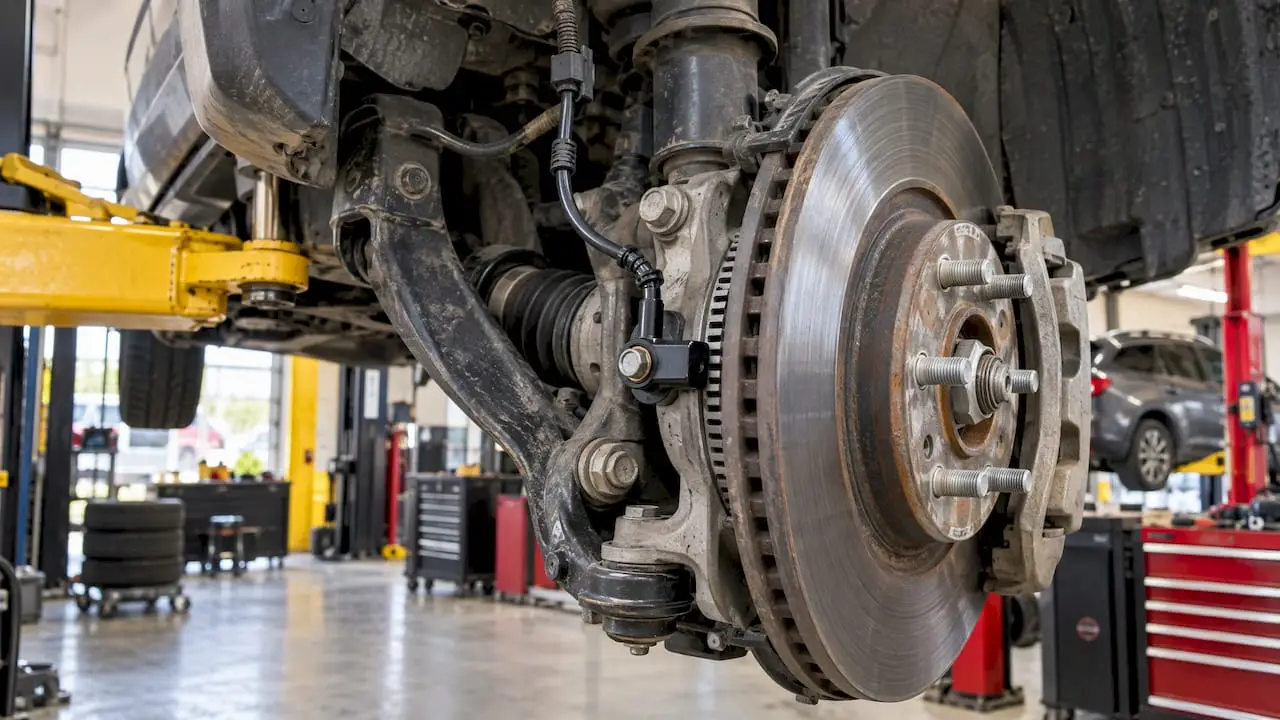
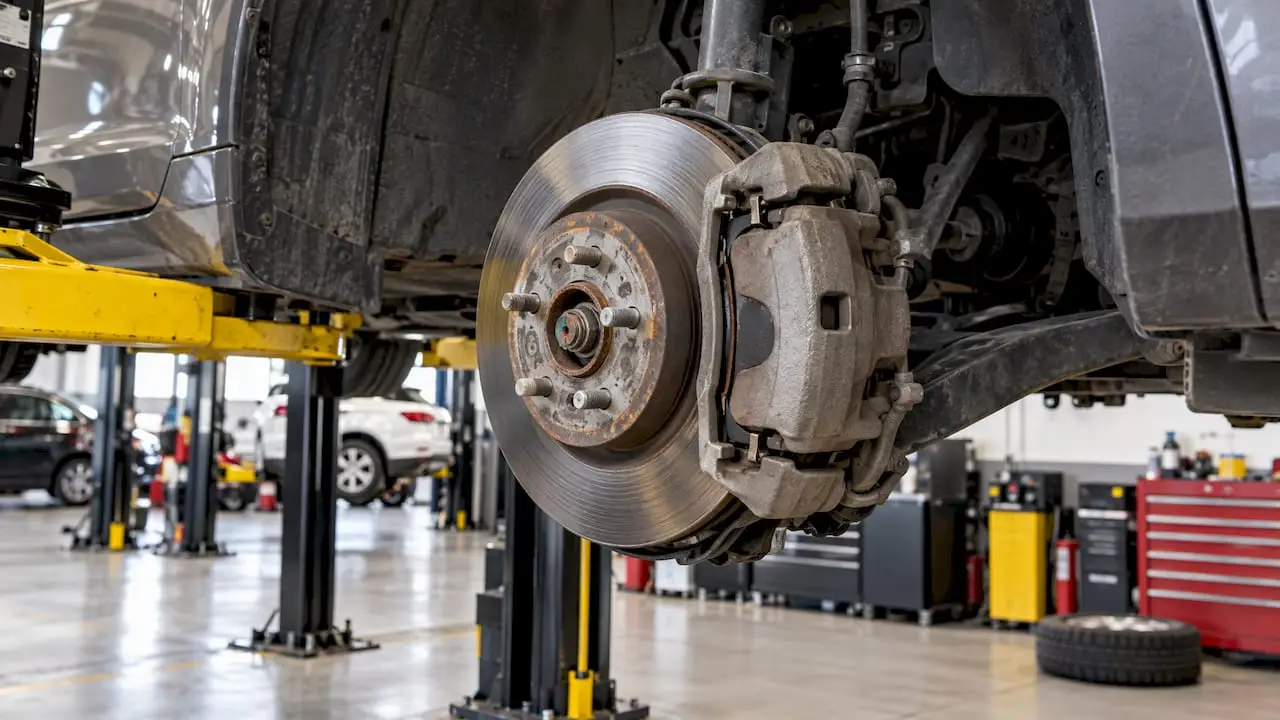
Loose or damaged wheel bearings and hubs can cause the ABS light because they affect what the sensor reads. Increased bearing clearance is also named as a cause of ABS sensor failure. If you hear a hum that changes with speed or turning, mention it when you drop off the car.
What are the symptoms of a bad ABS wheel speed sensor?
The wheel speed sensor reads how fast each wheel is turning. That data is used to decide when to activate ABS and how much pressure to apply, and the ABS control unit also shares it with other systems, such as engine and transmission controls.
When a sensor fails, the ABS light comes on, a fault code is stored, and the wheels may lock during braking. Typical signs include:
- The ABS light, normally the first sign, often with the traction control light.
- Reduced stopping power under heavy braking.
- Less stability on wet or slippery roads.
- A pulsing pedal or ABS activating at low speed when you haven’t braked hard.
- On some vehicles, an inconsistent speedometer or cruise control.
One caution: these signs don’t prove the sensor itself is bad. Damaged wiring, a corroded connector, debris, an incorrect sensor gap or a damaged tone ring can produce the same result. Sensors commonly fail from clogging with metallic debris, brake dust or dirt after years of exposure on the road.
We’ve written a separate page on wheel speed sensor symptoms if you want a closer look at what drivers notice.
What are the signs of ABS module problems?
The ABS module is the computer, often combined with the hydraulic control unit, that decides when to pulse the brakes. Symptoms of a failing module can include:
- An ABS light that stays on, plus traction or stability control warnings.
- Several ABS-related codes at once.
- No communication between the scan tool and the module.
- Loss of ABS function or unexpected activation.
- Faults that return after codes are cleared.
Modules can fail early from moisture, corrosion and other external factors, and software problems can mean a module needs to be reprogrammed or replaced. But an ABS light is a symptom of a problem in the ABS system, not automatic proof that the module is bad. A bad sensor, wiring, low battery voltage, a blown fuse, or a hydraulic unit problem can look very similar. That is why we test power, ground, connectors and sensor data before anyone talks about a module.
How do technicians diagnose an ABS light?
A good ABS diagnosis is a sequence, not a code swap. Here is the general approach used across the industry, and how we think about it at Kwik Kar of Celina.
- Confirm the complaint. Which lights are on, when did they appear, and did anything change recently, such as new tires, brake work or a battery replacement?
- Scan for codes. Diagnosis begins with retrieving diagnostic trouble codes. Most ABS faults store a performance, circuit or network code.
- Do the basic checks. Look at tire sizes and pressures, the sensor and tone ring, sensor mounting, wiring and connectors, and any leaks near the hydraulic unit.
- Check the foundations. Parts makers recommend checking battery voltage, fuses, wheel bearings, suspension, brake fluid level, sensor wiring and installation before replacing a wheel speed sensor.
- Read live data. Compare wheel speed readings while the car is rolling to see which corner drops out or reads erratically.
- Test components. Where needed, verify power and ground at the module, inspect connectors for corrosion, and use a bi-directional scan tool to command the pump or solenoids on.
- Explain the findings. You should hear what was found, what is urgent and what can wait.
Intermittent faults are the hardest. The car may behave normally when it reaches the shop, which is why stored codes, freeze-frame data and live data are so valuable. If your light comes and goes, tell us when it tends to appear: after rain, at low speed, after a bump.
Why a code is a starting point
A code tells the technician where the system noticed a problem. It doesn’t name the failed part. A wheel speed circuit code, for example, can come from the sensor, the harness, a connector, the tone ring or a bearing. If you want to understand how stored and historic codes differ, this explainer on understanding car fault codes is a good companion. For a broader look at why testing beats parts swapping, read our post on the OBD-II diagnostic test.
Can a parts store reset your ABS light? A basic code reader can sometimes read or clear codes, but clearing a code doesn’t fix the cause. If the fault is real, the light returns, and you’ve also erased useful information. It’s better to let the code and freeze-frame data be read and recorded first.
Is it expensive to fix an ABS light?
It depends entirely on what is wrong. AutoZone says ABS repairs can run under $100 for a sensor or well over $1,000 for more complex parts. A CarMD study of 1,250 American drivers, reported by Kelley Blue Book, put the average cost of replacing an ABS wheel speed sensor at $271 in 2024.
What moves the price:
- Which part failed. A sensor, a wiring repair, a bearing or hub, and a module are very different jobs.
- Your vehicle. Some sensors are separate, others are built into the hub assembly. European models often need specific parts and software procedures.
- Whether the fault is simple. A blown fuse or dirty sensor costs far less than a failed hydraulic unit.
- Whether there are related problems, such as worn pads or a leaking brake line.
We don’t publish fixed prices for ABS work, because we won’t quote a number before we know the cause. After the diagnosis, you get the findings and an estimate for the repair.
Perspective: why we diagnose before we replace
We see the same pattern often. A driver notices the ABS light, searches the code, buys the part the internet suggests, and the light is still on. The code pointed at a circuit, and the real problem was a corroded connector or a worn bearing.
That is why we start with a Digital Vehicle Inspection and a proper scan, then show you what we found. Our ASE-certified technicians combine old-fashioned honesty with modern tools, so you can see the condition of your vehicle and decide with confidence.
The ABS light also deserves a prompt visit. Your brakes may still stop the car, but the anti-lock safety net is what helps in a sudden stop on a wet Texas road. We back our repairs with a 2-year/24,000-mile warranty, and we’d rather find a small fix early than a big one later.
Kwik Kar
What if my traction control or stability light is also on?
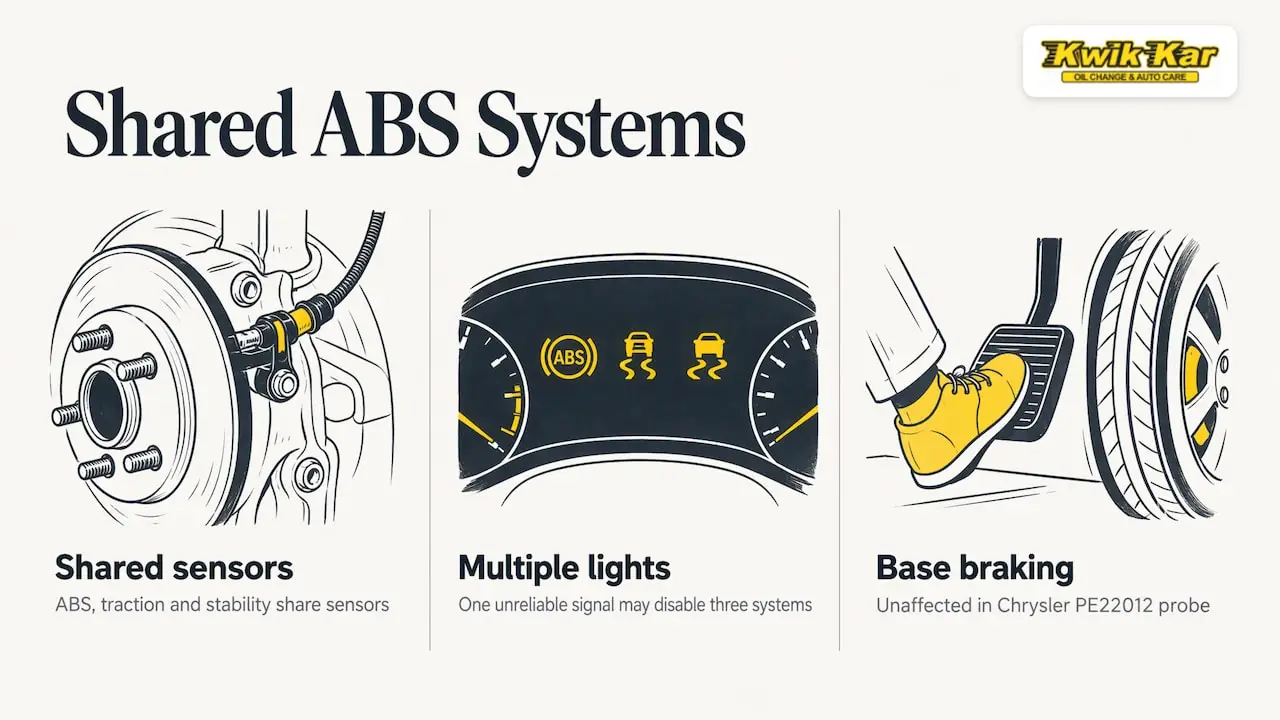
On many vehicles, ABS, traction control and stability control share the same wheel speed sensors and control module. When a wheel speed signal is unreliable, the module may turn off the ABS function along with the associated traction and stability systems. So seeing several lights together is common and often points back to one root cause.
A Chrysler-family truck investigation shows how this works in the real world. In NHTSA’s PE22012 probe, a supplier told the automaker that if an ABS pump motor has a problem, ABS, stability control and traction control would be disabled, but base braking would not be affected. That is a model-specific finding, not a rule for every car, but it matches the general behavior: the extra safety systems go off first.
Other symptoms that can show up with an ABS fault include a speedometer or odometer that stops working and changed steering effort on some models, per one manufacturer’s manual. Mention these when you book.
What to do when the ABS light comes on
- Note the other lights. Red brake light, parking brake light, traction or stability lights.
- Check the parking brake is fully released.
- Look at the brake fluid level if you know how to find the reservoir. Don’t keep adding fluid if it keeps dropping, since that suggests a leak or worn pads.
- Test the pedal feel gently at low speed in a safe place. A soft or sinking pedal means stop driving.
- Drive cautiously with extra following distance until the visit.
- Schedule a diagnosis. Our diagnostics service is the right starting point.
If you also have a brake light that doesn’t behave, our page on brake light switch symptoms can help you tell the difference.
ABS diagnosis at Kwik Kar of Celina
If your ABS light is on, we can scan the system, inspect sensors, wiring, bearings and brakes, and explain the results with a Digital Vehicle Inspection. We offer after-hours drop-off and a complimentary ride service, so a busy week doesn’t have to delay a brake safety issue. Repairs carry our 2-year/24,000-mile warranty.

We also work on European vehicles and business fleets. See our European repair and fleet services pages, or browse all auto repair services in Celina, TX. Wondering what the ASE badge means? Read about what an ASE certified mechanic is.
Does the ABS light affect a Texas inspection?
Texas changed its rules recently. As of January 1, 2025, most noncommercial vehicles no longer need an annual safety inspection before registration, under House Bill 3297. Qualifying vehicles in emissions counties, including Collin County, still require emissions testing, which is a separate program from the safety inspection. Commercial vehicle inspection rules differ from noncommercial rules, so fleet managers should confirm what applies to their vehicles on the official DPS site.
Even without a yearly safety inspection, a lit ABS light is still a safety issue worth fixing. Fleet drivers can pair this with a fleet maintenance checklist so warning lights are caught early.
FAQ
Can I drive with the ABS light on?
Usually yes, for a short time and with care, because the standard brakes still work. Slow down, increase your following distance and avoid hard braking on wet roads. If the red brake light is also on or the pedal feels soft, don’t drive the vehicle until it’s inspected.
Can low brake fluid turn on the ABS light?
Yes. Low brake fluid is one of the commonly listed causes. Fluid usually drops because pads are wearing or because there is a leak, so the level should be checked along with the brakes themselves rather than simply topped off.
Can a bad wheel bearing cause an ABS light?
Yes. A loose or damaged wheel bearing or hub can change the sensor’s reading and trigger the light. A humming or growling noise that changes with speed is a common clue, and it’s worth mentioning during your visit.
Will clearing the code fix the problem?
No. Clearing a code turns the light off temporarily, but if the fault is still there, the light returns. Diagnosis finds the cause, and the repair removes it.
Is the ABS light the same as the brake light?
No. The ABS light is about the anti-lock system. The red brake light can indicate low fluid, a released-parking-brake issue or a hydraulic problem. Seeing both together calls for more caution.
If your ABS light is on and you’d like a clear answer, you’re welcome to contact Kwik Kar of Celina or schedule a visit at kwikkarcelina.com. We’ll look at the system and tell you what we find.
Sources
- When The ABS Light Turns On, How Long Is It Safe To Keep Driving (Jalopnik via Yahoo Autos)
- Why Is My ABS Light On? (AutoZone)
- Warning and Indicator Lights (Hyundai 2026 owner’s manual)
- Making sense of your sensors: ABS sensor (Delphi Auto Parts)
- Check and change ABS and wheel speed sensors (HELLA)
- Anti-Lock Brake System (ABS) Sensor (NAPA Auto Parts)
- 6 Symptoms of a Faulty ABS Sensor and Diagnosis (A-Premium)
- Wheel speed sensor (inductive) test guide (Pico Technology)
- Symptoms of a Bad ABS Module (The Car Buzz)
- ABS module diagnostics: how modern brake control works (Tomorrow’s Technician)
- Study: Nearly Half of US Drivers Drive With Warning Light On (Kelley Blue Book)
- Loss of Brake Performance, NHTSA Investigation PE22012
- Vehicle Safety Inspection Program Changes Now in Effect (Texas DPS)
- Understanding Car Fault Codes: Permanent, Stored, Historic