



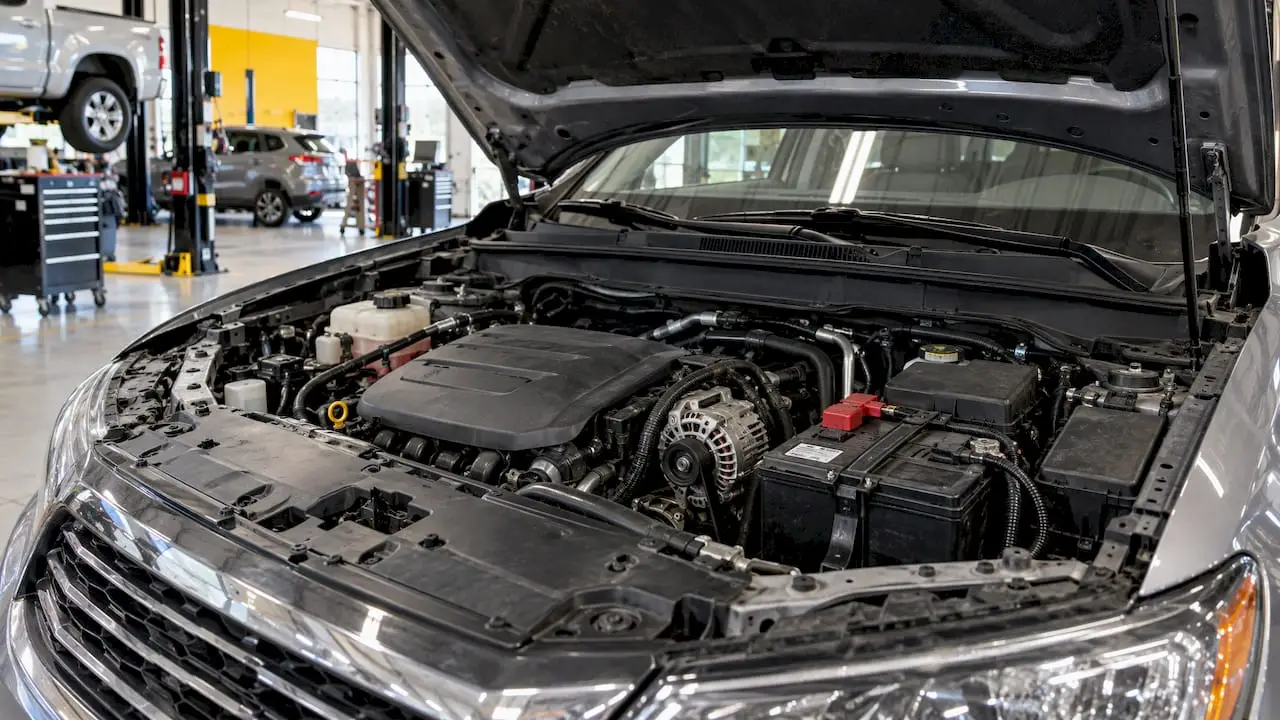
A bad battery usually shows up when you try to start the car: slow cranking, clicking or no start. A bad alternator usually shows up while you drive: a battery warning light, dimming or flickering lights, accessories acting up, and a car that dies again soon after a jump or a new battery. Many faults sit between the two, so the only reliable answer comes from testing the whole charging system. At Kwik Kar of Celina, we run that testing through our Diagnostics service, so you replace the part that actually failed.
TL;DR
- Battery trouble shows at startup: slow crank, clicking, or a car that runs normally once jump-started and stays running.
- Alternator trouble shows while driving: a battery or charging light, lights that dim or brighten with engine speed, and a car that stalls soon after a jump.
- A voltage reading alone does not settle it. Loose connections, a worn belt or a wiring fault can look like a failed alternator.
- A battery that keeps dying can also be a parasitic draw (something pulling power while the car is off) or a pattern of short trips.
- A warning light that stays on is not a “drive it until it quits” situation. Plan a charging-system check the same day.
Table of Contents
- What does each part do?
- How do I tell a bad battery from a bad alternator?
- Can a jump-start tell me which part failed?
- What do voltage readings tell you?
- What else can mimic a bad alternator?
- Why does my car battery keep dying?
- Other car electrical problems and what they point to
- When is it unsafe to keep driving?
- What does it cost to fix?
- What we see as the better way to sort this out
- Get the charging system checked in Celina, TX
- Does this affect your Texas inspection?
- FAQ
- Sources
What does each part do?
The battery and the alternator share one job: keeping your car’s electrical system alive. They do it at different times.
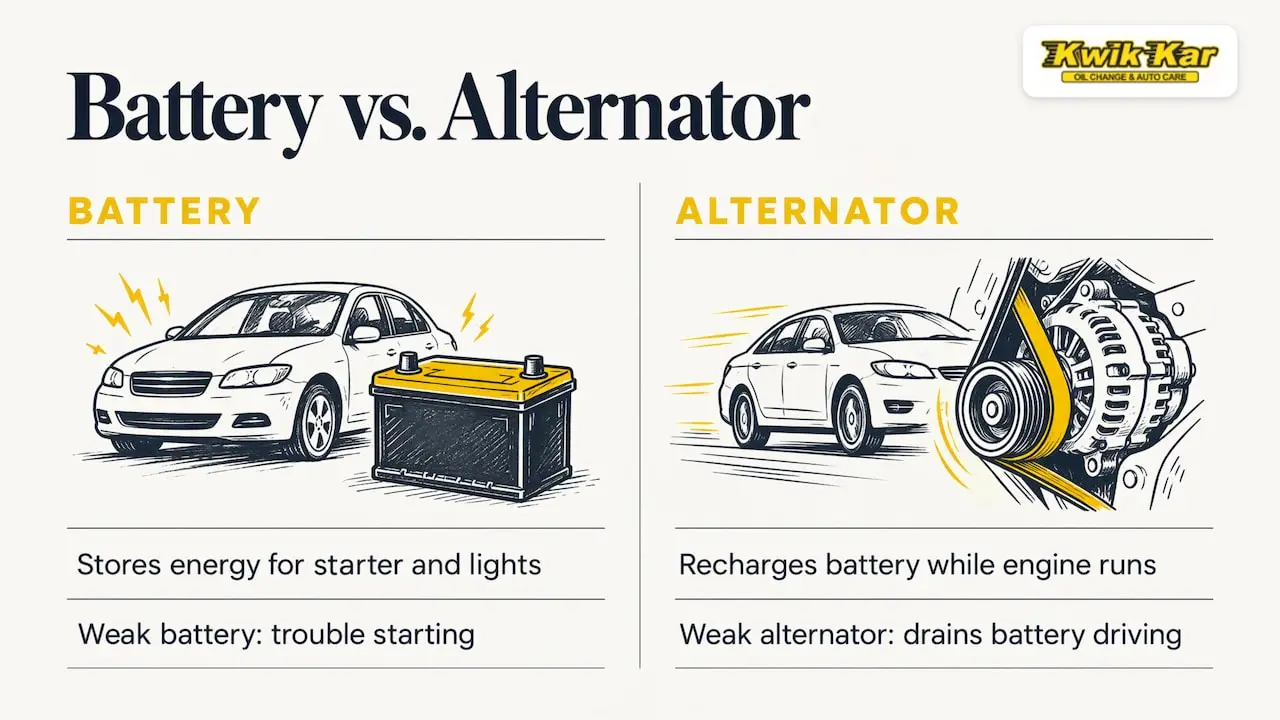
The battery stores energy. It powers the starter motor, the ignition and the lights while the engine is off or cranking.
The alternator is a generator driven by the engine through a belt. Once the engine is running, it powers the electrical system and recharges the battery.
That split is the key to diagnosis. If the battery is weak, the car struggles to start. If the alternator is weak, the car starts on stored power, then slowly drains the battery as you drive. Eventually, you get a dead battery that looks like the original problem.
How do I tell a bad battery from a bad alternator?
Start with when the symptom appears. The table below is a first sorting tool, not a verdict.
| What you notice | Points more toward | Why |
|---|---|---|
| Slow, labored cranking | Battery | Not enough stored power to turn the starter |
| Rapid clicking, no start | Battery (or a starter or connection problem) | Starter is not getting enough current |
| Car runs fine after a jump and keeps running | Battery | The alternator is charging, the battery just can’t hold it |
| Car starts after a jump, then stalls soon | Alternator | Nothing is replacing the power being used |
| Battery or charging light on while driving | Alternator or charging system | The system is reporting low or abnormal charging voltage |
| Headlights dim or brighten with engine speed | Alternator | Output is inconsistent |
| Power windows slow, radio or gauges flicker | Alternator | Electrical systems are short of steady power |
| Whining or grinding from the engine bay, or a burning smell | Alternator or belt | Failing internal parts or a slipping belt |
| New battery dies again within days or weeks | Alternator, a draw, or a connection | The new battery is not being charged properly or is being drained |
If you want the symptoms for one part in more depth, our guides to alternator failure symptoms and common car battery issues cover each.
Signs the battery is the problem
Batteries wear out gradually. Heat, short trips and age all take a toll, and Texas summers are hard on them. Watch for:
- Cranking that sounds slower than it used to
- Clicking when you turn the key or press the start button
- A swollen or cracked battery case
- Corrosion (white or blue-green crust) around the terminals
- A battery that has been in the car for several years
A swollen or leaking case is a stop-driving sign. Do not keep using a battery in that condition. Have it replaced.
Signs the alternator is the problem
An alternator fails while the engine is running, so the clues show up on the road:
- The battery or charging warning light comes on or flickers
- Headlights and dash lights dim, brighten or pulse
- Electrical features fail one after another
- A whining or grinding noise, or a hot or burning smell
- A car that starts with a jump but won’t stay running
Our page on the battery light coming on while driving explains how much time you may have once that light appears.
Can a jump-start tell me which part failed?
Often, yes. It is the most useful no-tools clue.
If the car starts with a jump and keeps running normally, the alternator is probably charging and the battery is probably the weak link. If the car starts and then dies shortly after the cables come off, the alternator may not be producing enough power.
Two cautions apply:
- Never disconnect the battery while the engine is running to see whether the car stays on. In a column on this exact test, Car Talk’s Tom and Ray Magliozzi warned it can damage the voltage regulator and possibly the alternator and other electronics.
- A jump-start is a clue, not a diagnosis. A battery can be weak and the alternator can be undercharging it. Each fault can hide the other.
What do voltage readings tell you?
A digital multimeter measures battery voltage, and many drivers use one for a first look. The commonly cited pattern is that a healthy, rested 12-volt battery reads roughly 12.6 volts with the engine off, and a working alternator pushes the reading higher with the engine running, typically somewhere in the 13 to 15 volt range.
Those numbers have limits, and they are why we prefer a full test over a single reading:
- Normal charging voltage varies by vehicle. According to Underhood Service, some vehicles run as high as 15 volts while others run as low as 13.
- Battery-level voltage with the engine running does not prove the alternator is dead. It shows only that it isn’t charging. The same source notes that many supposed alternator failures turn out to be a bad connection or a wiring harness problem.
- A decent resting voltage does not prove a healthy battery. A battery can look fine at rest and still fail when the starter pulls heavy current. That takes a load test.
Our guide on 13.5 to 14.5 volt checks for alternator failure symptoms walks through what those running readings can and cannot tell you.
What else can mimic a bad alternator?
Before anyone replaces an alternator, the rest of the charging path needs a look. These parts can produce the same symptoms:
- The drive belt. A worn, glazed or loose belt can slip and keep the alternator from spinning at full speed.
- The belt tensioner. A weak tensioner lets the belt slacken.
- Corroded or loose battery cables and terminals. Power cannot flow well through a dirty or loose connection.
- Ground straps and wiring. A bad ground or damaged harness can cause low charging or flickering lights.
- An aging battery. A weak battery can overload a healthy alternator and make it look like the culprit.
This is why parts swapping is expensive. Replace the battery when the alternator is the real fault and the new battery will be drained too. Replace the alternator when the real fault is a corroded cable and you have paid for a part you did not need. Our OBD-II diagnostic test guide explains how testing helps drivers avoid that outcome.
A note on trouble codes: if the check engine light is on, a scan tool can retrieve a code. A code points to a circuit or system that needs investigation. It is not proof that a specific part has failed.
Why does my car battery keep dying?
If you have already replaced the battery and it still goes flat, the battery was probably not the root problem. The usual suspects:
A charging problem
A weak alternator, slipping belt or poor connection means the battery never gets fully recharged while you drive.
Short, infrequent trips
Starting an engine takes a lot of power, and a short drive may not put it all back. A 2025 NHTSA-hosted service information bulletin lists repeated short trips among the causes of recurring dead batteries. If your commute is a few minutes each way, this can be part of the story.
A parasitic draw
A parasitic draw is a component pulling power after the car is shut off. The same bulletin lists aftermarket devices such as alarms, remote starters, dash cameras and GPS trackers as common sources. It describes a normal draw as typically under 70 milliamps and isolates a faulty circuit by pulling fuses one at a time with a meter connected in series.
That is a procedure for a technician with the right equipment. The practical takeaway for you: if you’ve added electronics to your vehicle, mention them when you bring the car in. It speeds up the search.
An old battery
Batteries have a limited life, and heat shortens it. A battery that is several years old and slow to crank is a reasonable suspect, but still worth confirming with a test, especially if it has died more than once.
Other car electrical problems and what they point to
If you landed here searching for general electrical symptoms, here is how the common ones map out:
- Dim interior or headlights: battery, alternator or a poor connection
- Rapid clicking when you start: low battery, bad connection or starter issue (see our Electrical & Starter service)
- Flickering gauges or random warning lights: charging system or a wiring fault
- Burning smell: a slipping belt, overheating alternator or wiring. Stop and have it checked.
- Hard starting only when hot: this has its own set of causes, covered in our hard starting when hot guide
- Misfire or rough running: may involve ignition parts. Our ignition coil failure symptoms page covers that side.
Moisture can also cause intermittent trouble. We cover it in common electrical problems after winter moisture.
When is it unsafe to keep driving?
A charging fault will eventually leave you without enough power to run the engine. In modern cars, that can mean losing power steering assist, lighting and ignition, sometimes with little warning.
Get the car checked the same day if the battery light stays on. Stop driving and arrange help if you notice:
- A burning smell or smoke
- A swollen or leaking battery case
- An overheating engine
- A red oil pressure light
- A soft or sinking brake pedal or a red brake warning light
- A flashing check engine light with heavy shaking
If the car dies in traffic, turn on your hazard lights, steer to a safe place and call roadside help or 911 if you are in danger.
What does it cost to fix?
Prices vary by vehicle, battery type and labor, so treat national figures as ballparks.
- Alternator replacement: Kelley Blue Book puts the average at $747 to $842.
- Battery replacement: a 2025 repair-trends report from Endurance cites $409 to $443 for a battery replacement, and the same report puts alternator replacement at $744 to $1,034.
We do not publish set prices for these jobs, because the right repair depends on what testing shows. A cable end or belt can be a far smaller fix than a new alternator, and finding that out before buying parts is where a proper diagnosis pays for itself.
What we see as the better way to sort this out
Our view at Kwik Kar of Celina
Most drivers who ask “battery or alternator?” are really asking, “what do I replace so this stops happening?” The honest answer is that the symptoms get you to a short list, and testing gets you to the answer.
That is why we start with a diagnosis rather than a part. Our ASE-certified technicians check the charging system as a whole, and our Digital Vehicle Inspections let you see what we see, so a recommendation is something you can understand rather than something you have to take on faith.
If it turns out to be a repair, it is backed by our 2-year/24,000-mile warranty. And if you can’t wait around, after-hours drop-off and our complimentary ride service are there so a dead battery does not have to wreck your day.
Kwik Kar
Get the charging system checked in Celina, TX
If your car is slow to start, lights are dimming or the battery light has come on, bring it to Kwik Kar of Celina. Our Electrical & Starter repair service covers batteries, charging systems and starters, and you can see everything we offer on our services page.

If you drive a European car, our European Repair team handles these vehicles too. For business vehicles, we also offer fleet services.
Does this affect your Texas inspection?
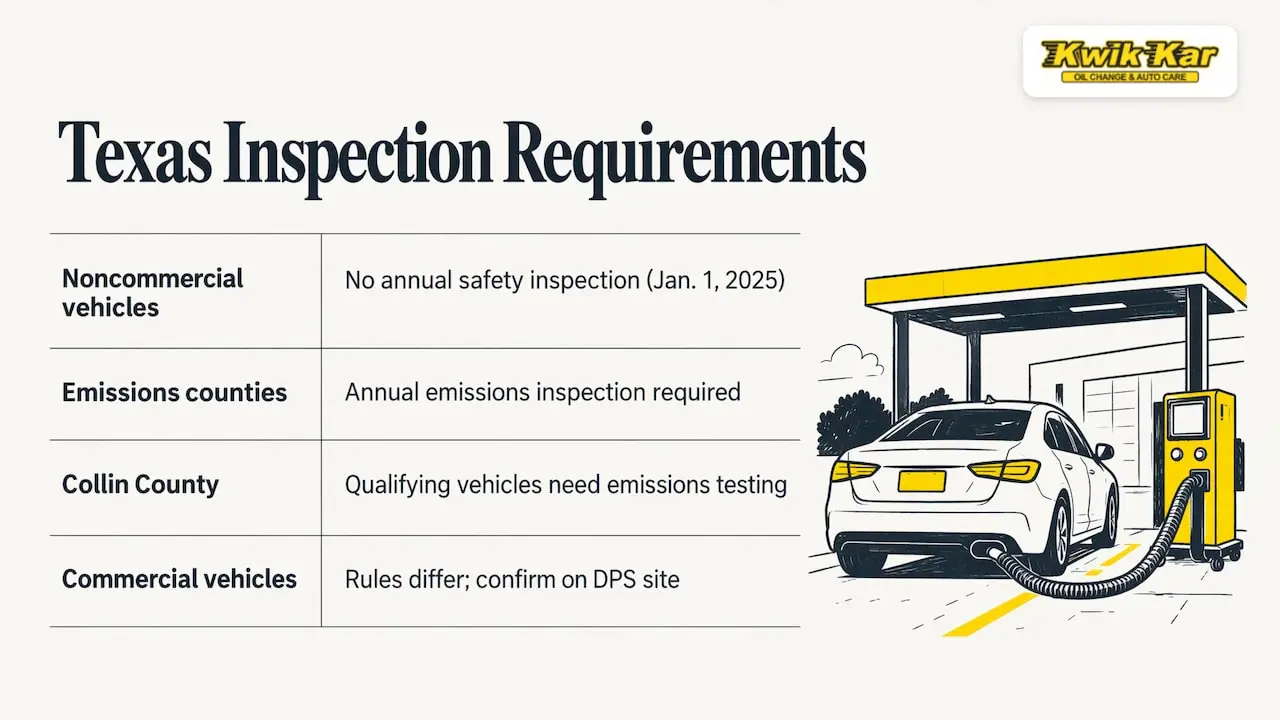
Electrical trouble sometimes comes up around inspection time, so here is where Texas stands. According to the Texas Department of Public Safety, as of January 1, 2025, most non-commercial vehicles in Texas no longer require an annual safety inspection. Vehicles registered in an emissions county still need an annual emissions inspection, and Collin County drivers continue to need emissions testing for qualifying vehicles.
Commercial vehicle inspection rules differ from the non-commercial rules. If you manage a fleet, confirm what applies to each vehicle on the DPS site.
A charging fault can also trigger warning lights, which is one more reason to sort it out before you head to an emissions test.
FAQ
Can a bad battery make the alternator look bad?
Yes. A failing battery can cause dim lights, slow cranking and electrical glitches that look like alternator problems. A weak battery can also force the alternator to work harder, which is why both parts should be tested together.
Can I drive with a bad alternator?
Only briefly, and it is a gamble. The car runs on battery power until it is depleted, then it can stall, sometimes with little warning. If the battery light is on, get the car checked the same day. If you smell burning, stop driving.
Can a new battery fix a car that keeps dying?
Not if the cause is elsewhere. A bad alternator, loose connection, parasitic draw or lots of short trips can drain a new battery as well. That is why a car that keeps dying should have its charging system and battery drain checked, not just the battery replaced.
How can I test the alternator without replacing it?
A technician checks charging output, the battery’s condition under load, the belt and tensioner, and the cables and connections. Voltage with a meter is a good first clue, but it does not replace a full test. You can schedule one with us at Kwik Kar of Celina.
Sources
- Texas Department of Public Safety: Inspection Items for the Annual Inspection
- Local Profile: What To Know About 2025 Texas Vehicle Safety Inspections In Collin County
- NHTSA-hosted service information bulletin, 2025
- Underhood Service: Modern Battery and Alternator Testing Methods
- Car Talk: Best way to safely test an alternator
- Kelley Blue Book: Alternator Replacement Costs
- Endurance Warranty: Top 5 Vehicle Repair Trends of 2025