



The most common mass air flow (MAF) sensor symptoms are a rough idle or stalling, weak acceleration, poor fuel economy, black exhaust smoke, hard starting and a lit check engine light. These signs overlap with several other engine problems, so they point toward the sensor without proving it is the culprit. At Kwik Kar of Celina, we see drivers in Celina, TX replace parts on a hunch and then still have the same problem. This guide helps you read the signs, understand what the sensor does, and decide what to do next.
TL;DR
- A failing or dirty MAF sensor most often shows up as rough idle, stalling, hesitation, poor gas mileage, black smoke from the tailpipe, hard starting or a check engine light.
- Many of these symptoms also come from fuel, ignition, vacuum and oxygen sensor problems, so the symptoms alone cannot confirm a bad sensor.
- A trouble code such as P0101, P0102 or P0103 tells a technician where to start looking. It is not proof that the sensor needs replacing.
- Driving for long periods with the problem can raise fuel use and, over time, stress engine and exhaust parts.
- A proper diagnosis compares live sensor data with the manufacturer’s specifications and checks the air intake, wiring and air filter first.
Table of Contents
- What does a mass air flow sensor do?
- What are the symptoms of a bad mass air flow sensor?
- What are the signs of a dirty MAF sensor?
- Can another problem look like a bad MAF sensor?
- Do MAF trouble codes mean the sensor is bad?
- How do mechanics diagnose a MAF sensor problem?
- Can you keep driving with a bad MAF sensor?
- Can you clean or reset a MAF sensor yourself?
- Where is the MAF sensor located?
- What can prevent MAF sensor trouble?
- Where does Texas inspection and emissions fit in?
- Perspective: why we diagnose before we replace
- Need help with a check engine light or rough running in Celina?
- FAQ
- Sources
What does a mass air flow sensor do?
The MAF sensor sits in the intake tube between the air filter and the throttle body. It measures how much air is entering the engine and reports that number to the engine computer. The computer uses it to decide how much fuel to inject, so the air and fuel arrive in the right balance.
When the reading is accurate, the engine idles smoothly, responds to the gas pedal and burns fuel efficiently. When the reading is off, the computer adds too much or too little fuel. That is why one small sensor can affect so many things you notice from the driver’s seat.
What are the symptoms of a bad mass air flow sensor?
A technical guide from parts maker WAI Global lists the typical signs as rough idle or stalling, poor acceleration, black exhaust smoke, poor fuel economy, hard or no starts, and a Check Engine Light with codes such as P0101, P0102 and P0103. Here is what each one tends to feel like in everyday driving.
Rough idle or stalling
The engine shakes at a stoplight, the RPM needle bounces, or the engine quits when you come to a stop. If the computer is working from a wrong airflow number, the fuel mixture at idle drifts and the engine cannot hold steady. Our guide to rough idle causes walks through the other things that can produce the same shake.
Hesitation and weak acceleration
You press the pedal to merge onto US-380 or the Dallas North Tollway and the car stumbles, surges or feels flat before it picks up. The engine needs a quick jump in fuel when airflow jumps. A sensor that reads low, slow or erratically gives the computer the wrong cue at exactly that moment.
Poor fuel economy
If the sensor underreports airflow, the computer may not trim fuel correctly, and you may notice more frequent fill-ups with no change in how you drive. Mileage drops are easy to miss, so track a few tanks before you decide anything.
Black smoke from the exhaust
Black smoke usually means the engine is burning more fuel than it can use. A sensor that tells the computer there is less air than there really is can push the mixture rich. It may also come with a fuel smell.
Hard starting or no start
A sensor that is badly out of range can make the engine crank longer than it should, or start and die right away. Hard starting has plenty of other causes, including heat-related ones, so see our article on hard starting when hot before assuming the MAF sensor is to blame.
A check engine light
The light is often the first and only sign. A MAF-related code means the computer saw an airflow reading that did not fit what the engine was doing. It tells us where to look, not what has failed.
What are the signs of a dirty MAF sensor?
A dirty sensor and a failed sensor feel almost the same to the driver. The sensing element is a tiny heated wire or film that sits in the airflow. Dust, oil vapor or fine debris that gets past the air filter can coat it and change how it reads. Typical signs of a contaminated sensor include a rough idle, hesitation under load, black smoke and lower mileage.
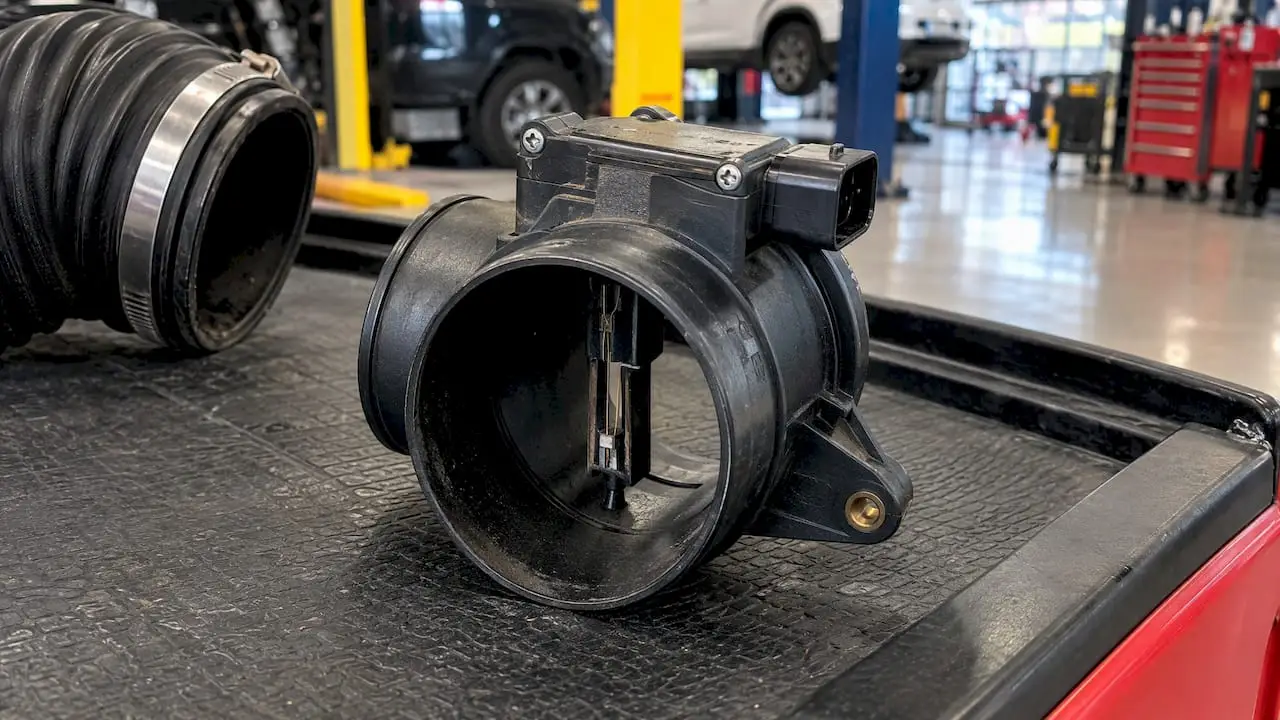
One detail makes this hard to diagnose. The trade magazine MOTOR points out that a contaminated airflow sensor can read too high in one operating range and too low in another. That means a simple “high airflow equals this symptom” chart will not reliably match what the car is doing, and it is a good reason to rely on measured data instead of guesswork.
Common reasons a sensor gets dirty include:
- An air filter that is clogged, wet with oil or poorly seated
- Skipped air filter replacements
- Oil-soaked filters or excess crankcase vapor reaching the intake
- Damaged intake tubing that lets unfiltered air in
- Dusty roads and construction around growing Collin County neighborhoods
That last one is local common sense rather than a statistic, but it explains why air filter checks matter for drivers who see a lot of dust.
Can another problem look like a bad MAF sensor?
Yes, and this is the part most quick-fix articles skip. MOTOR notes that MAF faults are hard to separate from other problems by driving impressions alone, and that similar symptoms can come from fuel pump, injector, purge system, oxygen sensor, ignition or knock sensor faults.
Here is how some common look-alikes compare.
| Symptom | MAF sensor could be involved | Other possible causes |
|---|---|---|
| Rough idle | Wrong airflow reading skews the fuel mixture | Worn spark plugs, failing coils, vacuum leak, dirty throttle body |
| Hesitation | Slow or erratic airflow signal | Weak fuel delivery, clogged injectors, ignition misfire |
| Poor fuel economy | Mixture drifts rich | Oxygen sensor problems, low tire pressure, dragging brakes |
| Black smoke | Mixture too rich | Leaking injector, fuel pressure issue |
| Hard starting | Reading far out of range | Weak battery, starter or fuel pump trouble |
| Check engine light | Airflow code stored | Hundreds of unrelated codes |
Two of these deserve a closer look because they come up often in our shop conversations:
- Ignition problems. A misfiring cylinder can feel just like a bad sensor. Our article on ignition coil failure symptoms explains how to tell the difference between a steady stumble and a random one.
- Oxygen sensors. These monitor the exhaust and help the computer fine-tune fuel. A weak one can cause the same mileage loss and rough running. We cover it in oxygen sensor failure and OBD II live data.
A leaking crankcase ventilation valve can also upset airflow and idle. If that sounds possible, read about PCV valve symptoms.
Do MAF trouble codes mean the sensor is bad?
Not by themselves. Codes like P0101, P0102 and P0103 relate to the MAF circuit and its readings. P0102, for example, means the computer sees a low signal from the sensor circuit. That signal can come from the sensor, but also from a damaged connector, a wiring fault or an air leak after the sensor.
We treat every code as a starting point. The same approach applies to other codes, as in our piece on diagnosing P0420 before replacing parts. Swapping a part because a code mentions it is how drivers end up paying twice.
How do mechanics diagnose a MAF sensor problem?
A sound diagnosis moves from cheap and simple checks to measured data. The order below follows the guidance in the WAI technical guide.
- Scan for codes and note freeze-frame data. This shows what the engine was doing when the computer logged the problem.
- Inspect the connector and wiring. Corrosion, bent pins, rubbed insulation and loose plugs can all mimic a failed sensor.
- Check the air intake. Cracked tubing, loose clamps or a poorly fitted air box let unmetered air in, which confuses the computer.
- Inspect the air filter. A clogged or oil-soaked filter is a warning sign, and it can contaminate the sensor.
- Read live data. The technician watches the sensor’s airflow reading as the engine idles and revs, then compares it with the manufacturer’s specification for your engine.
- Rule out the look-alikes. Fuel trims, ignition and oxygen sensor data help show whether the airflow reading really is the problem.
On live data, WAI gives general reference ranges that depend on engine size: roughly 2 to 7 grams per second at idle and 15 to 25 grams per second at 2,500 rpm. It also warns that readings that are irregular or flat suggest failure. Those figures are rough guides. The right numbers for your vehicle come from its own service information, which is why we compare against specifications rather than a generic chart.
This is the kind of work our diagnostics service is built around, and our article on an OBD-II diagnostic test explains what happens when you bring a car in with a warning light.
Can you keep driving with a bad MAF sensor?
You may be able to drive a short distance, but we would not make a habit of it. Edmunds’ code reference says driving with a P0102 code is not recommended, because a faulty sensor can reduce performance, cause rough idling and raise fuel consumption, and long-term driving can damage engine and exhaust components.
Practical guidance:
- Steady check engine light, car drives normally: schedule diagnosis soon, and avoid long trips and towing in the meantime.
- Flashing check engine light: a flashing light generally signals a misfire that can harm the exhaust system. Reduce speed and get the vehicle checked promptly.
- Stalling in traffic, loss of power or very rough running: this is a safety issue because the car may quit at a bad moment. Have it looked at before driving it more.
- Black smoke or a strong fuel smell: stop driving it much and have it inspected.
Can you clean or reset a MAF sensor yourself?
Drivers often ask whether cleaning is enough. Sometimes a contaminated sensor does improve after proper cleaning, but the sensing element is delicate and easily damaged, and cleaning does nothing if the real problem is a vacuum leak, a dirty filter feeding it dust, or a misfire.
The same goes for “resetting.” Clearing a code or disconnecting the battery may turn off the light for a while, but if the cause is still there, the light and the symptoms come back. It also erases the stored data a technician would use. Because the cause is the question, we suggest having the car scanned before clearing anything.
If a sensor does get replaced and the car still runs poorly, that is a sign something else is involved, such as an air leak, a wiring fault or one of the look-alike problems above. Follow-up diagnosis is the right next step, not another part.
Where is the MAF sensor located?
In most vehicles it is mounted in the intake duct right after the air filter box, before the throttle body, with an electrical plug on it. Placement and design vary by make, model and engine, and some vehicles use different airflow measurement methods. For the exact spot on your vehicle, check the owner’s manual or ask us.
What can prevent MAF sensor trouble?
Most prevention comes down to keeping clean air flowing in.
- Replace the engine air filter according to your owner’s manual, and sooner if you drive on dusty roads.
- Make sure the air box is closed and sealed after any service.
- Do not oil or modify air filters unless the manufacturer allows it.
- Stay current on oil changes, since engine health affects crankcase vapor and overall running quality.
- Look into any new rough running early, before it turns into a bigger repair.
For European vehicles, which often have sensitive airflow systems and specific service requirements, our European repair team handles diagnosis and service.
Where does Texas inspection and emissions fit in?
A MAF problem can affect how a car runs and what it emits, so it is worth knowing the current rules.
- Most noncommercial vehicles in Texas no longer require annual safety inspections as of January 1, 2025, according to the Texas Department of Public Safety. A $7.50 inspection program replacement fee is paid at registration.
- Qualifying vehicles in Collin County still require emissions testing. The DPS explains that emissions tests are separate from safety inspections and still apply in emissions counties.
- Commercial vehicle inspection rules differ from noncommercial rules, so fleet managers should confirm what applies to each vehicle.
A check engine light can affect an emissions test result, so fixing the cause before your test saves a second trip. Our TX state inspection services page lists what we offer.
Perspective: why we diagnose before we replace
We have seen it many times: a car comes in with a rough idle and a code, and a part has already been replaced. The code pointed at the right area, but not at the real cause.
That is why we lean on data. Our ASE-certified technicians combine hands-on experience with modern tools, including Digital Vehicle Inspections that let you see what we see. When the airflow reading is the problem, we want to show you that. When it is not, we want to tell you before you spend money.
Honest recommendations and clear communication matter most with a symptom this easy to misread. We back our repair work with a 2-year/24,000-mile warranty, and we would rather take the extra step of confirming the cause than guess.
Kwik Kar
Need help with a check engine light or rough running in Celina?
If your car idles rough, hesitates or has a check engine light on, Kwik Kar of Celina can scan it, check the intake and wiring, and read live data to find out what is going on. We offer after-hours drop-off and a complimentary ride service, so the diagnosis fits around your workday. You can see everything we do on our services page, and our Digital Vehicle Inspection explains how we share what we find.

We also work on fleet vehicles, so business owners with several units can ask about keeping them on the road.
FAQ
What happens if you ignore a bad MAF sensor?
The engine can keep running with the wrong fuel mixture, which may mean worse mileage, rough idle and weaker power. Over time, a mixture that is too rich or too lean can stress engine and exhaust components. It is better to have the cause found early.
Can a dirty air filter damage a MAF sensor?
A clogged or oil-soaked filter can affect airflow readings, and a poorly fitted filter can let dust reach the sensor. WAI recommends inspecting the filter for clogging or oil as part of troubleshooting. Replacing filters on schedule is simple protection.
Why does my car run worse after a new MAF sensor?
Usually because the sensor was not the original problem, or something else is affecting airflow. Common culprits include an air leak in the intake, a loose connector, a vacuum leak or a misfire. Bring it in for diagnosis so the cause is measured rather than guessed.
Will the check engine light come on for a MAF sensor problem?
Often, but not always right away. Mild contamination can cause drivability complaints before a code is stored. If the car feels off and the light is not on, a scan and a look at live data can still reveal a problem.
Sources
- WAI Global: Mass Air Flow Sensor Troubleshooting tech tip
- MOTOR magazine: Diagnosis (July 2006)
- Edmunds: P0102 Mass Air Flow (MAF) Sensor Circuit Low Input
- Texas Department of Public Safety: Vehicle Safety Inspection Program Changes Now in Effect