



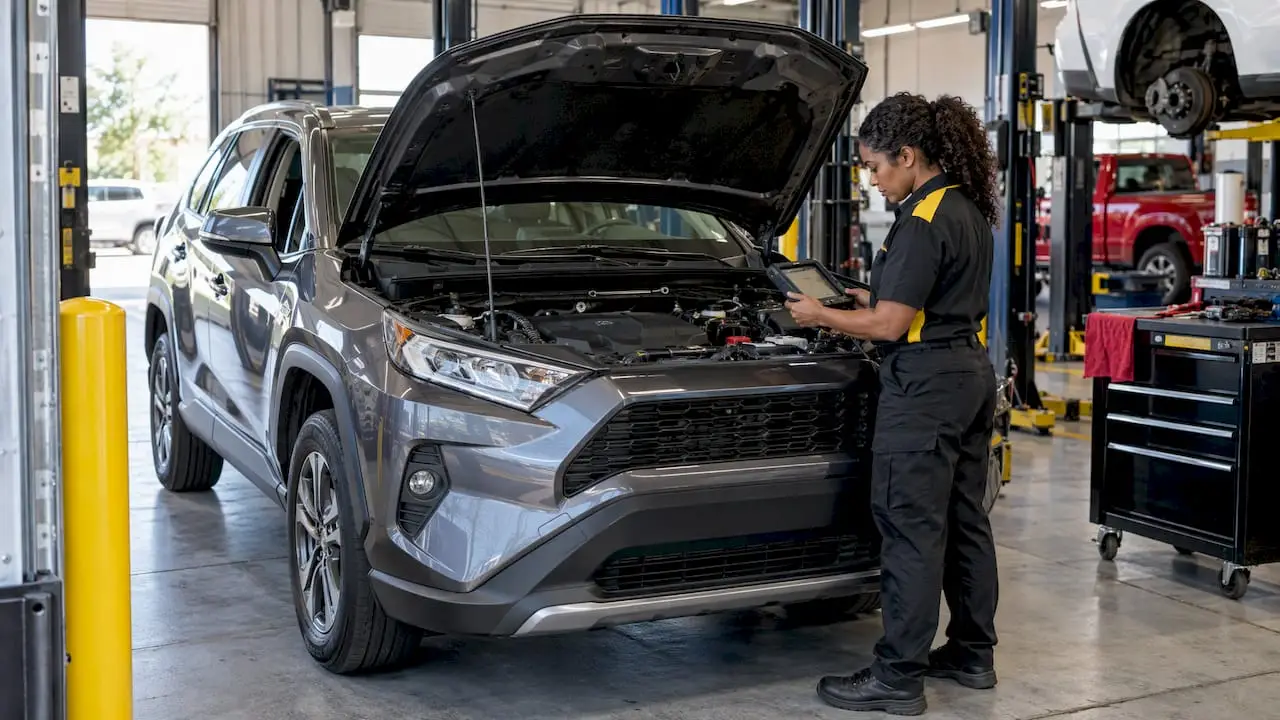
When your car loses power as you press the gas, the engine is not getting the right mix of air, fuel or spark, or the car’s computer has deliberately limited power to protect the engine. The cause can be as small as a dirty sensor or as serious as a failing fuel pump or a clogged exhaust. The fastest way to the right fix is a proper diagnosis. At Kwik Kar of Celina, TX, our ASE-certified technicians start with diagnostics and a Digital Vehicle Inspection, so you see what we see before any repair is approved.
TL;DR
- Power loss under acceleration usually traces to one of four areas: air intake, fuel delivery, ignition, or exhaust flow. Sensors and the throttle system can also trigger it.
- A blinking check engine light, low oil pressure, overheating, or a car that shakes and has almost no power means stop driving. Reduce speed, pull over safely and call for help.
- A trouble code points you toward a system. It does not prove a specific part is bad, so a code alone is not a reason to start replacing parts.
- Notice when it happens: from a stop, uphill, at highway speed, hot or cold. Those details help a technician narrow things down quickly.
- Kwik Kar of Celina offers diagnostics, European repair and a 2-year/24,000-mile warranty. Our drop-off and ride options are built for busy schedules.
Table of Contents
- Why Does a Car Lose Power When Accelerating?
- What Are the Most Common Causes?
- What Symptoms Help Point to the Cause?
- Can I Keep Driving If Engine Power Is Reduced?
- Why Trouble Codes Are Only the Starting Point
- What Does a Diagnosis at Kwik Kar of Celina Look Like?
- How Do Texas Inspection Rules Fit In?
- Fix It Before It Gets Expensive
- Our Perspective on Power Loss
- FAQ
- Sources
Why Does a Car Lose Power When Accelerating?
An engine makes power by burning a precise mix of air and fuel, lit by a spark at the right moment. Hard acceleration asks for the most of all three. Anything that is weak but still “good enough” at idle or cruising shows itself when you press the pedal.
A misfire is a good example. A misfire during acceleration often means the ignition or fuel system cannot keep up with the extra demand, with a weak ignition coil, worn spark plugs, low fuel pressure or a dirty injector as typical causes. The car felt fine at a stoplight, then stumbled when asked to do more.
There is a second path. Modern cars have a computer, usually called the powertrain control module (PCM), that watches dozens of sensors. When it sees something it does not trust, it can cut power on purpose. That is often called limp mode or reduced power mode. The cause may be a real fault or a sensor reading that no longer makes sense.
What Are the Most Common Causes?
Most cases fall into a handful of groups. Here is how each one tends to feel and what it involves.
Fuel delivery problems
The engine needs steady fuel pressure. A weak fuel pump, a clogged fuel filter or dirty injectors can deliver enough fuel to idle but not enough to accelerate. You may feel hesitation, surging, or a car that struggles on hills and on highway on-ramps.
Codes can point here too. P0087, for example, is a generic code for fuel rail pressure that is too low, and its symptoms are usually most noticeable during acceleration, highway driving or under load. Again, the code names a system, and a technician still has to find out why pressure is low.
Air intake and sensor problems
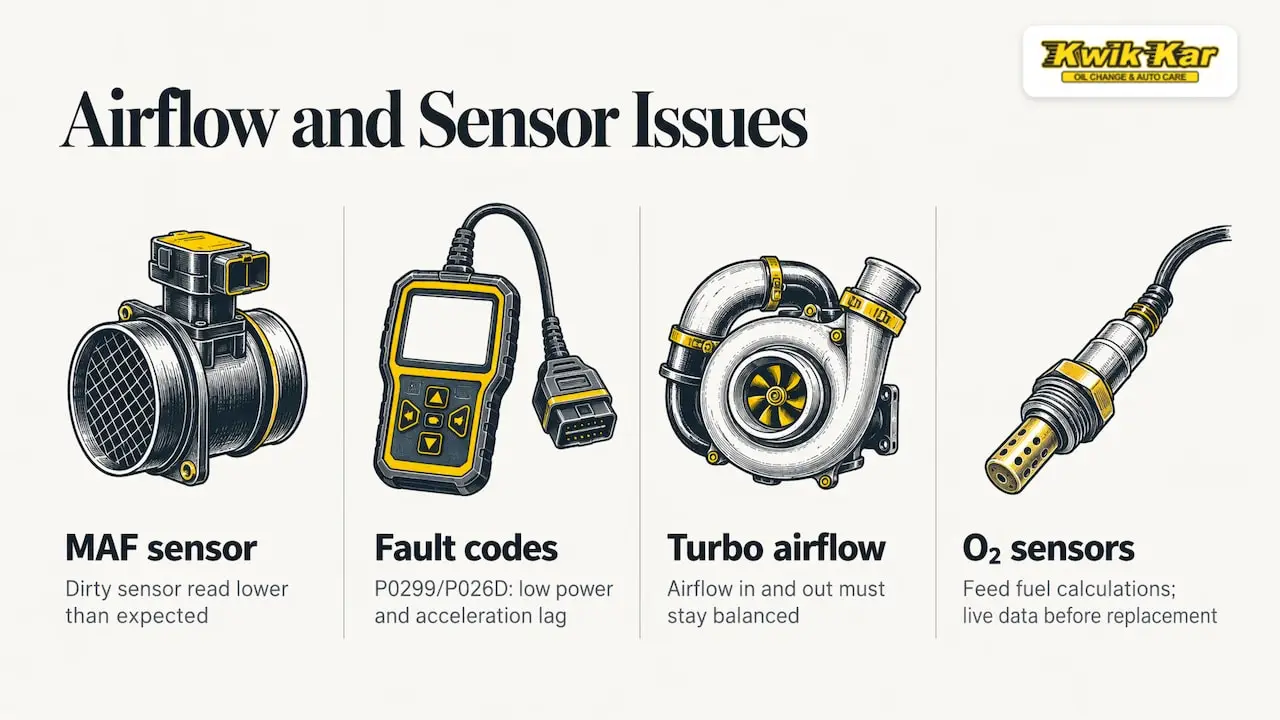
The engine measures incoming air with a mass air flow (MAF) sensor and tracks the gas pedal and throttle with other sensors. If a sensor reports the wrong number, the computer delivers the wrong amount of fuel.
A service bulletin from FCA (Chrysler, Dodge, Jeep and Ram) shows how subtle this can be. It describes perceived low power and acceleration lag with turbocharger underboost codes P0299 and P026D, traced to a dirty or contaminated MAF sensor reading lower than expected. The bulletin also warns that such a sensor cannot be cleaned without risking damage. That bulletin applies to specific FCA vehicles, so treat it as an example of how a small sensor can cause a big symptom, not as a rule for every car.
On turbocharged engines, air handling matters even more. If you drive one, turbo exhaust setup errors are one more reminder that airflow in and out of the engine has to stay balanced for the car to make its normal power. For a closer look at the sensor itself, see our guide to mass air flow sensor symptoms.
Oxygen sensors also feed the fuel calculation. Our page on oxygen sensor failure and live data checks explains why reading live data matters before anything gets replaced.
Ignition problems
Spark plugs wear, and ignition coils weaken with heat and age. Under light load they may still fire. Under hard acceleration the cylinder pressure rises, and a weak spark fails. The result is a stumble, a shake or a flashing check engine light. If your engine also runs rough at a stop, our article on rough idle causes covers the overlap.
Throttle and drive-by-wire faults
Most newer vehicles have no direct cable from pedal to throttle. Sensors read the pedal, and an electric motor moves the throttle blade. Ford’s technical guide explains that its system compares three pedal signals, and if one is not rational, the PCM stores a fault, keeps the vehicle moving with limited capability, lights a warning lamp, and may put the transmission in limp mode depending on severity. Other makes use similar logic with their own details.
Exhaust restrictions
An engine has to breathe out as well as in. A clogged catalytic converter or a crushed exhaust pipe creates back pressure, so the car feels strong at low throttle and then simply runs out of breath as speed builds. A misfire that goes unaddressed can make this worse, because unburned fuel can damage the converter.
Transmission and mechanical causes
If the engine revs but the car does not speed up, the problem may be in the transmission or clutch rather than the engine. A shudder in a specific speed range can also point to the torque converter, which we cover in our torque converter shudder article. Low compression from internal engine wear is a less common cause, and it needs hands-on testing to confirm. Our overview of engine repair explains what that work involves.
Model-specific known issues
Sometimes the cause is a documented defect in one model. Mazda’s 2015 bulletin describes some 2014 to 2015 Mazda3 2.0L vehicles losing power during hard acceleration near 6,000 rpm in cold weather, with misfire codes stored and the PCM entering fail-safe mode. The fix was a software update. Kia’s 2022 bulletin covers certain 2022 Carnival 3.5L vehicles with reduced power and air-fuel imbalance codes, repaired by replacing specific fuel system parts. These are narrow cases. They show why we check your exact vehicle rather than assume a cause from the symptom alone.
What Symptoms Help Point to the Cause?
You do not need to diagnose the problem yourself, but a few notes make our job faster. Write down what you notice and share it when you bring the car in.
| What you notice | What it may point toward |
|---|---|
| Hesitation or surge, worse on hills | Fuel delivery or ignition |
| Shaking plus a blinking check engine light | Active misfire |
| Strong at low speed, weak as speed builds | Exhaust restriction or airflow issue |
| Warning light and limited power, speed capped | Throttle or sensor fault, limp mode |
| Engine revs rise but the car barely speeds up | Transmission or clutch |
| Worse only in cold weather | Sensor, software or ignition issue, depending on the vehicle |
This table is a guide to questions, not a verdict. Several causes overlap, and the same symptom can come from different parts on different vehicles.
Helpful details to share:
- Does it happen from a stop, while passing, or only at highway speed?
- Is the engine hot or cold when it happens?
- Is the check engine light solid, blinking, or off?
- Did it start after a fill-up, a repair, or a stretch of stop-and-go driving?
- Do you notice any smell, smoke or unusual noise with it?
Cold-weather patterns are common enough that we have written about signs your engine is struggling in cold weather. Heat can cause a different set of problems, such as hard starting when hot.
Can I Keep Driving If Engine Power Is Reduced?
Sometimes, but only briefly and carefully, and it depends on the warning signs.
Consumer Reports explains that in late-model cars a blinking check engine light usually indicates a severe misfire that can quickly damage the catalytic converter. It advises reducing speed and engine load and having the car checked as soon as possible. It also notes that limp-home mode reduces power and may turn off some accessories, while steering and brakes still work. That can give you a chance to reach home or a nearby shop, or to call a tow truck.
Here is a simple way to sort it out.
Stop as soon as it is safe if:
- The check engine light is blinking and the car shakes or has almost no power
- The oil pressure warning comes on
- The temperature gauge climbs or you see steam
- You smell fuel or burning, or see smoke
- The engine stalls or the car will not respond to the pedal
Drive gently to a shop only if:
- The light is solid, not blinking
- The symptom is mild, such as occasional hesitation
- The engine is not overheating and no other warnings are showing
If you are on the road and the car loses power or you see steam, AAA advises pulling as far onto the shoulder as possible, turning on hazard lights, and waiting at least 20 minutes before opening the hood if you see steam, because pressurized coolant can cause severe burns. Then call roadside assistance or a tow service. Do not open a hot cooling system.
If you are unsure, towing is the safer call. A tow costs far less than a ruined catalytic converter or engine.
Why Trouble Codes Are Only the Starting Point
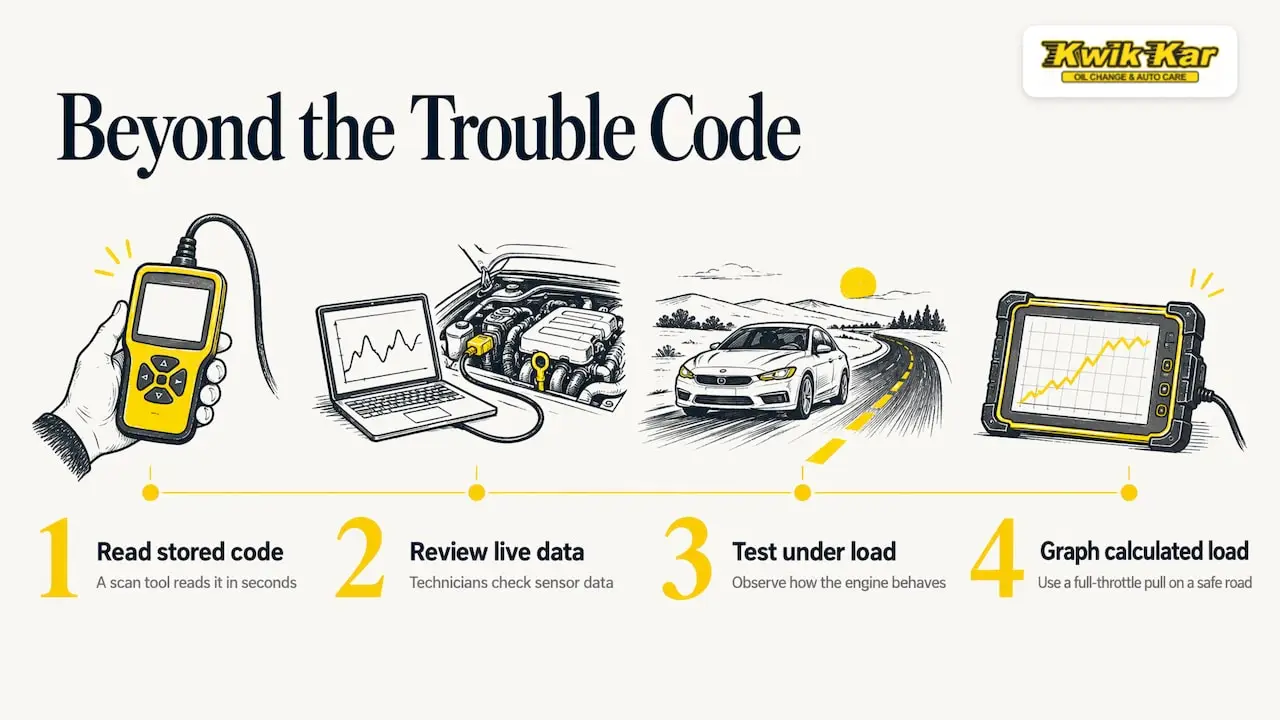
When the check engine light is on, the computer stores a code. A scan tool reads it in seconds. Many drivers then assume the named part is the culprit, but that is how people end up paying for parts that did not fix anything.
A misfire code tells you a cylinder is not firing well. It does not say whether the cause is a plug, a coil, an injector, a vacuum leak or low fuel pressure. An underboost code does not tell you whether the turbo, a sensor or a hose is at fault.
That is why a real diagnosis goes beyond the code. Technicians look at live data from the sensors and test how the engine behaves under load. One published driveability procedure has the technician graph the calculated load on a scan tool during a full-throttle pull to see whether the engine can reach the load it should, with a clear and safe road essential. That kind of test belongs with a trained technician in a safe setting, not in your daily commute.
Our article on the OBD-II diagnostic test explains how this helps you avoid costly parts swaps. For seasonal context, the same thinking applies to the check engine light in the fall and in winter.
What Does a Diagnosis at Kwik Kar of Celina Look Like?
We start by listening. You tell us when the power loss happens and what else you have noticed. From there our ASE-certified technicians inspect the vehicle and run diagnostics, and we use Digital Vehicle Inspections so you can see findings clearly instead of taking our word for it.
Then we explain what we found, what needs attention now and what can wait. Repairs are covered by our 2-year/24,000-mile warranty. We keep our recommendations honest and our communication plain, because a power problem is stressful enough.
Depending on what the diagnosis shows, the repair could fall under several of our services:
- Diagnostics for warning lights and drivability complaints
- Engine, transmission, electrical and exhaust repair
- Factory scheduled maintenance to keep plugs, filters and fluids on your manufacturer’s schedule
- European repair for owners who want dealership-quality care
- Fleet services for businesses that cannot afford a vehicle with unpredictable power
If a timing belt is part of your engine’s maintenance, our note on timing belt maintenance shows why it matters.
How Do Texas Inspection Rules Fit In?
Power loss and a lit check engine light can raise questions about inspections, so here is where things stand in Texas.
Most noncommercial vehicles in Texas no longer require annual safety inspections as of January 1, 2025, according to the Texas Department of Public Safety. Those vehicles are still subject to a $7.50 inspection program replacement fee paid at registration.
Qualifying vehicles in Collin County still require emissions testing. Celina is in Collin County, and Collin County is one of the Texas emissions counties where testing remains part of registration. A vehicle with an unresolved engine fault may have trouble passing, so it is worth fixing a misfire or sensor problem first.
Commercial vehicle inspection rules differ from noncommercial rules. Commercial vehicles in all counties must still pass a safety inspection, so fleet managers should confirm what applies to each vehicle. Our fleet maintenance checklist can help you organize it.
Fix It Before It Gets Expensive
Power loss rarely gets better on its own. A weak coil that is ignored can overheat a catalytic converter. A failing fuel pump can leave you stranded in traffic. A sensor fault can keep the engine in limp mode on the worst possible day.
If your car is hesitating or losing power, you can bring it to Kwik Kar of Celina for diagnostics. Our after-hours drop-off and complimentary ride service are meant to keep your day moving while we work. Browse everything we do on our services page.

If you drive a European car, our European repair service gives you dealership-quality care close to home in Celina, TX.
Our Perspective on Power Loss
We see power loss as a message, not a diagnosis. The symptom is the same whether the cause is a $20 part or a major repair, and the only way to know which is to measure instead of guess.
That is why we pair experienced ASE-certified technicians with Digital Vehicle Inspections. Old-fashioned honesty means telling you what is wrong in plain words. Modern technology means showing you the evidence.
A trouble code is a clue, and we treat it that way. We look at how your specific vehicle behaves, then recommend only what the findings support. When we repair it, the work carries our 2-year/24,000-mile warranty.
If your car is acting up, you do not need to wait for it to get worse. Call us, describe what you feel, and we will take it from there.
Kwik Kar
FAQ
What sensor causes loss of power?
Several can. A mass air flow sensor, throttle or pedal position sensor and oxygen sensor all influence how the computer sets fuel and throttle. When one reports a wrong value, the car can feel weak or go into limp mode. A technician has to confirm which one, since a code only points toward a system.
Can I still drive my car if it says engine power is reduced?
Only for a short, gentle trip if there are no other warnings. Limp mode limits power but steering and brakes still work, according to Consumer Reports. Pull over for a blinking check engine light, low oil pressure or overheating, and have the car checked as soon as possible.
Why is my car losing power only when I accelerate hard?
Hard acceleration demands the most air, fuel and spark. A weak fuel pump, worn plugs, a failing coil or a restricted exhaust may be fine under light load and then fall short. Where and when it happens, such as uphill or at highway speed, gives a technician useful clues.
Does a check engine code tell me which part to replace?
No. A code identifies the system or condition the computer noticed, such as a misfire or low fuel pressure. The actual cause may be one of several parts or a wiring or software issue, so testing comes before replacement.
Sources
- Mazda service bulletin 01-011/15 (NHTSA)
- Kia TSB MC-10218933-0001 (NHTSA)
- FCA service bulletin MC-10229751-9999 (NHTSA)
- Motorcraft throttle body and pedal diagnostics guide
- Consumer Reports: check engine light guide
- AAA press release, May 5, 2026
- Vehicle Service Pros: driveability and powertrain issues
- Motortriage: engine misfire
- Autofixengine: P0087 code
- Texas DPS: vehicle safety inspection changes
- Local Profile: Collin County inspections
- Common turbo exhaust setup errors