



The DSG service interval depends on your gearbox, not just your car’s badge. Volkswagen’s U.S. 2018 schedule lists a fluid-and-filter change every 40,000 miles for the 6-speed DSG and a fluid change every 80,000 miles for the 7-speed DSG in the Golf R. Newer schedules list 80,000 miles for several applications. Your VIN and transmission code decide which number applies to you.
At Kwik Kar of Celina, we work on European vehicles every week, and the DSG question comes up often. This guide walks through the published intervals, what changes them, the symptoms that mean you should not wait, and how to confirm the right schedule for your car.
TL;DR
- 6-speed wet-clutch DSG: Volkswagen’s 2018 U.S. schedule lists fluid and filter every 40,000 miles.
- 7-speed DSG: the same 2018 schedule lists a fluid change at 80,000 miles for the Golf R, and the 2024 schedule lists 80,000 miles for the 0GC applications, “if applicable.”
- Your gearbox code matters more than your model name. Use your VIN and the transmission code to match the right schedule.
- Hard use, heat and stop-and-go driving can justify servicing earlier than the listed number.
- Shudder, harsh shifts, hesitation or a warning light mean it is time for an inspection, not a wait-and-see approach.
Table of Contents
- What is a DSG, and why does it need fluid service?
- What does Volkswagen’s schedule say about the DSG service interval?
- How do I find the right schedule for my car?
- What affects when you should service a DSG?
- What does a DSG fluid service include?
- What happens if a DSG fluid service is late?
- What about AWD cars with a DSG?
- Do Texas inspection rules affect DSG service?
- Can Kwik Kar of Celina help with your DSG service?
- FAQ
- Sources
What is a DSG, and why does it need fluid service?
DSG stands for Direct-Shift Gearbox. It is a dual-clutch automatic: two clutches handle alternate gears, so the next gear is already waiting when the car shifts. You get quick shifts without a traditional torque converter.
That design is why the fluid matters. In a wet-clutch DSG, the fluid cools the clutches, lubricates the gears and carries hydraulic pressure to the mechatronic unit, which is the electronic and hydraulic control module that actually does the shifting. A filter catches the fine clutch material that wears off over time. As the fluid ages and the filter loads up, the gearbox loses some of its ability to shift smoothly and stay cool.
The key point for drivers: a DSG is not a conventional automatic, and it does not follow conventional automatic maintenance logic. Parts guidance for Volkswagen products says the exact transmission must be identified before choosing fluid, filter, procedure or interval, because DSG variants and standard automatics differ.
What does Volkswagen’s schedule say about the DSG service interval?
The published numbers vary by model year and gearbox. Here is what the official schedules list.
| Schedule | Transmission | Listed service | Interval |
|---|---|---|---|
| 2018 U.S. schedule | 6-speed DSG | Fluid and filter | 40,000 miles |
| 2018 U.S. schedule | 7-speed DSG (Golf R only) | Fluid | 80,000 miles |
| 2012 Passat U.S. schedule | DSG (non-automatic), if applicable | Fluid and filter | 40,000, 80,000 and 120,000 miles |
| 2024 U.S. service literature | 0GC DSG: Arteon, GTI, Golf R, Jetta, Taos | Automatic transmission fluid and filter, if applicable | 80,000 miles |
The same 2024 literature lists the 09P (Atlas and Tiguan) and 09S (Jetta and Taos) automatic transmissions at 80,000 miles. Those are conventional automatics, not DSGs, which is a good example of why the transmission code matters.
Why do the numbers differ so much?
Because “DSG” covers more than one gearbox. A Volkswagen Group parts table identifies the DQ250 (0D9) as a 6-speed unit needing fluid and filter service every 40,000 miles, and the DQ381 (0GC) as a 7-speed unit with a fluid-only service every 80,000 miles. The 6-speed DQ250 is a wet-clutch design, which is where the shorter 40,000-mile figure comes from. The gap between the 2018 and 2024 literature reflects different gearboxes and different model years, not a contradiction.
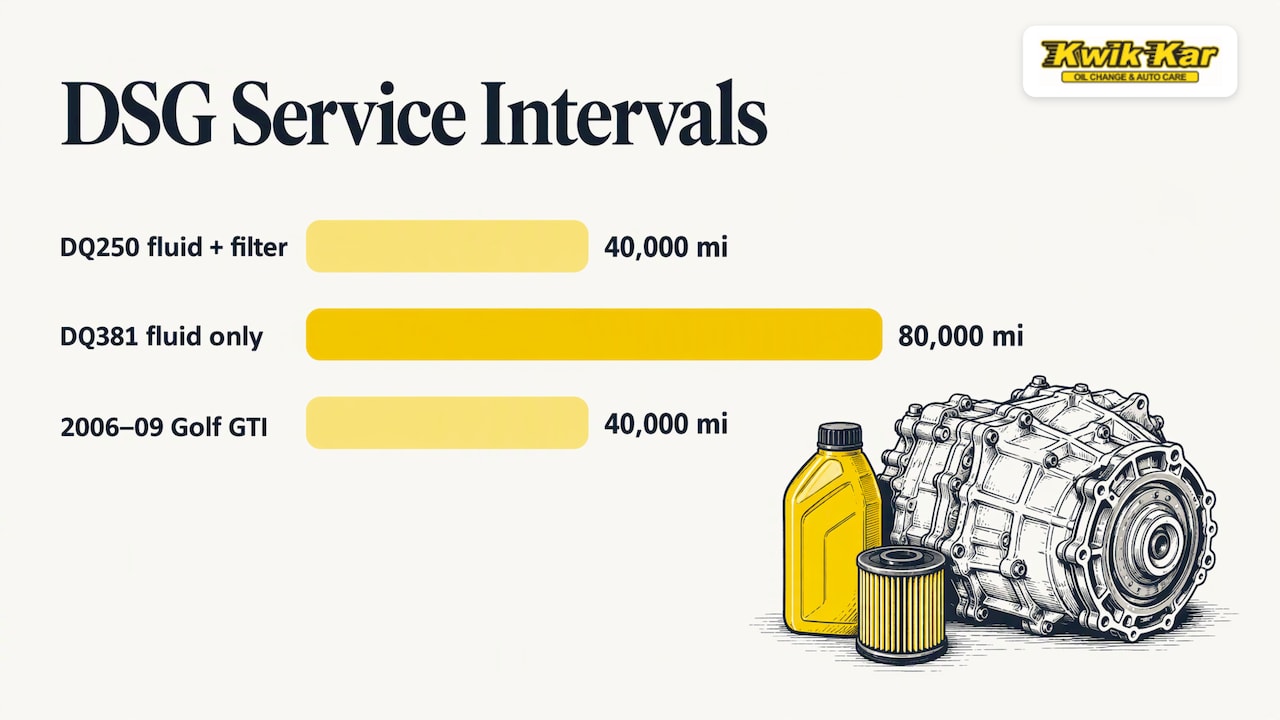
Older cars follow the shorter pattern too. A U.S. technical article on the 2006 to 2009 Golf GTI says Volkswagen calls for DSG oil and filter replacement every 40,000 miles.
Owner forums confirm the confusion: some owners report that intervals depend on the gearbox code, and that some have no listed interval at all. That is exactly why a general number from a web page should never replace your own schedule.
How do I find the right schedule for my car?
We suggest this order:
- Check your owner’s manual and maintenance booklet. It lists the services for your model year.
- Note your VIN. It sits at the base of the windshield on the driver’s side and on the door jamb sticker.
- Identify the transmission. Parts guidance advises confirming the model year, VIN, engine and transmission type, then matching the interval, fluid, filter and procedure to official Volkswagen maintenance literature. Look for a gearbox code such as 0D9, 02E, 0GC or DQ-series designations.
- Check whether the schedule says “if applicable.” Volkswagen’s literature uses that wording for some DSG entries, so a line on the page may not apply to your gearbox.
- Ask a shop that works on European vehicles to confirm. Bring the VIN and the service history.
This matters for audiences beyond Volkswagen, too. Audi, Seat and Skoda models use related dual-clutch units, and their schedules may be different. Treat every number in this article as a starting point for your own model-specific check.
What affects when you should service a DSG?
The listed interval assumes normal use. Volkswagen’s own schedule notes that severe conditions, such as extremely low temperatures or excessive dust, can require some operations between the listed intervals, particularly drivetrain fluid service.
In and around Celina, TX, we would add a few local realities to think about:
- Summer heat. North Texas summers keep a transmission hot for months. Heat is hard on any fluid. Our summer transmission tips cover how to protect the gearbox when temperatures climb.
- Stop-and-go commuting. Traffic on the roads toward the Dallas North Tollway and U.S. 380 means a lot of creeping, which keeps a DSG’s clutches slipping lightly for long periods.
- Towing or hard driving. More load means more clutch heat.
- Tuning. A software tune that raises torque asks more of the clutches and the fluid.
- Unknown service history. If you bought the car used and have no records, a fresh fluid service gives you a clean starting point.
If your driving matches several of these, ask your technician whether servicing ahead of the listed mileage makes sense for your car. We do not give a blanket “every 30,000 miles” number, because we would be making up a manufacturer interval. We would rather tell you what the schedule lists and then adjust for how you really drive.
What does a DSG fluid service include?
A proper DSG service is more than draining and refilling. In a typical wet-clutch job, the technician:
- Drains the old fluid.
- Replaces the filter and gasket, where the gearbox design calls for one.
- Refills with the fluid specified for that transmission.
- Cycles the selector through the gears, then sets the fluid level with the fluid at the correct temperature. One U.S. technical procedure for the Mk V GTI gives 35 to 45°C for setting the level, after cycling through the gears.
The temperature step is why level-setting is not a driveway guess. Too little or too much fluid changes how the gearbox behaves, and the correct level is specific to each gearbox.
If you need to source a kit for a six-speed unit, a DSG fluid and filter kit has to match your gearbox code exactly, which is one more reason to confirm the transmission before you buy parts.
For a general look at how a transmission fluid service runs in our shop, see our page on changing transmission fluid with OEM guidance.
What happens if a DSG fluid service is late?
Volkswagen once treated the DSG as a lifetime-fill transmission, and many owners still hear that. Service guidance since then has put a regular fluid interval on it, which is why we take the “lifetime fluid” idea with caution on any DSG.
A delayed service does not guarantee a failure, and we will not promise an outcome. But worn fluid and a loaded filter are known to add stress to the clutches and the mechatronic unit. Symptoms that point toward a problem include:
- Shudder when pulling away from a stop
- Harsh or jerky shifts, especially under load
- Hesitation at takeoff or while creeping in traffic
- Delayed engagement when you move from Park into Drive or Reverse
- Unexpected neutral or a loss of gears
- A warning light or limp mode, where the car restricts itself to a few gears
One guide to DQ200 problems describes this kind of progression from shudder to harsh shifts, then unexpected neutral and a stored fault code. Treat it as an example of how symptoms can escalate, not as a prediction for your car.
Can a reset or adaptation fix these symptoms?
Sometimes a software adaptation (basic settings) helps a gearbox relearn after service. It does not fix every problem. One DSG tuning resource says basic settings cannot repair severe clutch slip, persistent shudder, delayed engagement, hydraulic pressure faults, solenoid faults, loss of gears or mechanical damage. If a symptom persists after a fluid service, the gearbox needs a proper diagnosis.
If a warning light is on, a scan tool can read stored codes. A code points your technician toward where to look. It is not proof that a specific part has failed, and we never recommend replacing a part on a code alone. Our OBD-II diagnostic guide explains why, and our transmission slipping page covers what to check when a gearbox feels wrong. If the shudder happens at certain speeds, read about torque converter shudder diagnosis, which applies to conventional automatics and helps you tell the two designs apart.
What about AWD cars with a DSG?
Many DSG-equipped cars are all-wheel drive, and the AWD hardware has its own fluid. Volkswagen’s 2018 U.S. schedule lists AWD-clutch fluid changes every three years on applicable vehicles. This is separate from the DSG fluid. Rear differentials also have a fluid schedule of their own, covered in our differential fluid change guide.
Putting these together on one visit can save you a trip. A shop that works from your VIN can lay out which services apply to your car and which do not.
Do Texas inspection rules affect DSG service?
Not directly, but drivers often ask when they are planning maintenance, so here is where things stand.
- Safety inspections: as of January 1, 2025, most non-commercial vehicles in Texas no longer need a vehicle safety inspection before registration. A $7.50 inspection program replacement fee is collected at registration instead.
- Emissions testing: qualifying vehicles registered in emissions counties still need it. Collin County is on the list, and gasoline vehicles from 2 through 24 years old receive the OBD-II test.
- Commercial vehicles: inspection rules for commercial vehicles differ from the non-commercial rules. Fleet managers should check the current requirements for their vehicles.
A transmission fault light can matter at an emissions test, because the test reads the car’s onboard diagnostic system. If a warning light is on, it is worth getting it diagnosed before your test. See our Diagnostics page for what that visit involves.
Our perspective on DSG maintenance
We see the same pattern with European drivers in Celina, TX. The car feels fine, the schedule says a fluid service is coming up, and it gets pushed back because nothing seems wrong. A DSG rarely complains early. By the time it shudders, the clutches and mechatronic unit have already been working harder than they should.
That is why we start with your VIN and transmission code, not a generic mileage number. Our ASE-certified technicians work from the maintenance literature for your specific car, and we show you what we find with a Digital Vehicle Inspection, so you can see the condition of your vehicle instead of taking our word for it.
We also think honest advice means saying when something does not need to be done yet. If your schedule lists 80,000 miles, we are not going to invent a shorter interval. If your driving is hard on the gearbox, we will talk through whether earlier service makes sense.
Kwik Kar
Can Kwik Kar of Celina help with your DSG service?
Kwik Kar of Celina services European vehicles and performs transmission service, with ASE-certified technicians and Digital Vehicle Inspections that show what we see on your car. Our work carries a 2-year/24,000-mile warranty, and we offer after-hours drop-off and a complimentary ride service for busy schedules.
If you are not sure which interval applies to your car, start with your VIN and mileage. You can review our transmission services and European repair pages, or see everything we offer on our services page. For factory-scheduled work in general, our digital inspection guide shows how to read the report.
FAQ
How often should DSG fluid be changed?
It depends on the gearbox. Volkswagen’s 2018 U.S. schedule lists 40,000 miles for the 6-speed DSG fluid and filter, and 80,000 miles for the 7-speed DSG fluid in the Golf R. Its 2024 literature lists 80,000 miles for the 0GC DSG applications, if applicable. Confirm your gearbox code and VIN before choosing a number.
Does a DSG service include a filter?
On the 6-speed DSG in the 2018 schedule, yes: fluid and filter. The 7-speed entry for the Golf R in that schedule is fluid only. Your gearbox design decides, which is why the transmission code matters.
Is a DSG fluid service worth doing on a car with high mileage?
If the schedule lists the service and it has never been done, a technician can inspect the car and talk through your options. Do not assume a late service means damage, and do not assume it means none. A symptom check and a look at the service history will tell you more than mileage alone.
Does my DSG have a lifetime fluid fill?
Volkswagen’s published schedules list service intervals for DSG gearboxes, and some entries read “if applicable.” A few gearboxes may show no interval at all. Check the literature for your exact model year and transmission rather than relying on a general “lifetime” claim.
Sources
- 2018 VW Maintenance Schedule, all models except e-Golf
- 2024 VW Service literature
- 2012 Volkswagen Passat maintenance schedule
- Texas DPS: Vehicle safety inspection changes, January 2025
- Texas DPS: Emission inspection criteria
- VW DSG and automatic transmission service guide
- DSG servicing technical table
- Golf GTI Mk V DSG oil and filter replacement
- DSG gearbox problems guide
- DQ250 DSG basic settings and adaptation
- DSG clutch repair kit 02E141029N
- r/Tiguan: DSG service interval thread