



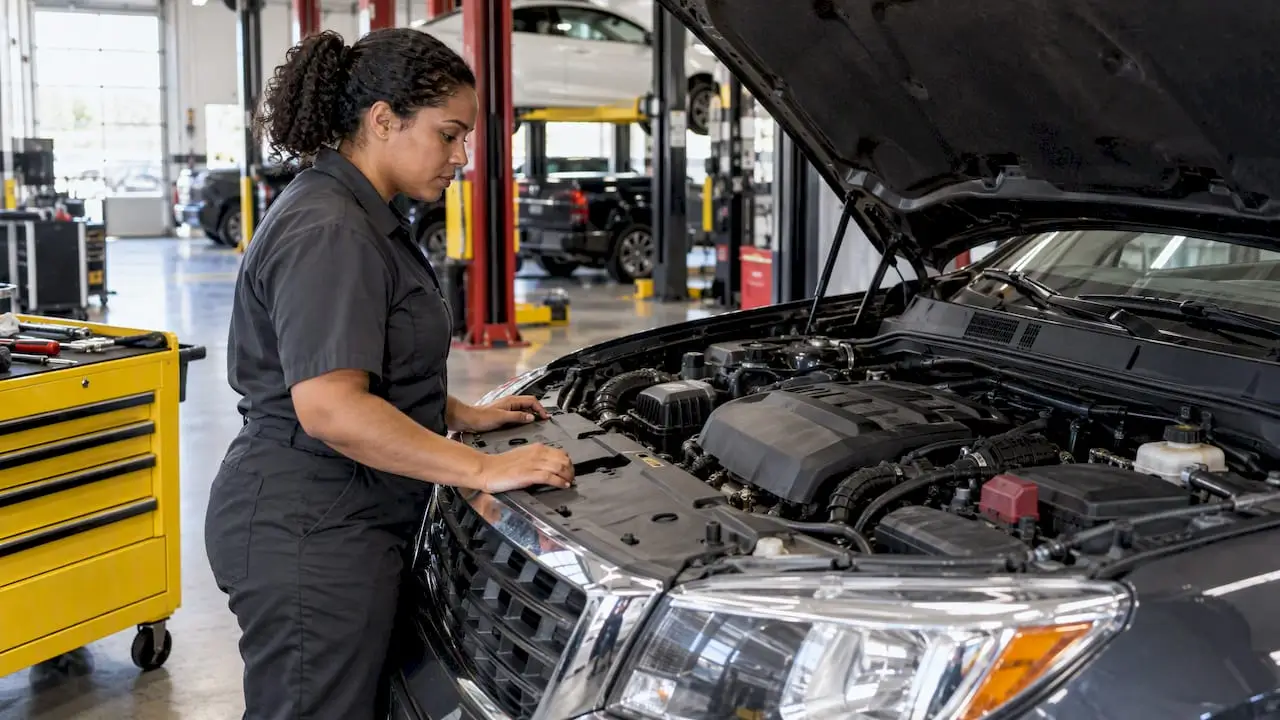
When an engine stalls at idle, the engine is almost always losing one of three things at low speed: the right amount of air, the right amount of fuel, or a steady spark. At a stoplight the engine has the least margin for error, so a small problem that is invisible at 60 mph can shut it off. Below we explain the most common causes, the checks you can safely do yourself, what to do if it happens in traffic, and when it is time to hand the car to a professional.
TL;DR
- A car that dies at a stop usually has an airflow, fuel or ignition problem. A dirty throttle body, a vacuum leak, a sticking idle control part, a weak fuel pump or a failing sensor are the usual suspects.
- If stalling happens only with the A/C on or the steering turned, the idle control system is probably not keeping up with the extra load.
- A stall makes the brakes and steering harder to operate, so treat repeated stalling as a safety issue, not an annoyance.
- A trouble code points you toward a system. It does not prove which part has failed, so avoid buying parts from a code alone.
- Kwik Kar of Celina, TX can diagnose the cause with ASE-certified technicians and Digital Vehicle Inspections before any repair is recommended.
Table of Contents
- What does it mean when an engine stalls at idle?
- Why does my car die when I come to a stop?
- What does it mean when it stalls only in certain situations?
- Why do manual cars stall, and is that a problem?
- What should you do if your car stalls in traffic?
- Can you keep driving a car that stalls at idle?
- What can you safely check yourself?
- How do technicians diagnose an engine that dies at idle?
- What does the repair usually involve?
- Perspective: how we approach a car that stalls
- What about Texas inspections and emissions?
- When should you bring it to Kwik Kar of Celina?
- FAQ
- Sources
What does it mean when an engine stalls at idle?
Stalling simply means the engine stops running when you did not turn it off. Stalling can come from airflow problems, insufficient fuel, overheating or mechanical failures. Stalling at idle is the version that happens while you are stopped or rolling slowly: at a red light, in a drive-through, or while backing into a parking space.
Drivers describe it in different ways. Some say the car dies at a stop. Others say the RPMs dip, the engine shudders and then quits. The pattern you notice is useful information, and we will come back to it below, because when it stalls tells a technician where to look first.
Why does my car die when I come to a stop?
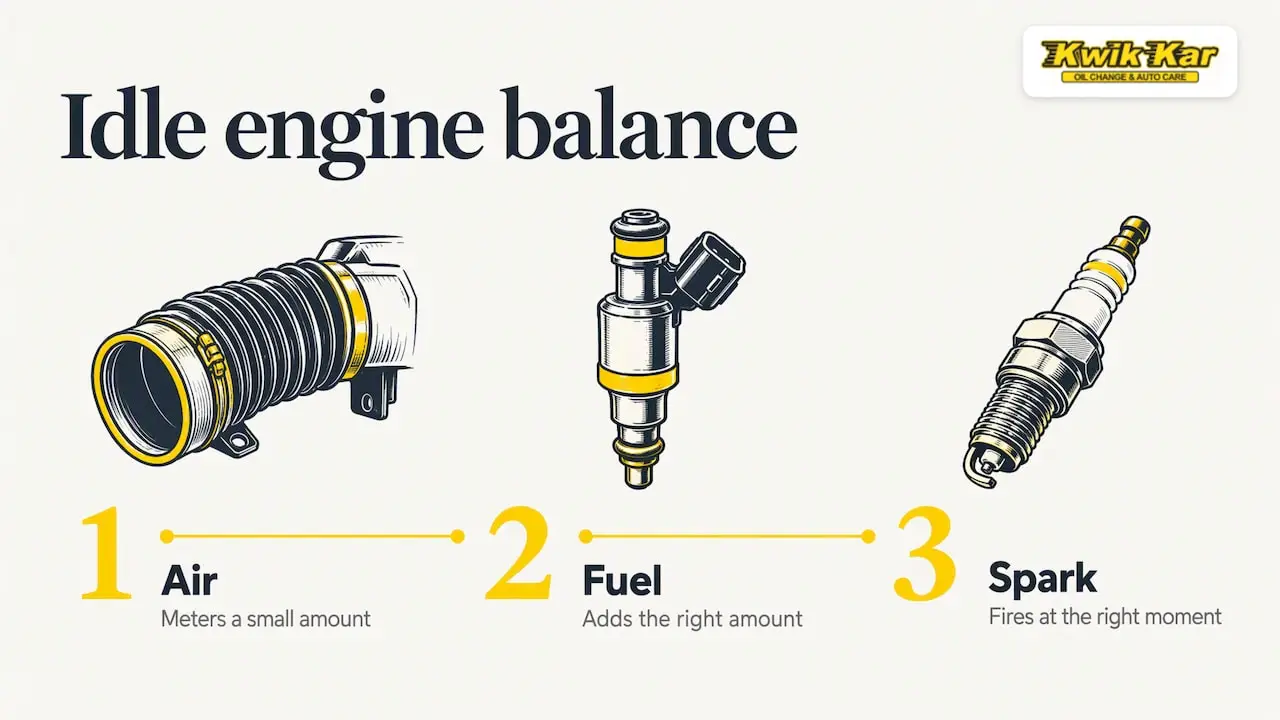
An idling engine is running on a tightly controlled balance. The computer meters a small amount of air, adds the right amount of fuel and fires the spark at the right moment. If any one of those slips, the engine has no momentum from driving speed to cover for it. These are the causes we see most often, roughly in the order a technician thinks about them.
Dirty throttle body or idle control problems
The throttle body is the door that lets air into the engine. Over time, carbon and grime build up around it and restrict the small amount of air needed at idle. Many vehicles also use an idle air control valve or an electronic throttle that holds the idle steady as loads change. AutoZone notes that a failing idle air control valve can cause stalling when you stop, and that vacuum leaks and throttle body buildup should be checked before blaming the valve.
Typical symptoms: an idle that hunts up and down, stalling when you let off the gas to stop, and an engine that restarts right away.
Vacuum leaks
The engine is designed to draw air only through the throttle body, where it is measured. A cracked hose, a loose intake boot or a leaking gasket lets in unmeasured air. That makes the air-fuel mixture too lean at idle. You may hear a hiss under the hood, feel a rough or shaking idle, or see a Check Engine light. Rubber hoses in Texas heat get brittle, so this is a common age-related failure.
One related part is the crankcase ventilation system. A stuck or clogged PCV valve can also upset idle, and we explain its two failure patterns in our guide to PCV valve symptoms.
Fuel delivery problems
If the engine is not getting enough fuel pressure or volume, it may sputter, hesitate and quit. Causes include a weak fuel pump, a clogged fuel filter on vehicles that have a serviceable one, dirty fuel injectors, or contaminated fuel. Fuel pump failure is serious enough that it has driven multiple recalls on some vehicles. Consumer Reports lists fuel pump recalls on various 2013 to 2023 Honda and Acura models because the failure can cause stalling while driving. That is one example, not a rule for every brand, so check your own vehicle’s recall status.
Ignition problems
Worn spark plugs, a failing ignition coil or damaged wiring can cause a misfire. At idle, a misfire often feels like a stumble or shake before the engine dies. Because ignition parts wear gradually, you may have noticed worsening fuel economy or a rough start first.
Failing sensors
The engine computer relies on sensors to time spark and fuel. A faulty crankshaft or camshaft position sensor, mass airflow sensor, throttle position sensor or coolant temperature sensor can send bad data and cause a stall. Sensor faults are often intermittent, which is why a car can stall twice in a week and then run fine for days.
EGR valve and emissions components
An exhaust gas recirculation (EGR) valve that sticks open can let exhaust into the intake at idle, which makes the engine run poorly and stall. This is a model-specific issue. Some vehicles are far more prone to it than others, so a technician needs to confirm it with testing.
Overheating and cooling system faults
An engine that overheats at idle may stall or run roughly. At a standstill, the radiator relies on the cooling fan to pull air through. If the fan is not working, the temperature climbs in traffic and drops once you move. Watch your temperature gauge. If it rises while the engine stumbles, read our guide on radiator fan diagnosis, and see our cooling system page for what we service.
Transmission and torque converter issues
On an automatic, the torque converter connects the engine to the transmission. If it fails to release properly when you stop, the engine can be loaded down until it stalls, much like letting a manual car’s clutch out in gear. You may also feel a shudder at certain speeds. Our article on torque converter shudder covers those symptoms, and our transmissions page explains the repair side.
Weak battery or charging system
A failing alternator cannot keep up with electrical demand at low RPM. The engine computer, fuel pump and ignition all need steady voltage. If your headlights dim at idle and brighten when you rev, the charging system is worth testing. Our guide to the alternator and electrical system in summer heat has more detail.
Known recalls
Sometimes the cause is a documented defect. For example, an NHTSA emission recall notice describes certain 2019 Chevrolet Equinox, Chevrolet Malibu and GMC Terrain vehicles on which a charge air cooler outlet duct can disconnect from the throttle body, leading to a reduced power message and possible stalling at low speeds or idle. That recall applies only to those models. Always search your VIN on NHTSA’s recall lookup before paying for a repair, since a recall fix is free at a dealer.
What does it mean when it stalls only in certain situations?
The situation matters more than the symptom. Use this table as a starting point, not a verdict.
| When it happens | What it can point to |
|---|---|
| Only when the A/C turns on | Idle control not compensating for the load, weak battery or charging, or an overloaded A/C compressor |
| Only when you turn the steering wheel at low speed | Idle control, a vacuum leak or a power steering load |
| Only when the engine is hot | Heat-related sensor or ignition failures, a cooling fan problem, or fuel vaporization |
| Only on cold starts, then smooths out | Dirty throttle body, a coolant temperature sensor fault or a vacuum leak |
| With a hiss or rough shaking | Vacuum leak or ignition misfire |
| With sputtering or hesitation when you accelerate too | Fuel delivery or ignition |
| After the A/C blows warm and the engine hunts | Idle compensation or cooling load; see below |
If the engine almost dies when the A/C kicks on, when you turn the wheel, or when the headlights and blower are all running, the idle control system may not be compensating properly, as this troubleshooting guide explains. If your A/C also blows warm while idling, our quick checks for AC that blows warm at idle can help you separate a cooling issue from an engine one. Hard restarts after a hot soak are a different clue, covered in hard starting when hot.
Why do manual cars stall, and is that a problem?
A manual-transmission car stalls when the clutch is released too quickly without enough throttle. That is a driver technique issue, not an engine fault, and every new driver does it. It becomes a mechanical concern when it happens even though your technique has not changed, or when the car stalls while the clutch is fully pressed in. A worn or malfunctioning clutch can cause stalling on manual vehicles, and a problem like a vacuum leak or fuel issue can show up the same way as in an automatic.
What should you do if your car stalls in traffic?
Stay calm and work through these steps in order:
- Keep your foot on the brake. The engine is off, so the brake booster and power steering assist are reduced. Consumer Reports notes that the brake pedal becomes harder to push, stopping distance increases and steering gets more difficult. Press firmly rather than pumping lightly.
- Turn on your hazard lights. This warns the drivers behind you.
- Try restarting. Shift to Park or Neutral and turn the key or press the start button. If it restarts, drive carefully to a safe place.
- If it does not restart, steer to safety. If you are still rolling, coast toward the shoulder or a parking lot. Mobil’s safety guidance advises getting off the road when you can, turning on hazards, and not leaving the vehicle if you are stuck in a travel lane.
- Call for help. If the car keeps stalling or will not restart, arrange a tow instead of repeatedly cycling the key.
Do not keep driving a car that stalls repeatedly, especially on busy roads like US-380 or the Dallas North Tollway, where a sudden loss of power assist can be dangerous.
Can you keep driving a car that stalls at idle?
We do not recommend it. Occasional, minor stalling may not mean a catastrophic failure, but you cannot predict when it will recur. Stalling at an intersection puts you and others at risk, and because the brakes and steering are harder to use without the engine, stalling while moving is worse than stalling at a stop.
Some causes also get worse over time. A fuel pump that is failing will eventually leave you stranded. An overheating engine can be damaged by continued driving. Treat these signs as an immediate reason to stop driving and call for a tow:
- The temperature gauge is climbing into the red or you see steam.
- The engine will not restart after a stall.
- There is a fuel smell, smoke or a burning smell.
- The car loses power while moving, not just at a stop.
- Warning lights for oil pressure, charging or a flashing Check Engine light are on.
What can you safely check yourself?
These steps do not require tools and can give a technician useful information. Do them with the engine off and cool.
- Note the pattern. Write down when it stalls: hot or cold, A/C on or off, in Drive or Park, after refueling. This is more valuable than it sounds.
- Check the fuel level. A fuel gauge can be wrong, and low fuel can cause sloshing and starvation on slopes and in turns.
- Look for warning lights. A Check Engine light means the computer has stored data worth reading.
- Look and listen for leaks. With the engine running and parked safely, listen for hissing near the intake hoses. Visible cracks in rubber hoses are a clue.
- Watch the temperature gauge. A rising reading while idling suggests a cooling problem.
- Check the battery terminals. Look for corrosion or loose clamps.
A clean engine bay makes cracked hoses, leaks and loose connections far easier to spot. If you plan to do that yourself, read about cleaning your engine bay safely first, since water on electrical connectors and sensors can create new problems.
We do not suggest spraying cleaners into the throttle body or intake, or removing sensors, unless you know your specific vehicle. Many modern throttle bodies are electronic and need a relearn procedure after cleaning, and the wrong approach can create a bigger problem. That is a job for a technician with the right procedure for your model.
How do technicians diagnose an engine that dies at idle?
Good diagnosis follows a sequence, rather than guessing at parts. At a shop like ours, it generally looks like this:
- Interview. We ask when it stalls, how it behaves and what has been done recently.
- Scan for codes and live data. A scan tool reads stored trouble codes and shows live readings, such as fuel trims, airflow and idle speed. A code is a starting point. It tells us which circuit or system reported a problem, and it does not prove that a particular part is bad. A lean-condition code, for instance, can come from a vacuum leak, a dirty sensor or low fuel pressure. Read more in our article on the OBD-II diagnostic test.
- Visual and Digital Vehicle Inspection. We inspect hoses, connectors, the throttle body, belts, the battery and charging system, and the cooling fan. Our Digital Vehicle Inspections let you see what the technician sees.
- Targeted tests. Depending on the findings, that can include fuel pressure testing, a smoke test to find vacuum leaks, ignition checks, and electrical testing.
- Recommendation. We explain what we found, what needs attention now and what can wait, so you can decide.
Only after testing does a repair make sense. That is how you avoid replacing a sensor that was never the problem. For more on the process, see our diagnostics page.
What does the repair usually involve?
Because the causes are so varied, the repair depends entirely on the finding. The examples below are common, and none applies to every car:
- Throttle body or idle control service: cleaning or replacing parts, followed by any idle relearn your vehicle requires.
- Vacuum leak repair: replacing a cracked hose, intake boot or gasket.
- Ignition service: spark plugs, coils or wiring repair.
- Fuel system service: a fuel pump, filter or injector service when testing confirms a delivery issue.
- Sensor replacement: only after testing confirms the sensor, its wiring or its signal is at fault.
- Cooling system repair: a fan, thermostat, coolant or radiator repair.
- Charging system repair: a battery or alternator replacement.
- Transmission-related repair: torque converter or fluid service as diagnosed.
If you own a European vehicle, idle problems can involve model-specific sensors and software. Our European repair service is built for that kind of work. Our engine repair guide also explains the bigger picture of engine health.
Perspective: how we approach a car that stalls
The most common mistake we see is the parts swap. A driver reads a code, replaces the part named in an online article, and the car still stalls. A stalled engine is a symptom with a long list of possible causes, and the quickest fix is rarely the correct one.
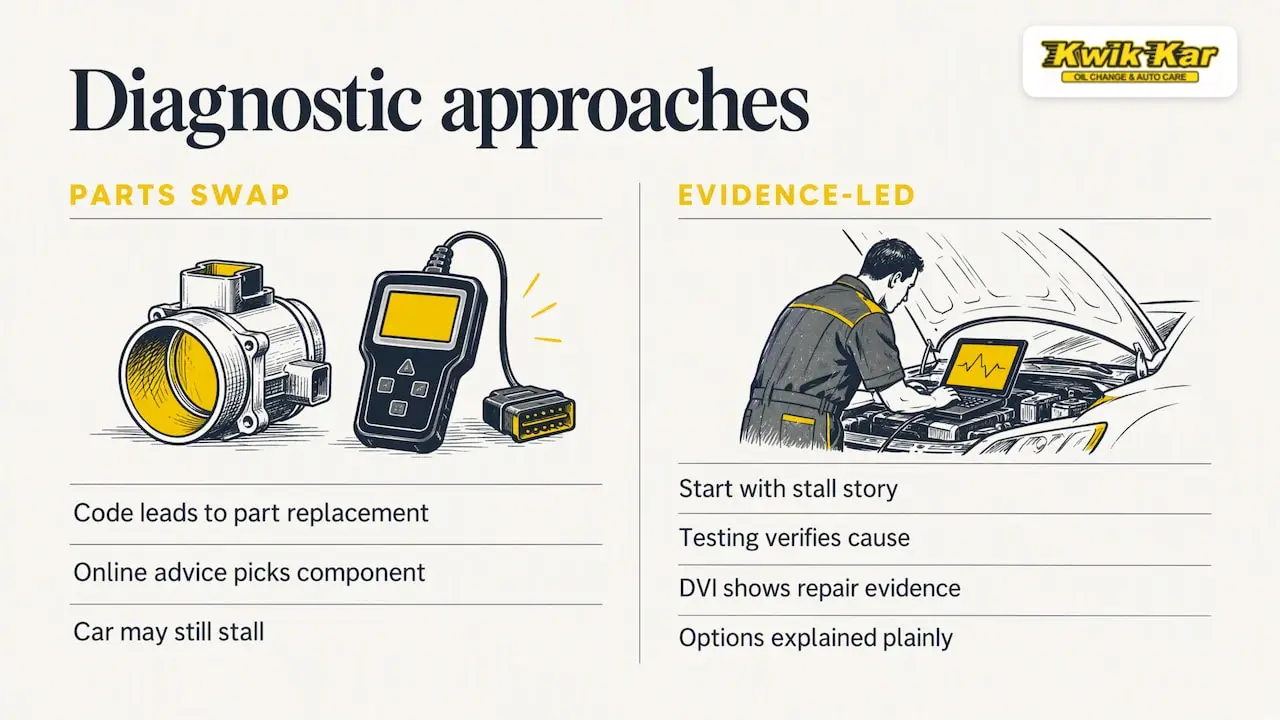
We start with the story of the stall, then verify with testing. We prefer to show you the evidence through a Digital Vehicle Inspection, explain the options plainly, and let you decide. Our technicians are ASE-certified, and our repairs carry a 2-year/24,000-mile warranty. Our after-hours drop-off and complimentary ride service are there because a stalling car rarely picks a convenient time.
And please do not push through it. If your car keeps dying at stops, the safest and often least expensive choice is to have it looked at early, before a small issue becomes a tow.
— Kwik Kar
What about Texas inspections and emissions?
Stalling and a lit Check Engine light can complicate inspection and registration, so here is how the current rules work. Most noncommercial vehicles in Texas no longer require annual safety inspections as of January 1, 2025, under House Bill 3297, according to the Texas Department of Public Safety. Noncommercial vehicles are still charged an inspection program replacement fee, which is paid at registration.
Emissions testing is a separate requirement. Qualifying vehicles in Collin County still require emissions testing, and the same DPS notice stresses that emissions tests differ from safety inspections. A vehicle that stalls, runs rough or has an active Check Engine light may have trouble passing, so it is wise to sort out the cause first. Commercial vehicle inspection rules also differ from noncommercial rules, so fleet managers should confirm the requirements for each vehicle class with DPS.
When should you bring it to Kwik Kar of Celina?
Book a visit if the engine stalls more than once, if the stalling comes with a Check Engine light, a hunting idle or a hard restart, or if you feel unsafe driving the car. Kwik Kar of Celina in Celina, TX offers diagnostics, cooling system, electrical, engine and transmission service, plus fleet services for businesses whose vehicles cannot afford downtime. You can see everything we handle on our services page. We publish no flat prices for these jobs because the cause decides the work, so we explain the findings and the options before you approve anything.
FAQ
Why does my car stall when I stop but run fine otherwise?
At speed, airflow and momentum cover small problems. At idle the engine has little margin, so a dirty throttle body, vacuum leak, weak fuel delivery or sensor fault shows up first. A technician can confirm which with testing rather than guessing.
Can a bad battery or alternator make a car stall at idle?
Yes. At low RPM an alternator may not produce enough power, and the ignition and fuel systems need steady voltage. Dimming headlights at idle that brighten with revs are a clue, but only a charging system test can confirm it.
Will a Check Engine code tell me exactly what is wrong?
No. A code tells you which system or circuit reported a fault, not which part has failed. The same code can come from several causes, so testing should come before parts replacement.
Is it safe to drive a car that stalls at stoplights?
It is not a good idea. Without the engine, the brakes need more pedal force and steering gets heavier, and you cannot predict when it will happen again. Have the car checked soon, and call for a tow if it stalls while moving or will not restart.
Does the A/C cause stalling at idle?
It can contribute. The A/C compressor adds load, and if the idle control system or the battery and charging system is weak, the engine can nearly die when the compressor engages. The root cause is usually elsewhere, so it needs to be diagnosed.
Sources
- Texas Department of Public Safety: Vehicle Safety Inspection Program Changes
- NHTSA emission recall notice: charge air cooler duct
- Consumer Reports: What to Do When Your Car Stalls
- Consumer Reports: 2020 Acura TLX reliability
- Mobil: What to do when your car stalls while driving
- AutoZone: Symptoms of a bad idle air control valve
- Engine Stalling: Causes, Handling a Stall, Prevention
- Car Sputters and Stalls at Idle: Top Causes